Tea and Caffeine: Stimulant and Diuretic
Story context (click to hide this block) (click to show this block)
This paragraph may contain plot information.
When Maomao devises her care plan for Lady Lihua, poisoned by the lead in her makeup, she works tea into it as a diuretic tool. She first plans a diuretic tea to encourage the elimination of toxins, then explains that she had her drink it so she would relieve herself more often and flush out what was poisoning her. The reasoning is that of a pragmatic apothecary: if the body can expel toxins through the kidneys, why not stimulate that pathway.
The subject in depth
Tea is made by infusing the dried leaves of Camellia sinensis, a shrub native to Southeast Asia whose cultivation stretches back several millennia
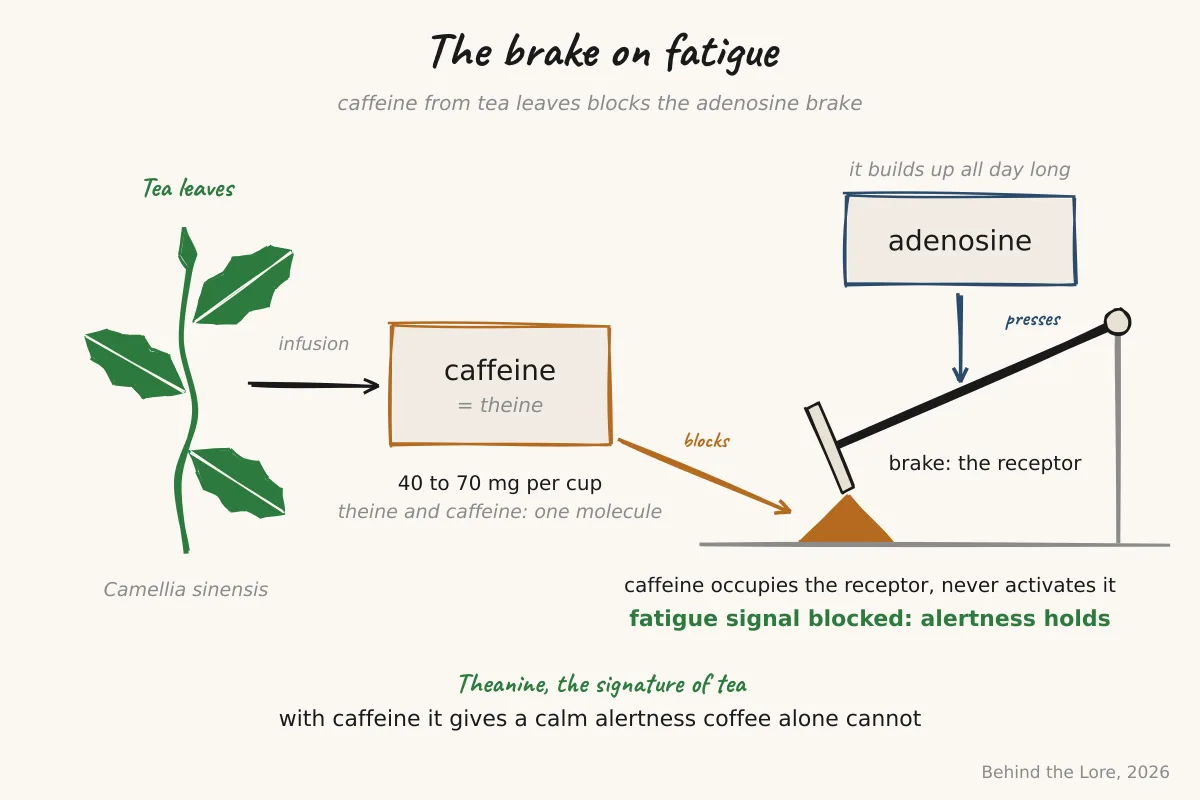
[Wikipedia] . Depending on how the leaves are processed, tea is classified as green (unoxidized), white, oolong (semi-oxidized), or black (fully oxidized). Their chemical composition varies in intensity, but they all share the same families of active molecules.
The key molecule from a pharmacological standpoint is caffeine
[Wikipedia] . Long called “theine” when found in tea and “caffeine” when found in coffee, it is in fact the same molecule: 1,3,7-trimethylxanthine. Its mechanism of action relies on the competitive antagonism of adenosine receptors, mainly the A1 and A2A receptors of the central nervous system. Adenosine is an inhibitory neurotransmitter whose concentration rises throughout the day; it is what generates the feeling of fatigue and the urge to sleep. By occupying its receptors without activating them, caffeine blocks that signal and sustains a state of alertness.
Caffeine’s diuretic effect is real but dose-dependent. At high doses, it inhibits tubular reabsorption of sodium in the kidney, which increases urine output. At the usual dose in a cup of tea (40 to 70 mg of caffeine, depending on type and steeping time), this effect is modest. Above all, it is largely offset by the volume of water ingested along with the infusion: studies show that regular consumption of tea or coffee, at typical doses, does not produce a negative fluid balance in people used to caffeine. In other words, drinking tea hydrates as much as, or even more than, it dehydrates.
Tea also contains theanine, a particular amino acid that modulates caffeine’s effects. Theanine promotes relaxation without drowsiness and, in synergy with caffeine, produces a calm alertness not found with coffee alone. This pharmacological profile specific to tea partly explains its millennia-long use as a drink for care and meditation in Asian traditions.
Going further
Sources
Published on
Keep investigating
Auto-suggested from shared concepts, disciplines, episodes, or characters.
Dehydration and Rehydration
In The Apothecary Diaries, Maomao treats heatstroke with salted, sweetened water. We explain dehydration and why salt is vital.
Orpiment and Arsenic
In The Apothecary Diaries, a yellow pigment poisons slowly. We explain orpiment, arsenic, and the chronic poisoning of court painters.
The Dandelion
In The Apothecary Diaries, Maomao identifies dandelion as a medicinal herb. We explain its diuretic properties, its inulin, and its culinary uses.
Ginger
In The Apothecary Diaries, Maomao prepares ginger pastilles to keep warm. We explain gingerol, TRPV1, and Chinese pharmacopoeia.
Kudzu
In The Apothecary Diaries, over-concentrated kudzu turns into glue. We explain kuzu starch, its medicinal uses, and its invasion beyond Asia.