Orpiment and arsenic: the yellow poison
Story context (click to hide this block) (click to show this block)
This paragraph may contain plot information.
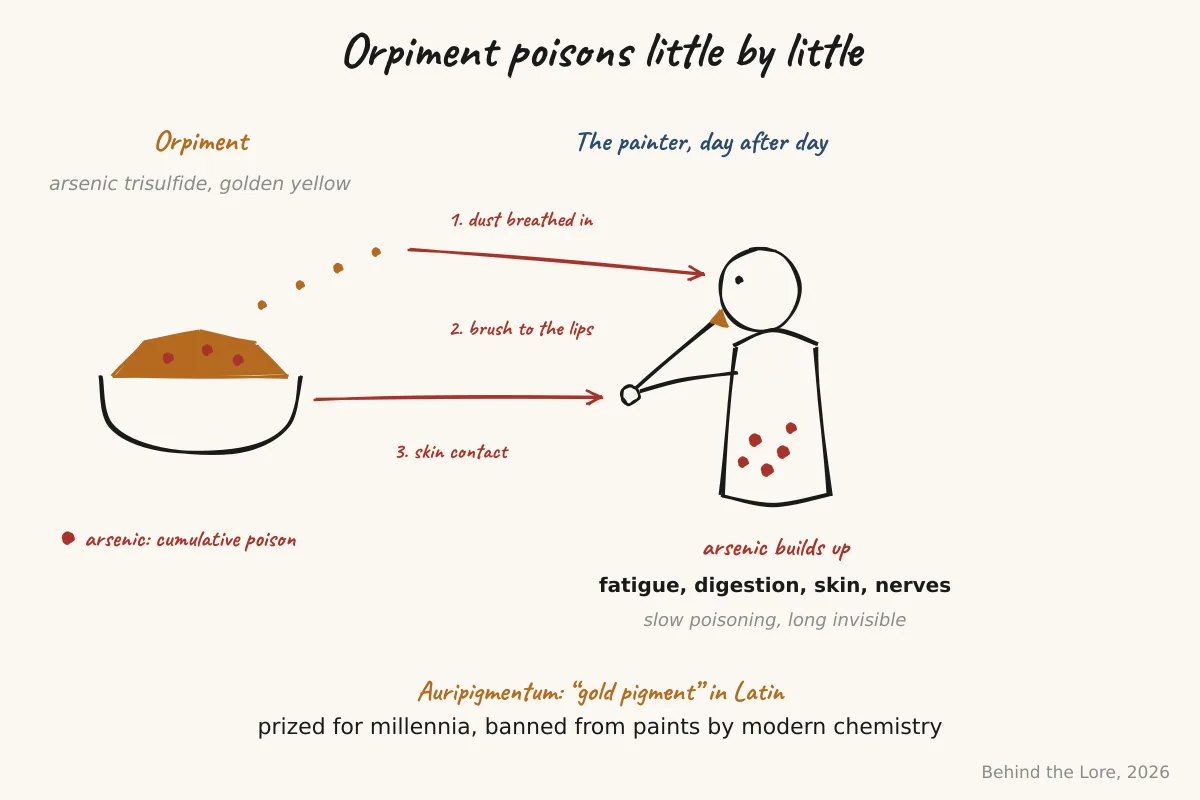
Examining a court fresco, Maomao pauses on the brilliant yellow of a painted garment. She recognizes it as orpiment, a mineral she names as arsenic sulfide, and realizes how a character could have been poisoned without knowing it: through years of painting, the pigment’s arsenic gradually spread through their body, via a brush tip brought to the lips and via dust. The poison hadn’t been administered, it had been breathed and licked, for years.
The subject in depth
Orpiment is a natural mineral, arsenic trisulfide, of a deep golden yellow that made it a sought-after pigment for painters for millennia [Wikipedia] . Its Latin name, auripigmentum, means “gold pigment,” which says enough about the beauty once attributed to it. But its composition is also its curse: it contains arsenic, one of the oldest known poisons.
Arsenic is not a poison like tetrodotoxin or aconitine, which strike quickly at a precise nerve target
[Wikipedia] . It is a cumulative poison, acting deeply on metabolism. It binds to many enzymes, substituting for elements the cell needs, and thereby disrupts energy production. At a high dose, it causes a devastating acute poisoning, with violent digestive distress. At a small, repeated dose, it produces a slow-developing chronic poisoning: fatigue, digestive trouble, skin and nerve damage, and, in the long run, certain cancers.
This chronic form is precisely what the series describes. A painter who uses orpiment daily is exposed through three routes: the dust they breathe, the brush they habitually bring to their mouth to point it, and skin contact. Nothing dramatic day to day, but the arsenic accumulates, and the body eventually becomes saturated with it. The soundness of Maomao’s analysis lies in this reasoning: tracing a symptom back to a discreet, prolonged source of exposure, rather than to a single poisoning event.
Going further
Sources
Published on
Keep investigating
Auto-suggested from shared concepts, disciplines, episodes, or characters.
Lead White Makeup
In The Apothecary Diaries, white makeup kills courtesans. We explain why this ceruse-based cosmetic caused deadly lead poisoning.
Datura
In The Apothecary Diaries, datura is used to induce sleep and feign death. We explain its alkaloids, its toxicity, and its role in the history of anesthesia.
Elixirs of Immortality
Several Chinese emperors were killed by elixirs meant to make them immortal. Waidan alchemy, cinnabar, mercury, and arsenic explained.
Mercury
In The Apothecary Diaries, quicksilver goes into a court poison. We explain mercury, its toxicity, and the immortality elixirs that killed emperors.
Sensory Detection of Poison
Maomao inspects the soup by sight and smell. We explain the food-taster method, how silver tarnishes, and why arsenic went undetected.