Fake death by tetrodotoxin: can pufferfish poison mimic death?
Story context (click to hide this block) (click to show this block)
This paragraph may contain plot information.
While investigating the suspicious death of a conspirator, Suirei, Maomao suspects a staged death. She mentions a decoction from a distant land, said to make a person die and then bring them back to life, which would contain datura and fugu in high concentration.
Much later, Suirei turns up alive and well. Maomao realizes she swallowed this poison to make everyone believe she was dead, and blames some of her after-effects on this “resurrection potion”. Asked about its composition and dosage, Suirei says the datura is unnecessary: the recipe, taken from a foreign book, serves to prolong a comatose state, and memory loss on waking is not unusual.
The price of the potion finally shows in a child who survived it: he has lost his memory and keeps a partial paralysis.
The subject in depth
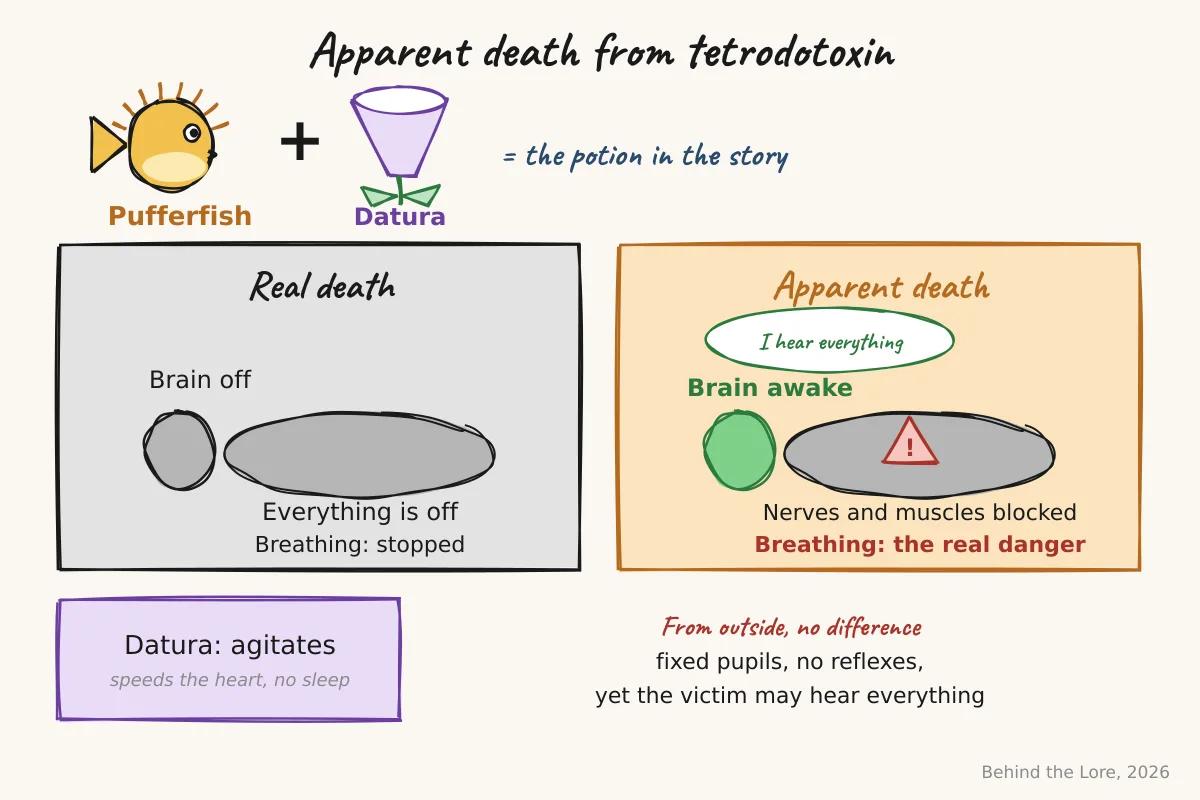
How does tetrodotoxin make a living person look dead?
Apparent death is the state of a living person who shows the outward signs of death: stillness, no response, breathing and pulse undetectable on a quick examination. Fake death by tetrodotoxin is its best-described form in toxicology. This poison, concentrated in the liver, ovaries and skin of the pufferfish, blocks the voltage-gated sodium channels of nerves and muscles [Wikipedia] . Without these pores, nerve impulses stop traveling: the muscles no longer respond, breathing becomes shallow and blood pressure drops.
The decisive point lies in where the poison acts. Its effects on the brain remain limited: the victim can stay lucid and hear what is said around them without being able to move or speak. The classic clinical scale of the poisoning has four grades. At grade 3, paralysis is flaccid and generalized, breathing fails, the voice disappears, the pupils are fixed and dilated, and yet the patient is conscious: the picture resembles that of a dead person. At grade 4, the most severe, consciousness itself may be lost [Article] .
Why is this state so close to real death?
Tetrodotoxin has no antidote. The danger comes not from the heart but from the breathing muscles: when the diaphragm is paralyzed, oxygen no longer reaches the blood, and suffocation is what kills. This is therefore not a suspended metabolism, in which the body would slow down until it could do without oxygen: the cells keep consuming it, which is what makes respiratory paralysis so dangerous. Under mechanical ventilation , on the other hand, recovery can be complete as the body clears the toxin: in one series of poisonings, ventilated patients recovered within 4 days [Article] , and a man in a coma with no reflexes at all returned to his previous state within 36 hours [Article] .
Then there is the dosing problem. The poison content of a pufferfish varies with species, region, season and organ [Wikipedia] , and the margin between the amount that paralyzes and the amount that kills is narrow. There is no “fake death dose”: only an uncertain outcome between suffocation and waking up, which only a hospital can tip the right way.
What is datura doing in the potion?
Datura works in a completely different way. Its tropane alkaloids , mainly scopolamine and atropine, block the muscarinic receptors of acetylcholine, a chemical messenger of the nervous system [Wikipedia] . Unlike tetrodotoxin, scopolamine enters the brain. At low doses it calms and prevents memory formation; at high doses it triggers an anticholinergic syndrome : agitation, delirium, hallucinations, a racing heart, fever [Web] . Datura therefore does not make anyone look dead: it rather produces a hot, agitated body. No published study describes any interaction between tetrodotoxin and scopolamine in humans: nothing suggests that combining them makes the paralysis less dangerous.
Where would the memory loss come from?
| Effect | Tetrodotoxin (fugu) | Scopolamine (datura) |
|---|---|---|
| Target | Sodium channels of nerves and muscles | Acetylcholine receptors |
| Effects on the brain | Limited | Marked |
| Consciousness | Often preserved | Confusion, delirium, then sleep or coma |
| Heart | Slowed, low blood pressure | Accelerated |
| Memory | Little directly affected | Marked anterograde amnesia |
| Cause of death | Respiratory paralysis | Overheating, heart rhythm disorders, coma |
Memory loss therefore points to scopolamine rather than to fugu. Survivors of tetrodotoxin poisoning who are treated in time generally recover without after-effects [Article] . Explaining a survivor’s amnesia and partial paralysis thus requires another hypothesis: in general, prolonged brain hypoxia can damage the areas of the brain that lay down memories or control movement. No publication, however, describes such after-effects following tetrodotoxin poisoning.
Going further
- Fugu and Tetrodotoxin
- Datura
- Morning Glory
- Elixirs of Immortality
- Discipline: Toxicology
- Discipline: Pharmacology
Glossary
- Voltage-gated sodium channel ↗
- Pore in the membrane of nerve and muscle cells that opens in response to an electrical signal and lets sodium in. Its opening triggers and propagates the nerve impulse.
- Mechanical ventilation ↗
- Medical technique that moves air in and out of the lungs in place of the breathing muscles, using a bag or a ventilator.
- Tropane alkaloid ↗
- Family of nitrogen-containing plant molecules, produced mainly by nightshades such as datura or belladonna. Scopolamine and atropine belong to it.
- Anticholinergic syndrome ↗
- Set of symptoms caused by blocking acetylcholine, a chemical messenger of the nerves. It combines agitation, delirium, a fast heart, fever, dry skin and dilated pupils.
- Anterograde amnesia ↗
- Inability to form new memories from a given moment on. Events experienced during that period are not stored.
- Hypoxia ↗
- Lack of oxygen in the tissues. The brain is the most sensitive organ and can keep permanent damage after a few minutes of deprivation.
Sources
- Tetrodotoxin, French Wikipedia [Wikipedia]
- V. Bane et al., “Tetrodotoxin: chemistry, toxicity, source, distribution and detection”, Toxins, 2014 [Article]
- Fugu, French Wikipedia [Wikipedia]
- Scopolamine, French Wikipedia [Wikipedia]
- French poison control centers, nightshades and tropane alkaloids [Web]
- Zombie, French Wikipedia [Wikipedia]
- E. W. Davis, “The ethnobiology of the Haitian zombi”, Journal of Ethnopharmacology, 1983 [Article]
- T. Yasumoto and C. Y. Kao, “Tetrodotoxin and the Haitian zombie”, Toxicon, 1986 [Article]
- Elixir of life, French Wikipedia [Wikipedia]
- A. Awada et al., “Deep non-reactive reversible coma after a Mediterranean neurotoxic fish poisoning”, Revue neurologique, 2009 [Article]
- Y. K. Loke and M. H. Tan, “A unique case of tetrodotoxin poisoning”, The Medical Journal of Malaysia, 1997 [Article]
- Safety coffin, English Wikipedia [Wikipedia]
Published on
Keep investigating
Auto-suggested from shared concepts, disciplines, episodes, or characters.
Datura
In The Apothecary Diaries, datura is used to induce sleep and feign death. We explain its alkaloids, its toxicity, and its role in the history of anesthesia.
Fugu and Tetrodotoxin
In The Apothecary Diaries, Maomao loves fugu and its poison. We explain tetrodotoxin, how it paralyzes, and why there's no antidote.
Elixirs of Immortality
Cinnabar, mercury, arsenic: Chinese waidan alchemy sought eternal life in poisons. The alchemists' logic, what mercury does to the brain, and who died of it.
Morning Glory
The seeds are: purgative, and psychoactive at high doses. White morning glory can be mistaken for far more toxic datura. Why, how they differ, and the Asian uses.
Autopsy and Forensic Medicine
In The Apothecary Diaries, a body is examined. We explain autopsy, post-mortem signs, and the birth of forensic medicine.