Morning Glory: The Ipomoea Genus
Story context (click to hide this block) (click to show this block)
This paragraph may contain plot information.
Toward the end of the episode, Suirei, who quietly tends a physic garden in the military quarter, tells Maomao she plans to plant morning glories there. The context is an inventory of medicinal plants grown on the margins of the official pharmacopoeia, and this botanical choice is not incidental: the sweet potato, which belongs to the same genus, had already been mentioned earlier in the episode as a remedy prescribed for Jinshi.
The subject in depth
The genus Ipomoea belongs to the bindweed family (Convolvulaceae) and includes several hundred species, the best known being the sweet potato (Ipomoea batatas), the common morning glory (Ipomoea purpurea or I. tricolor), and the Japanese morning glory (Ipomoea nil) [Wikipedia] . All share a characteristic floral architecture: funnel-shaped corollas, often purple, blue, or white, that open in the morning and close within a few hours.
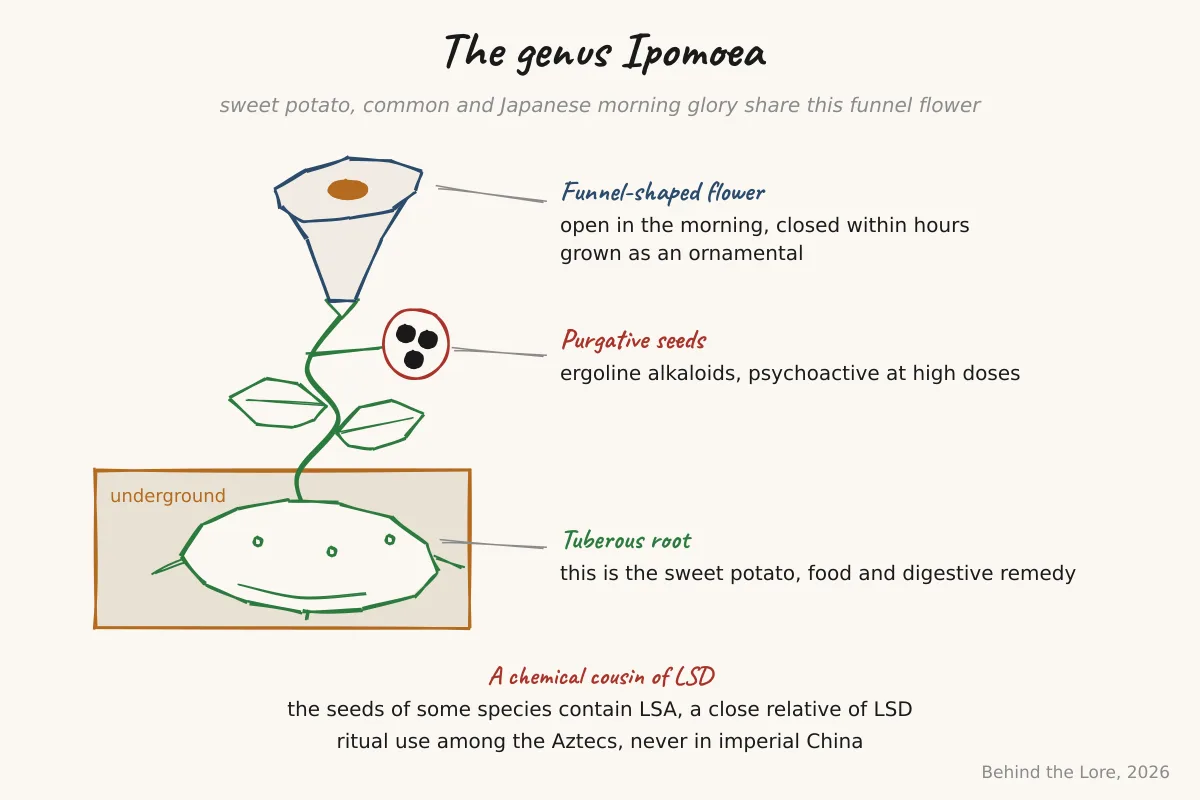
The sweet potato is the most important species for food and medicine. Native to tropical America, it spread to East Asia as early as the 16th century and was quickly absorbed into Chinese pharmacopoeia and cuisine [Wikipedia] . Its starchy tuberous root has been used as a food for digestive comfort, as a source of thickening starch, and as nutritional support during convalescence.
The seeds of certain Ipomoea species concentrate ergoline alkaloids, notably lysergic acid amide (LSA), a structural cousin of LSD. These alkaloids are purgative at low doses and psychoactive at high doses. Their ritual use is documented in pre-Columbian America, particularly among the Aztecs, who called these seeds ololiuqui. This Mesoamerican context, however, must be clearly distinguished from Asian uses: in imperial China, no source documents a psychoactive use of Ipomoea seeds. It is the tuberous root and the leaves that hold medicinal interest in Asia.
One risk of botanical confusion is worth noting: some white-flowered Ipomoea species (I. alba, in particular) superficially resemble datura flowers. Both plants are climbers with large, white, funnel-shaped flowers. But datura belongs to an entirely different family (Solanaceae) and contains tropane alkaloids (atropine, scopolamine, hyoscyamine) whose toxicity far exceeds that of Ipomoea alkaloids. This confusion has already caused serious poisonings. On this point, the entry on datura provides all the necessary detail.
Going further
- Datura and Its Tropane Alkaloids
- Aconite, Another Plant with Remarkable Properties
- Discipline: Botany
Sources
Published on
Keep investigating
Auto-suggested from shared concepts, disciplines, episodes, or characters.
Aconite
In The Apothecary Diaries, aconite poisons even through honey. We explain aconitine, its action on nerves, and why it shows no mercy.
Datura
In The Apothecary Diaries, datura is used to induce sleep and feign death. We explain its alkaloids, its toxicity, and its role in the history of anesthesia.
Syphilis
In The Apothecary Diaries, syphilis erases a courtesan's memories. We explain Treponema pallidum, the disease's phases, and neurosyphilis.
Acetanilide
Senku makes acetanilide in Dr Stone. We explain this historical painkiller and fever reducer, an ancestor of paracetamol, and why it was abandoned.
Ginger
In The Apothecary Diaries, Maomao prepares ginger pastilles to keep warm. We explain gingerol, TRPV1, and Chinese pharmacopoeia.