Aconite: Europe's most toxic plant
Story context (click to hide this block) (click to show this block)
This paragraph may contain plot information.
Aconite comes up more than once in Maomao’s own words as the archetype of a merciless poison. When she discusses a poisoning, she remarks that honey from aconite would have settled the matter quickly. Later, she notes that honey gathered from aconite or azalea flowers is no ordinary honey, but a genuine poison to humans. For her, it’s a pharmacist’s plain fact: aconite gives no second chance.
The subject in depth
Aconite, or monkshood, is a mountain plant with blue, helmet-shaped flowers, from the buttercup family [Wikipedia] . The whole plant is toxic, root included, and the root in fact concentrates the most. Its reputation is ancient: it has been called the “queen of poisons” and “wolfsbane,” because it was used to coat bait for wolves.
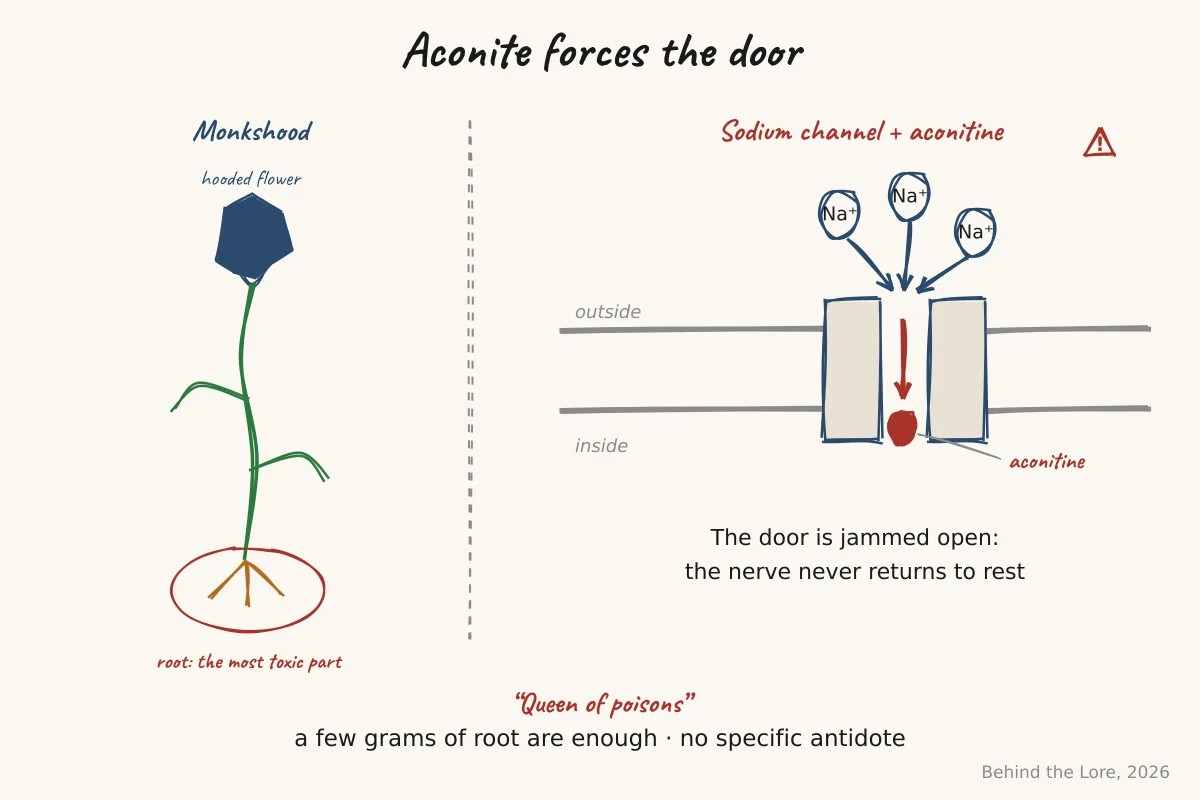
The poison responsible is aconitine, an alkaloid that acts on a precise target: the voltage-gated sodium channels of nerve, muscle, and cardiac cells [Wikipedia] . These channels let sodium in to trigger a signal, then close again so the cell can return to rest. Aconitine forces them to stay open: the cell is continuously excited and can no longer reset.
It’s illuminating to compare this mechanism with that of fugu’s tetrodotoxin. Both poisons target the same sodium channel, but in opposite ways: tetrodotoxin plugs it and cuts the signal, while aconitine jams it open and sends it into overdrive. The clinical outcome converges nonetheless, because in both cases nerve and cardiac command is thrown into disorder.
The first symptoms of aconite poisoning are tingling and numbness of the mouth and extremities, followed by nausea, cardiac rhythm disturbances that can progress to arrest, and progressive paralysis. The course is fast and the lethal dose very small: a few grams of root are enough. There is no specific antidote, only symptomatic care, which fully justifies the reputation the series gives it.
Going further
Sources
Published on
Keep investigating
Auto-suggested from shared concepts, disciplines, episodes, or characters.
Rhododendron and Mad Honey
In The Apothecary Diaries, a tainted honey and a burned plant cause poisoning. We explain rhododendron's grayanotoxins and the famous mad honey.
Honey and Infant Botulism
In The Apothecary Diaries, honey kills a baby. We explain infant botulism: why honey is forbidden before age one, and safe afterward.
Fugu and Tetrodotoxin
In The Apothecary Diaries, Maomao loves fugu and its poison. We explain tetrodotoxin, how it paralyzes, and why there's no antidote.
Datura
In The Apothecary Diaries, datura is used to induce sleep and feign death. We explain its alkaloids, its toxicity, and its role in the history of anesthesia.
Mandarin Peel
In The Apothecary Diaries, an infusion of mandarin peel. We explain chen pi, its flavonoids, its essential oils, and what modern science confirms.