Rhododendron and mad honey: a natural poison
Story context (click to hide this block) (click to show this block)
This paragraph may contain plot information.
Maomao solves two separate cases linked to the same family of plants. Facing a mass poisoning, she traces it back to rhododendron, explaining that it makes people sick and that burning it only scatters its toxins into the air. Later, investigating a deadly honey, she notes that honey foraged from aconite or azalea flowers is not food but poison for humans. Two scenes, one lesson: these pretty flowers are not harmless.
The subject in depth
Rhododendrons and azaleas belong to the heath family (Ericaceae), and many of them produce grayanotoxins, a group of toxic substances found in the leaves, flowers, and nectar [Wikipedia] . Their target is once again the sodium channel of nerve, muscle, and heart cells: grayanotoxin holds it open, making the cells abnormally excitable [Wikipedia] . The mechanism echoes that of aconitine from aconite, which explains the similar symptoms.
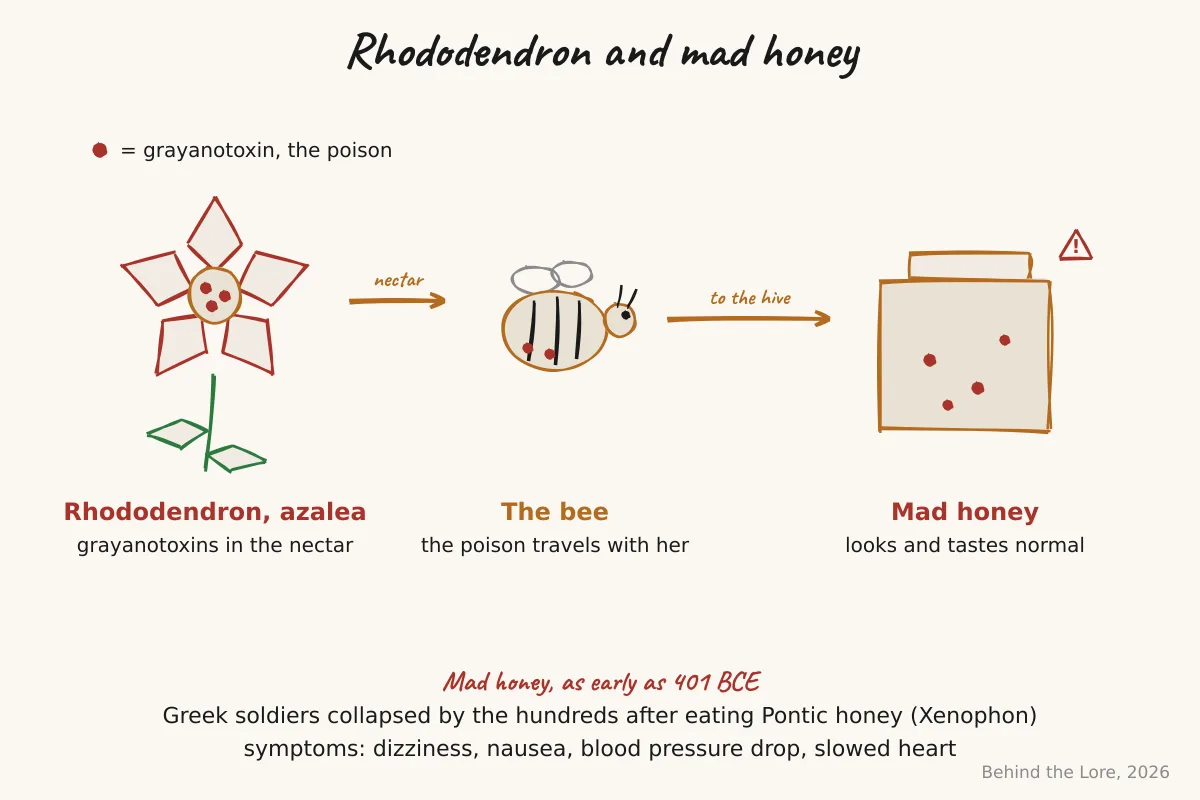
Direct poisoning, whether from eating the plant or inhaling its smoke, causes salivation, nausea, dizziness, vision disturbances, a drop in blood pressure, and a slowed heart rate, sometimes leading to loss of consciousness. Maomao’s remark about the smoke is accurate: burning the plant does not destroy the poison, it puts it into suspension in the air, where it can be inhaled.
The most unusual case is honey. When bees forage heavily on rhododendrons, the grayanotoxins from the nectar end up concentrated in the honey they produce. This honey, called mad honey, looks and tastes normal but causes the same symptoms as the plant itself. It is one of the very rare cases where a honey is dangerous by its very composition, rather than through microbial contamination as in infant botulism: here, the danger comes from the source flower, not from a bacterium.
The subject in depth, continued: two honey dangers not to confuse
By bringing together, in the same episode, honey from aconite or azalea and the danger honey poses to infants, the series invites us to distinguish two very different things. Mad honey is toxic to everyone, because of the grayanotoxins from the flowers. Ordinary honey, on the other hand, is only dangerous for infants, because of bacterial spores, and becomes safe again after age one. Same food, two unrelated mechanisms, two different groups at risk.
Going further
Sources
Published on
Keep investigating
Auto-suggested from shared concepts, disciplines, episodes, or characters.
Aconite
In The Apothecary Diaries, aconite poisons even through honey. We explain aconitine, its action on nerves, and why it shows no mercy.
Honey and Infant Botulism
In The Apothecary Diaries, honey kills a baby. We explain infant botulism: why honey is forbidden before age one, and safe afterward.
Datura
In The Apothecary Diaries, datura is used to induce sleep and feign death. We explain its alkaloids, its toxicity, and its role in the history of anesthesia.
Nicotine and Tobacco
In The Apothecary Diaries, macerated tobacco serves as a poison. We explain nicotine, its acute toxicity, and why diluting a poison can make it worse.
Amaryllis
In The Apothecary Diaries, Maomao mentions amaryllis bulbs: toxic raw, edible after soaking, but always a digestive risk.