Four o'clock flower seeds: poisonous and abortive?
Story context (click to hide this block) (click to show this block)
This paragraph may contain plot information.
Called to the bedside of a sick servant, Maomao notices in the pavilion garden a bed of four o’clock flowers with pure white blooms. The choice passes for a matter of feng shui, where green and white would be pledges of good health, but she sees something else: the white powder inside the seeds of this plant is used as an abortifacient. She links this clue to the oils brought in by the caravan and concludes that the flowers were planted on purpose. A few days later, on spotting other four o’clock flowers, Maomao remembers that the courtesans of the pleasure district used to gather the seeds to compound an abortifacient, mixed with ground cherry, garden balsam, peonies and quicksilver.
The subject in depth
What is the four o’clock flower?
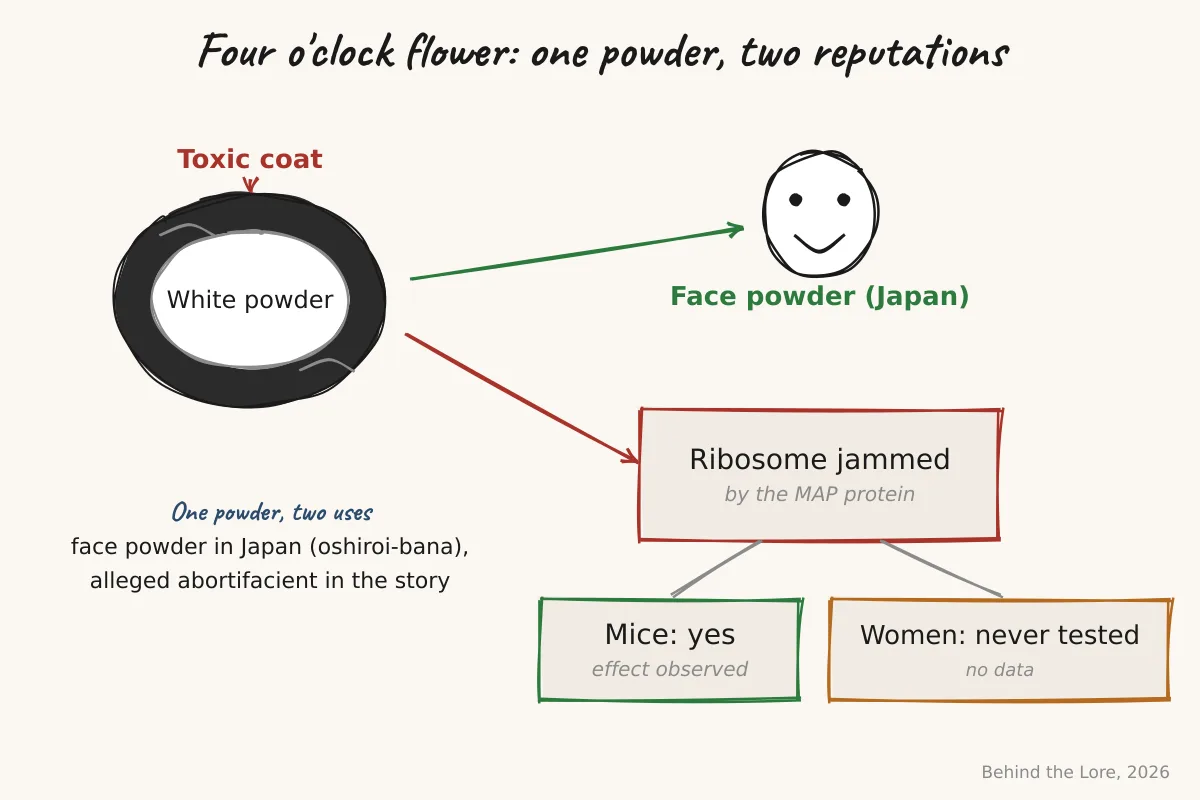
The four o’clock flower, Mirabilis jalapa, also called marvel of Peru, is a herbaceous plant of the Nyctaginaceae family, native to the dry tropical regions of Mexico, Central America and South America [Wikipedia] . Its flowers open in late afternoon and stay open all night, hence its English name “four o’clock” and its French name “belle-de-nuit”, the night beauty. A single plant can bear pink, yellow, white or variegated flowers [Wikipedia] . Its fruit holds a single black, wrinkled seed, which contains a white, floury reserve.
Are four o’clock flower seeds poisonous?
Yes, but moderately. The poisonous four o’clock flower seeds and its roots are the parts of the plant recognized as toxic. Eating them mainly causes abdominal pain, nausea, vomiting and diarrhea, and handling the roots can irritate the skin [Web] . The root is purgative and emetic, which earned it an old medical use as a laxative [Wikipedia] . The compound responsible for these digestive troubles has not been formally identified.
Which molecule could act on a pregnancy?
The strongest lead is a family of plant enzymes, the ribosome-inactivating proteins . The ribosome is the workshop where the cell assembles its proteins. These enzymes pull out a tiny part, an adenine of the ribosomal RNA, and the workshop shuts down. Ricin belongs to the same family. In the four o’clock flower, an Italian team measured this activity in every tissue of the plant: it peaks in the seed [Étude] . The main protein is called MAP, for Mirabilis antiviral protein, because it was first studied for its action against plant viruses.
In 1992, biochemists in Hong Kong purified MAP from the roots and observed that it ended pregnancy in mice [Étude] . This result is explained by analogy with a well-known related protein, trichosanthin.
Why does this mechanism target the placenta?
Trichosanthin, extracted from the root of a Chinese gourd, is the active ingredient of Tian Hua Fen powder, used as an abortifacient in Chinese medicine. It was purified in 1972 to reduce its side effects [Étude] . It preferentially destroys the cells of the trophoblast , the layer that forms the placenta: deprived of its nourishing cells, the embryo can no longer be sustained. The four o’clock flower’s MAP belongs to the same family, which makes a comparable effect plausible.
Two limits nevertheless separate this plausibility from real effectiveness. Proteins are largely broken down by digestion, and the medical use of trichosanthin relied on injection (intramuscular, intra-amniotic or intrauterine) [Étude] . Moreover, no study has measured the effect of four o’clock seeds swallowed by a pregnant woman. The rest of the seed, with its digestive irritants, acts on the mother long before reaching any placental target.
Going further
- Emmenagogue and Abortive Plants, uterotonic activity and toxicity
- Lead White Makeup, toxicology of cosmetic powders
- Mercury, systemic toxicity of a liquid metal
- Discipline: Pharmacology
- Discipline: Toxicology
Glossary
- Abortifacient ↗
- Substance or method capable of ending a pregnancy. In pharmacology, the real, measured effect is distinguished from the reputation handed down by tradition.
- Ribosome ↗
- Molecular machine found in every cell, which reads messenger RNA to assemble proteins. Without working ribosomes, a cell can no longer make its proteins and eventually dies.
- Ribosome-inactivating protein ↗
- Plant enzyme that pulls out one specific base (an adenine) from the ribosome's RNA, which blocks protein production. Ricin is the best-known member of the family.
- Trophoblast ↗
- Layer of cells surrounding the embryo that forms the fetal part of the placenta. It ensures implantation in the uterus and exchanges with the mother.
- Cytoplasmic inheritance ↗
- Transmission of traits by elements located outside the cell nucleus, such as chloroplasts, usually through the maternal line only.
Sources
- Mirabilis jalapa, French Wikipedia [Wikipedia]
- Mirabilis jalapa, English Wikipedia [Wikipedia]
- Mirabilis jalapa (Four O’Clock), North Carolina State University Extension [Web]
- Bolognesi A. et al., Ribosome-inactivating and adenine polynucleotide glycosylase activities in Mirabilis jalapa L. tissues, J. Biol. Chem., 2002 [Étude]
- Wong R. N. et al., Characterization of Mirabilis antiviral protein, Biochem. Int., 1992 [Étude]
- Lu J.-Q., Wong K.-B., Shaw P.-C., A Sixty-Year Research and Development of Trichosanthin, Toxins, 2022 [Étude]
- Abortifacient, French Wikipedia [Wikipedia]
Published on
Keep investigating
Auto-suggested from shared concepts, disciplines, episodes, or characters.
Mercury
In The Apothecary Diaries, quicksilver goes into a court poison. We explain mercury, its toxicity, and the immortality elixirs that killed emperors.
Emmenagogue and Abortive Plants
Mostly they poisoned first: jasmine, mugwort, rue and chili stimulate the uterus only at doses toxic to the mother. The pharmacology and history behind them.
Lead White Makeup
Ceruse is lead carbonate: worn daily, it caused slow lead poisoning. The symptoms, why it killed nursing infants, and the palace curse in The Apothecary Diaries.
Datura
In The Apothecary Diaries, datura is used to induce sleep and feign death. We explain its alkaloids, its toxicity, and its role in the history of anesthesia.
Nicotine and Tobacco
In The Apothecary Diaries, macerated tobacco serves as a poison. We explain nicotine, its acute toxicity, and why diluting a poison can make it worse.