Emmenagogue plants and herbal abortifacients
Story context (click to hide this block) (click to show this block)
This paragraph may contain plot information.
When a merchant caravan passes through the imperial court, Maomao browses the stalls and notices tea scented with jasmine. Later, she worries that the aromatic oils popularized by the caravan’s perfumes pose a danger to pregnant women. When Jinshi reads her the list of fashionable products (rose, benzoin, frankincense, cinnamon, sterculia) she confirms that all of them are harmful to expectant mothers. She adds that courtesans use chili pepper as an abortifacient, and that heavy exposure to jasmine contributes to infertility. What the episode presents as an apothecary’s obvious knowledge actually reflects millennia-old empirical wisdom, real, but far more complex and ambiguous than its brevity suggests.
The subject in depth
The term emmenagogue refers to any substance believed to induce or regulate menstruation. In pre-modern pharmacopoeias, the line between emmenagogue and abortifacient was blurry: triggering a period and ending an early pregnancy belonged to the same body of knowledge [Wikipedia] . These categories did not correspond to an understood mechanism, but to an observed effect, partly real, partly imagined.
Jasmine
Jasmine, mainly Jasminum sambac and Jasminum officinale, contains aromatic compounds such as benzyl acetate, indole, and linalool. In vitro studies and animal models have shown that concentrated jasmine extracts exert a uterotonic effect, meaning they stimulate uterine contractions. This effect is documented well enough that aromatherapists and midwives advise against jasmine essential oil during pregnancy. The dose, however, is decisive: a diluted cup of jasmine tea does not carry the same active concentrations as an essential oil applied to the skin or inhaled intensively. The possible effect on male fertility, raised in the episode through Maomao’s concern for Jinshi, is biologically plausible according to a handful of rodent studies, but evidence in humans is nearly nonexistent.
Mugwort and rue
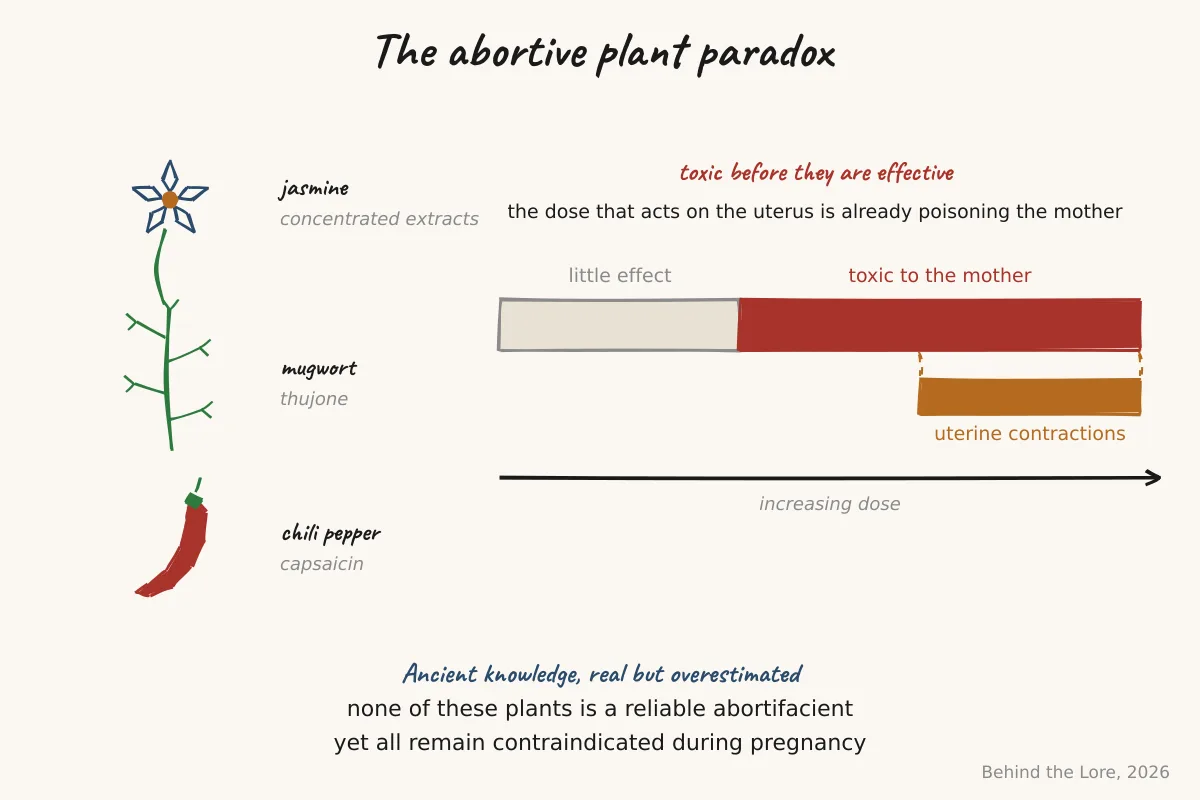
Mugwort (Artemisia spp.) and rue (Ruta graveolens) are two of the plants most often cited in ancient medical treatises as emmenagogues and abortifacients. Mugwort contains thujone, a monoterpene that stimulates uterine contractions. Rue contains rutacridone and other alkaloids with an experimentally demonstrated abortive effect. In both cases, the doses active on the uterus fall in a range where liver, kidney, and neurological toxicity for the mother is already significant. Deaths from rue or mugwort poisoning during attempted pregnancy termination are historically documented, illustrating the fundamental paradox of these plants: they could kill before they affected the pregnancy.
Chili pepper
Capsaicin from chili peppers (Capsicum spp.) has vasomotor effects and, at very high doses, can stimulate smooth muscle, including that of the uterus. Abortive use of chili pepper is attested in many ethnomedical traditions, from the Americas to Asia. In modern pharmacology, reliable abortive efficacy has not been clinically established at doses tolerable by mouth. The doses needed to produce a significant uterine effect would first cause burns to the digestive mucosa and severe systemic toxicity [Wikipedia] .
A shared mechanism and its limits
These plants share a partial mechanism: they stimulate uterine contractions through varied pathways, acting on prostaglandin receptors, calcium channels, or smooth-muscle tone. What ancient pharmacopoeias interpreted as abortive power corresponds to a real uterotonic activity, but one too weak and too toxic to be reliable. For most of these plants, the margin between the emmenagogue dose and the lethal dose is very narrow.
Going further
- Aconite, pharmacology of plant poisons
- Orpiment and Arsenic, substances used medicinally despite their toxicity
- Datura, a plant on the border between remedy and poison
- Discipline: Pharmacology
- Discipline: History of Science
Sources
Published on
Keep investigating
Auto-suggested from shared concepts, disciplines, episodes, or characters.
Datura
In The Apothecary Diaries, datura is used to induce sleep and feign death. We explain its alkaloids, its toxicity, and its role in the history of anesthesia.
Aconite
In The Apothecary Diaries, aconite poisons even through honey. We explain aconitine, its action on nerves, and why it shows no mercy.
Orpiment and Arsenic
In The Apothecary Diaries, a yellow pigment poisons slowly. We explain orpiment, arsenic, and the chronic poisoning of court painters.
Earthworms in Medicine
Maomao thinks of earthworms as a fever remedy. We explain dilong in traditional Chinese medicine and the lumbrokinases studied in modern pharmacology.
Mugwort
In The Apothecary Diaries, mugwort is one of the court's medicinal herbs. We explain its uses and artemisinin, Tu Youyou's antimalarial drug (Nobel 2015).