Earthworms in Medicine: Dilong and Lumbrokinases
Story context (click to hide this block) (click to show this block)
This paragraph may contain plot information.
Browsing the stalls of the merchant caravan, Maomao spots medicinal insects and briefly thinks of the earthworm as a fever remedy. The mention is quick, almost automatic, but it reveals practical knowledge of traditional pharmacopoeia: for an apothecary trained in court remedies, the dried earthworm is a common ingredient, not a curiosity.
The subject in depth
The earthworm is used in traditional Chinese medicine (TCM) under the name dilong, literally “earth dragon” [Wikipedia] . It mainly refers to the species Pheretima aspergillum, collected, steamed, and dried. The official Chinese pharmacopoeia (2020 edition) lists it among substances used for their antipyretic (fever-reducing), antispasmodic, and blood-thinning properties. Its use is documented at least since the Song period (10th–13th centuries) in major materia medica compilations.
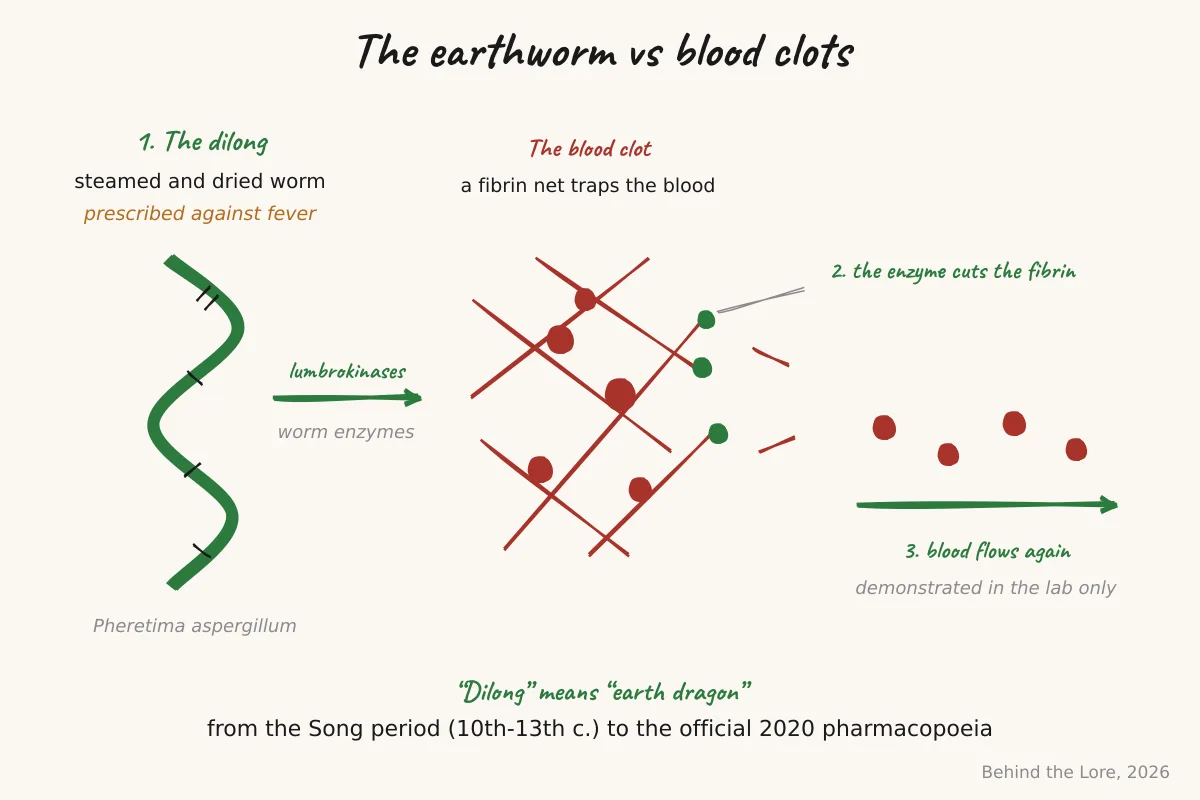
Modern pharmacology has taken an interest in this substance from an unexpected angle. Researchers have isolated, from several earthworm species, enzymatic proteins called lumbrokinases
[Wikipedia] . These enzymes have shown an ability to break down fibrin, the protein that forms the scaffold of blood clots, in laboratory experiments and animal models. The effect is termed fibrinolytic: it resembles, in principle, that of the thrombolytic drugs used in emergency medicine to dissolve clots in the arteries.
The lead is serious enough to have given rise to purified extracts sold as dietary supplements in some East Asian countries. Still, the path from a demonstrated in vitro enzymatic activity to a medicine validated by rigorous clinical trials is a long one. Studies in humans remain few, with small sample sizes and variable methodology. Dilong therefore remains, for now, a TCM ingredient backed by a millennia-old tradition and a plausible biology, but without proof of clinical efficacy by current standards.
Going further
Sources
Published on
Keep investigating
Auto-suggested from shared concepts, disciplines, episodes, or characters.
Aconite
In The Apothecary Diaries, aconite poisons even through honey. We explain aconitine, its action on nerves, and why it shows no mercy.
Mercury
In The Apothecary Diaries, quicksilver goes into a court poison. We explain mercury, its toxicity, and the immortality elixirs that killed emperors.
Orpiment and Arsenic
In The Apothecary Diaries, a yellow pigment poisons slowly. We explain orpiment, arsenic, and the chronic poisoning of court painters.
Spider Silk and Hemostasis
In The Apothecary Diaries, Maomao mentions spider webs to clot blood. We separate the real mechanical effect from the vitamin K myth.
The Mantis Ootheca
In The Apothecary Diaries, mantis eggs are seen as an aphrodisiac. We describe the ootheca, its structure, and its use in Chinese medicine.