The Mantis Ootheca: biology and pharmacology
Story context (click to hide this block) (click to show this block)
This paragraph may contain plot information.
As Maomao walks the caravan’s stalls, her trained herbalist’s eye instinctively sorts through the goods on display. She scans the medicinal insects and thinks of mantis eggs as an ingredient for aphrodisiacs. The mention is brief, almost automatic, like a catalog entry surfacing in a practitioner’s memory.
The subject in depth
The praying mantis is a predatory insect with a distinctive reproductive process: the female lays her eggs in a secretion that she whips with her abdomen to incorporate air, forming a foamy mass that hardens quickly on contact with air [Wikipedia] . This structure, called an ootheca, encloses one hundred to four hundred eggs depending on the species and acts as both a thermal and mechanical shield [Wikipedia] . The outer wall hardens like a natural polystyrene, while the interior stays softer, maintaining stable humidity and temperature for the larvae’s development.
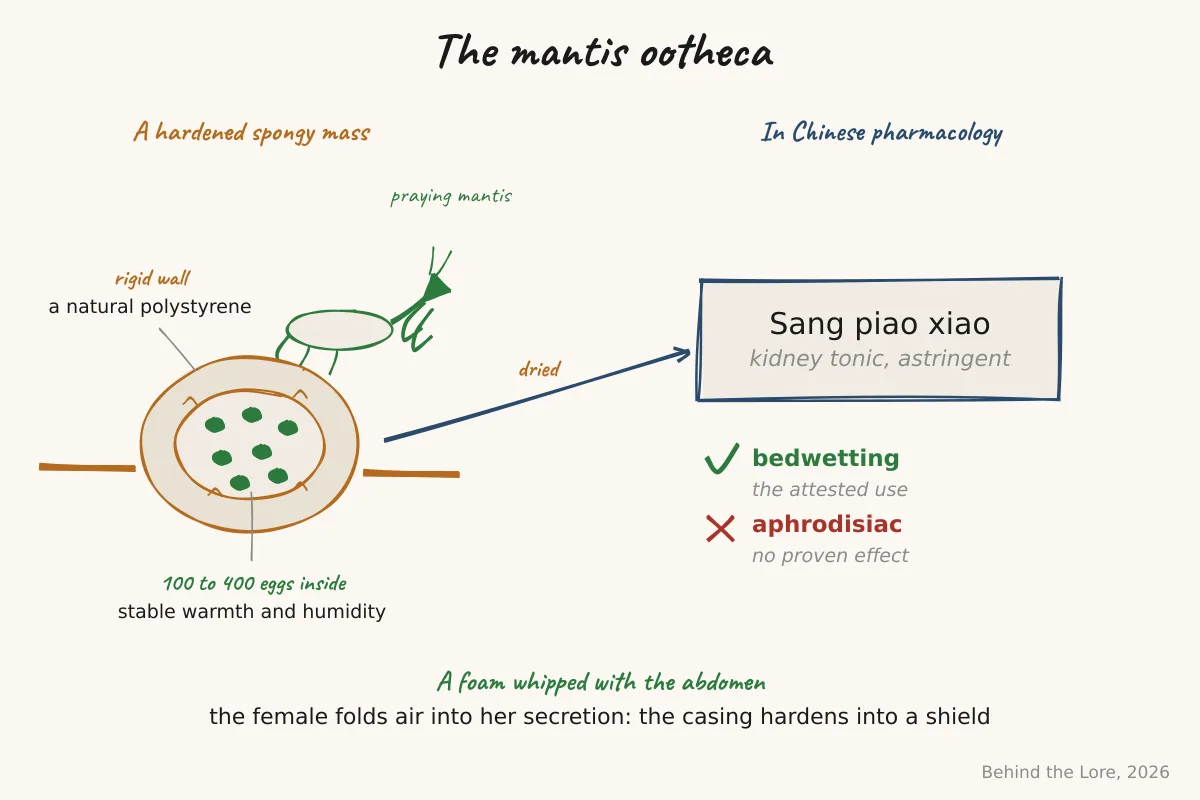
The ootheca’s toughness is remarkable. It withstands weather, winter temperature swings, and numerous predators. Some species attach their oothecae to stems, stones, or walls, where they overwinter before hatching in spring into small nymphs called mantis larvae.
In traditional Chinese pharmacology, the dried ootheca of several mantis species is known as sang piao xiao. It is classified among astringent, kidney-tonifying substances. According to the official Chinese Pharmacopoeia (2020 edition), its main indications are nocturnal enuresis, frequent urination, and certain forms of spermatorrhea. The underlying logic is that of traditional Chinese medicine: the kidneys govern both fluid retention and vital energy (jing). Tonifying the kidneys thus means improving both urinary control and, by metaphorical extension, sexual vitality.
From the standpoint of modern pharmacology, no clearly identified active molecule in the mantis ootheca has demonstrated any aphrodisiac or hormonal effect. Its components are mainly structural proteins, lipids, and polysaccharides. Preliminary research has explored crude extracts in animal models, without conclusive results regarding sexual function. The clinically attested use does concern enuresis, with several Chinese clinical studies reporting a positive effect, particularly in children.
Going further
Sources
Published on
Keep investigating
Auto-suggested from shared concepts, disciplines, episodes, or characters.
Aconite
In The Apothecary Diaries, aconite poisons even through honey. We explain aconitine, its action on nerves, and why it shows no mercy.
Orpiment and Arsenic
In The Apothecary Diaries, a yellow pigment poisons slowly. We explain orpiment, arsenic, and the chronic poisoning of court painters.
Earthworms in Medicine
Maomao thinks of earthworms as a fever remedy. We explain dilong in traditional Chinese medicine and the lumbrokinases studied in modern pharmacology.
Spider Silk and Hemostasis
In The Apothecary Diaries, Maomao mentions spider webs to clot blood. We separate the real mechanical effect from the vitamin K myth.
Emmenagogue and Abortive Plants
Jasmine, mugwort, rue, chili pepper: were these plants, said to trigger periods or end a pregnancy, really effective? The history and pharmacology behind them.