Spider Silk to Stop Bleeding
Story context (click to hide this block) (click to show this block)
This paragraph may contain plot information.
On learning that spiders live in the ruins of the palace, Maomao mentions the clotting effect of their webs. For her, it’s practical knowledge from an apothecary’s toolkit: applying web to a bleeding wound is a field remedy, far from elaborate medicine. The scene is brief, but it grounds an ancient medical practice that the story presents without romanticism or magic, as just one tool among others in the apothecary’s kit.
The subject in depth
Hemostasis is the process that stops bleeding in three stages: vessel constriction, formation of a platelet plug (primary hemostasis), then solidification through a fibrin network (coagulation) [Wikipedia] . For this process to work, platelets need a scaffold to aggregate on and fibrin strands need something to grip. That’s exactly what spider web provides.
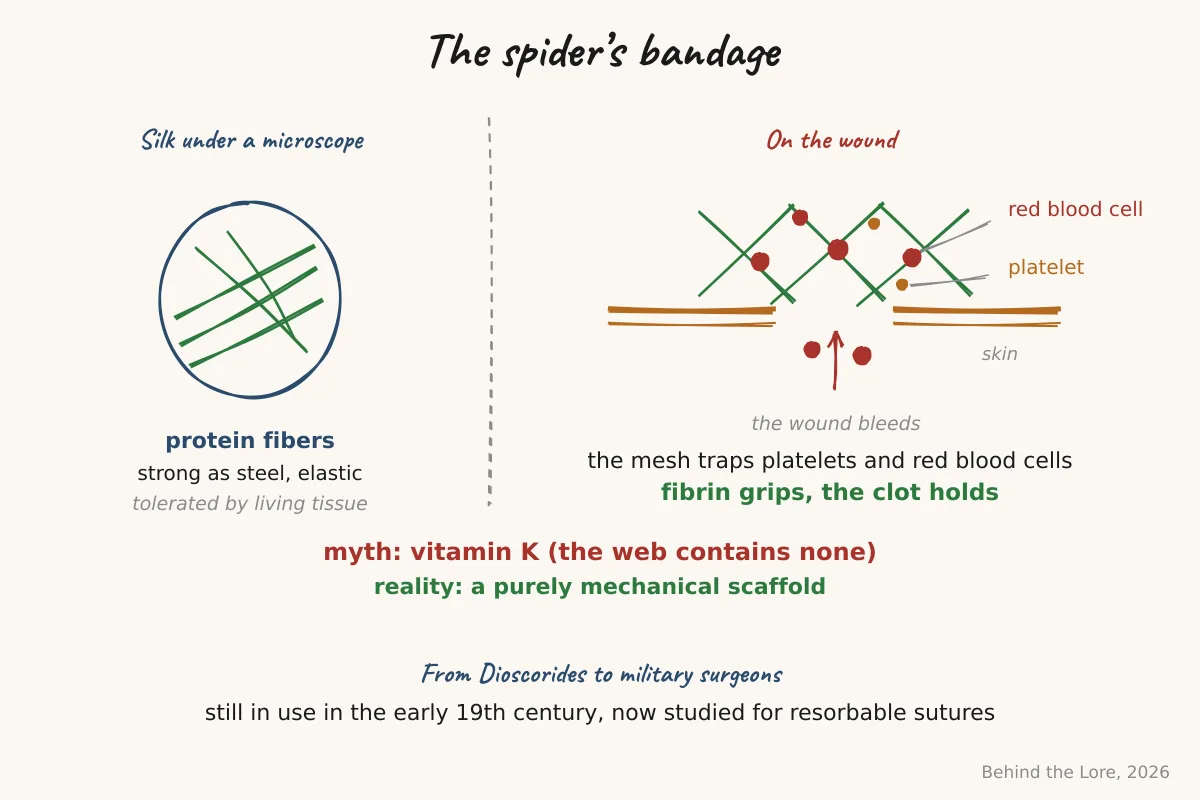
Spider silk is a fibrous protein with remarkable mechanical properties: tensile strength comparable to high-grade steel, significant elasticity, and biocompatibility, it’s tolerated by living tissue without major inflammatory reaction [Wikipedia] . Applied to a wound, it forms a three-dimensional mesh that slows blood flow, traps platelets and red blood cells, and offers a surface for fibrin to grip. The effect is purely mechanical and physical: the web secretes no clotting enzyme, no endogenous pro-coagulant factor.
The mix-up with vitamin K is a persistent myth. Vitamin K plays a role in the coagulation cascade by activating certain protein factors, but it is absent from the composition of spider web. Invoking vitamin K to explain the web’s hemostatic action confuses two distinct biological levels: the passive scaffolding effect of silk on one hand, and the biochemistry of coagulation on the other.
Modern biomedical research confirms spider silk’s value while clarifying its nature. Biomaterials teams are working on silk synthesized from recombinant proteins to produce resorbable sutures, wound-healing membranes, and tissue regeneration scaffolds. These applications exploit the same mechanical qualities that ancient practitioners used empirically, but within a controlled, sterile, standardized framework.
Going further
Sources
Published on
Keep investigating
Auto-suggested from shared concepts, disciplines, episodes, or characters.
Dehydration and Rehydration
In The Apothecary Diaries, Maomao treats heatstroke with salted, sweetened water. We explain dehydration and why salt is vital.
Aconite
In The Apothecary Diaries, aconite poisons even through honey. We explain aconitine, its action on nerves, and why it shows no mercy.
Earthworms in Medicine
Maomao thinks of earthworms as a fever remedy. We explain dilong in traditional Chinese medicine and the lumbrokinases studied in modern pharmacology.
The Mantis Ootheca
In The Apothecary Diaries, mantis eggs are seen as an aphrodisiac. We describe the ootheca, its structure, and its use in Chinese medicine.
Emmenagogue and Abortive Plants
Jasmine, mugwort, rue, chili pepper: were these plants, said to trigger periods or end a pregnancy, really effective? The history and pharmacology behind them.