Mercury: The Liquid Metal That Poisons
Story context (click to hide this block) (click to show this block)
This paragraph may contain plot information.
While tracing the composition of a poison used at court, Maomao pauses on one ingredient in particular. Every other component, she notes, is easy to find, except one: quicksilver, that is, mercury. Its rarity and cost set it apart from common plants, marking it as a court poison, accessible only to those with means. The shimmering liquid metal that fascinated the ancients here becomes, once again, what it has always been: a poison.
The subject in depth
Mercury is the only metal that is liquid at room temperature, which earned it its old name of quicksilver, “living silver” [Wikipedia] . This shifting, shining appearance fed its magical and medical reputation for centuries. But in every one of its forms, mercury is a poison. As a heavy metal, it behaves like lead and arsenic: it accumulates and disrupts the function of many proteins in the body.
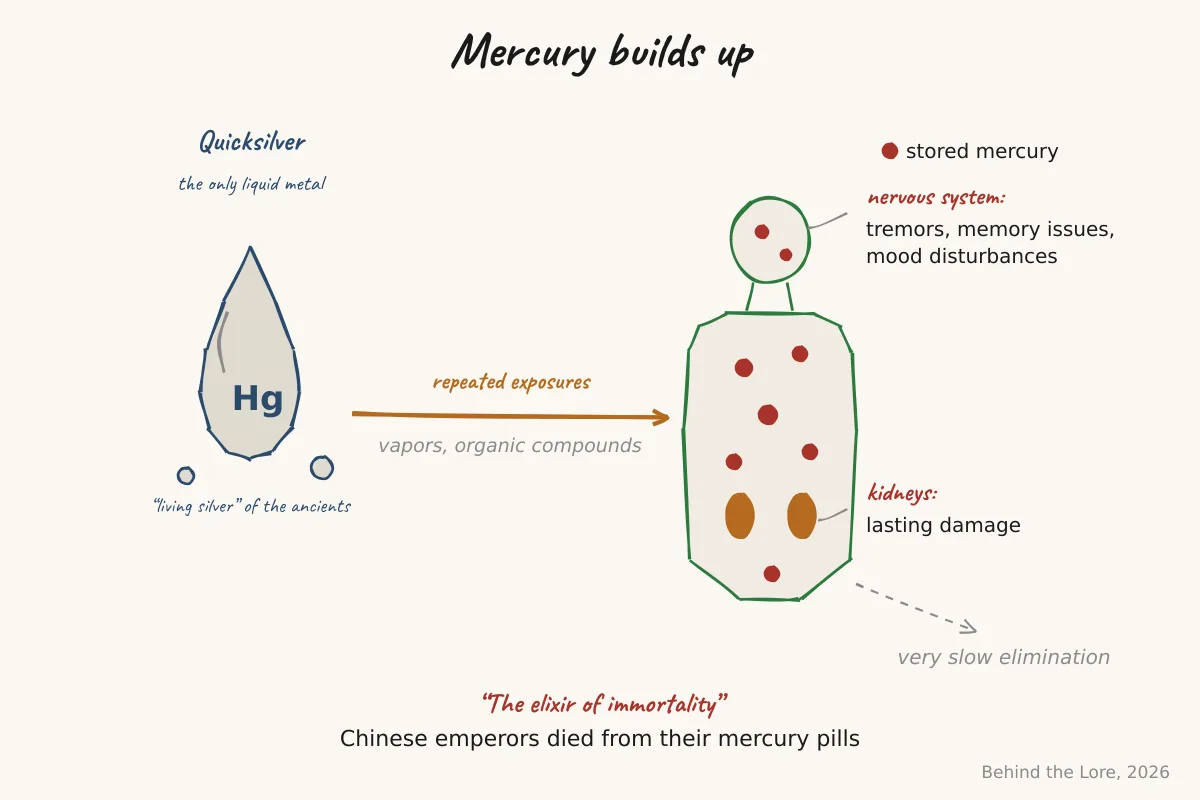
Its toxicity depends on its form. Liquid mercury that is swallowed is largely eliminated without being absorbed, which for a long time falsely suggested it was harmless. Its vapors, however, released as soon as it is heated, are highly toxic to the lungs and brain. And when it combines with other elements, as in cinnabar, its red ore, or as organic compounds produced by bacteria in water, it becomes even more dangerous [Wikipedia] .
The effects of poisoning, called mercurialism, mainly strike two organs
[Wikipedia] . First the nervous system: tremors, memory problems, irritability, changes in mood and behavior, sometimes even delirium. Then the kidneys, which mercury damages over the long term. As with other heavy metals, poisoning is often chronic and insidious, because mercury is eliminated very slowly and builds up with each exposure.
Mercury thus completes the trio of heavy metals featured in the story, alongside the lead in white makeup and the arsenic in orpiment. Three shining, useful metals, three slow poisons, illustrating the same lesson: the beauty or usefulness of a material says nothing about its safety.
Going further
Sources
Published on
Keep investigating
Auto-suggested from shared concepts, disciplines, episodes, or characters.
Lead White Makeup
Ceruse is lead carbonate: worn daily, it caused slow lead poisoning. The symptoms, why it killed nursing infants, and the palace curse in The Apothecary Diaries.
Orpiment and Arsenic
In The Apothecary Diaries, a yellow pigment poisons slowly. We explain orpiment, arsenic, and the chronic poisoning of court painters.
Four O'Clock Flower
Partly: four o'clock flower seeds hold a protein that ends pregnancy in mice, never tested in women. Mechanism, toxicity and the limits of court lore.
Elixirs of Immortality
Cinnabar, mercury, arsenic: Chinese waidan alchemy sought eternal life in poisons. The alchemists' logic, what mercury does to the brain, and who died of it.
The Caesarean Section
Before antisepsis and anesthesia, caesarean section almost always killed the mother. We explain why, and what changed everything in the 19th century.