The Caesarean Section
Story context (click to hide this block) (click to show this block)
This paragraph may contain plot information.
The Empress Dowager Anshi reveals to Maomao that at her birth, her adolescent body, barely past puberty, was unable to withstand a natural delivery. A physician, Luomen, performed an incision to bring the child into the world, and had himself castrated to earn the right to operate within the women’s quarters. The show treats this as an exceptional act, undertaken as a last resort, and the dramatic weight it gives the moment matches the reality of pre-modern obstetric surgery well.
The subject in depth
The caesarean section involves extracting the fetus by successively incising the mother’s abdominal wall and uterus [Wikipedia] . Performing this operation before the great advances of the 19th century amounted to condemning the mother in nearly every case.
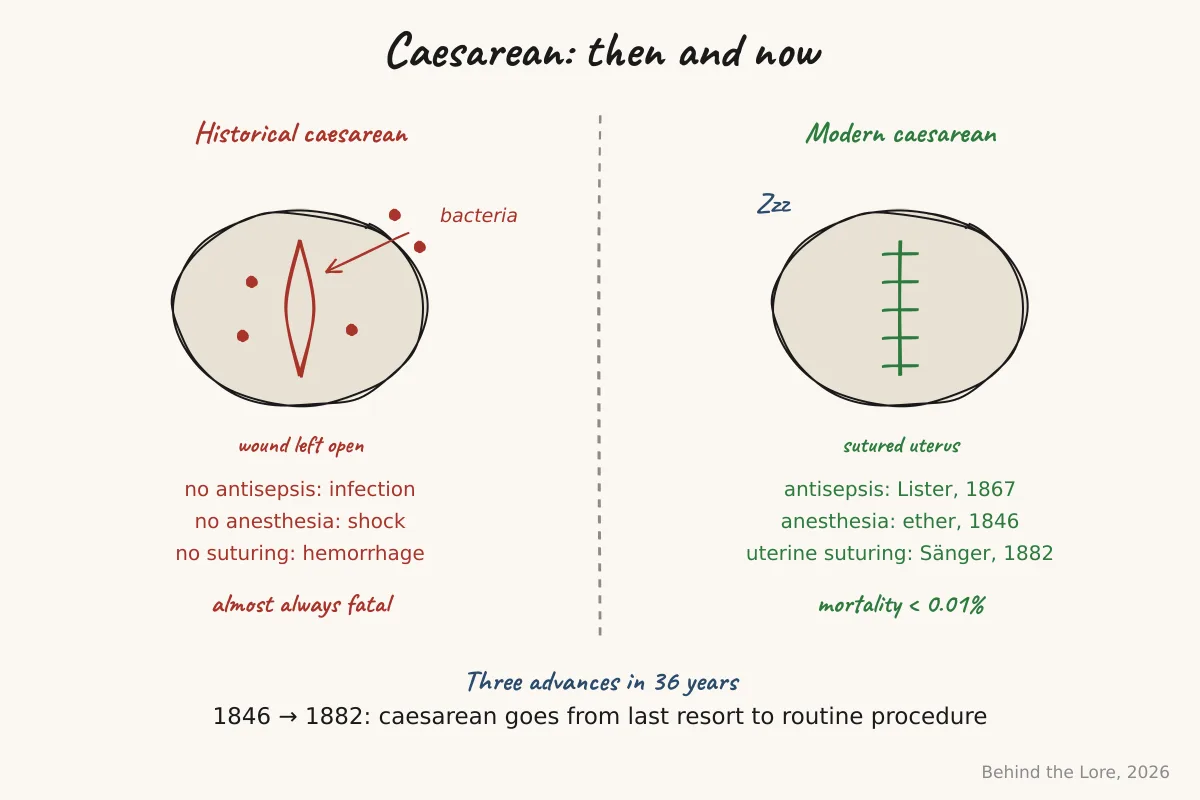
The absence of antisepsis: the main cause. Before Joseph Lister introduced the principles of antisepsis in 1867, drawing on Pasteur’s work on germs, no surgeon disinfected their hands or instruments [Wikipedia] . The uterus, a richly vascularized organ connected to the abdominal cavity, offered an ideal breeding ground for bacteria. Peritonitis or septicemia in the days following the operation would carry off the mother, often within a week.
The absence of anesthesia. Before the discovery of ether (1846) and chloroform (1847), the operation was performed on a conscious patient, in a state of painful shock. Tachycardia, vasoconstriction, and physiological exhaustion worsened the risk of hemorrhage and made any lengthy procedure nearly incompatible with survival.
The absence of uterine suturing. Even when a mother survived the first two dangers, the incised uterus was not closed: surgeons believed uterine muscle could not be properly sutured, and left the wound to close on its own. Post-operative hemorrhage then killed the rare survivors of shock and infection. It was only in 1882 that Max Sänger standardized systematic uterine suturing, finally drastically reducing mortality.
The only accepted indication. In this context, a caesarean on a living mother was only considered as an absolute last resort, when the mother’s death was already deemed inevitable without intervention, typically in cases of major dystocia (a bony pelvis too narrow or immature), making vaginal delivery biologically impossible. The post-mortem operation, performed on a deceased mother to try to save the child, was more common and less risky for the surgeon.
What changed everything. The combination of three advances between 1846 and 1882 turned the caesarean section into a routine procedure: general anesthesia, which removes the painful shock; antisepsis and asepsis, which eliminate bacterial infection; and systematic uterine suturing, which controls hemorrhage. Today, in a modern surgical setting, maternal mortality linked to a planned caesarean section is below 0.01%.
Going further
Sources
Published on
Keep investigating
Auto-suggested from shared concepts, disciplines, episodes, or characters.
Mercury
In The Apothecary Diaries, quicksilver goes into a court poison. We explain mercury, its toxicity, and the immortality elixirs that killed emperors.
Orpiment and Arsenic
In The Apothecary Diaries, a yellow pigment poisons slowly. We explain orpiment, arsenic, and the chronic poisoning of court painters.
Decomposition and Mummification
In The Apothecary Diaries, a body remains intact for a year. We explain autolysis, bacterial putrefaction, and what stops it: cold, dryness, preserving salts.
Surgical Sutures
In The Apothecary Diaries, Maomao is recovering from fifteen stitches. The history of suture thread, from Egyptian linen to resorbable catgut and synthetic thread.
The Bezoar
In The Apothecary Diaries, the bezoar is a prized pharmacopoeia treasure. We explain what this concretion really is and what modern science makes of it.