Decomposition and Mummification of the Human Body
Story context (click to hide this block) (click to show this block)
This paragraph may contain plot information.
Suirei reports to Maomao that the former emperor’s body remained intact in the mausoleum for an entire year, showing no sign of decomposition, while his mother’s body, kept in the same place, was in an advanced state of putrefaction. Maomao thinks aloud: without ice to keep a body cold, a corpse normally ends up rotting. The difference between the two bodies in the same place becomes the episode’s central mystery, steering suspicion away from a curse and toward a cause specific to one of the two bodies, whether dietary, medical, or the result of a discreet embalming.
The subject in depth
The decomposition of a human body follows a progression through several phases, the speed of which depends entirely on environmental conditions [Wikipedia] .
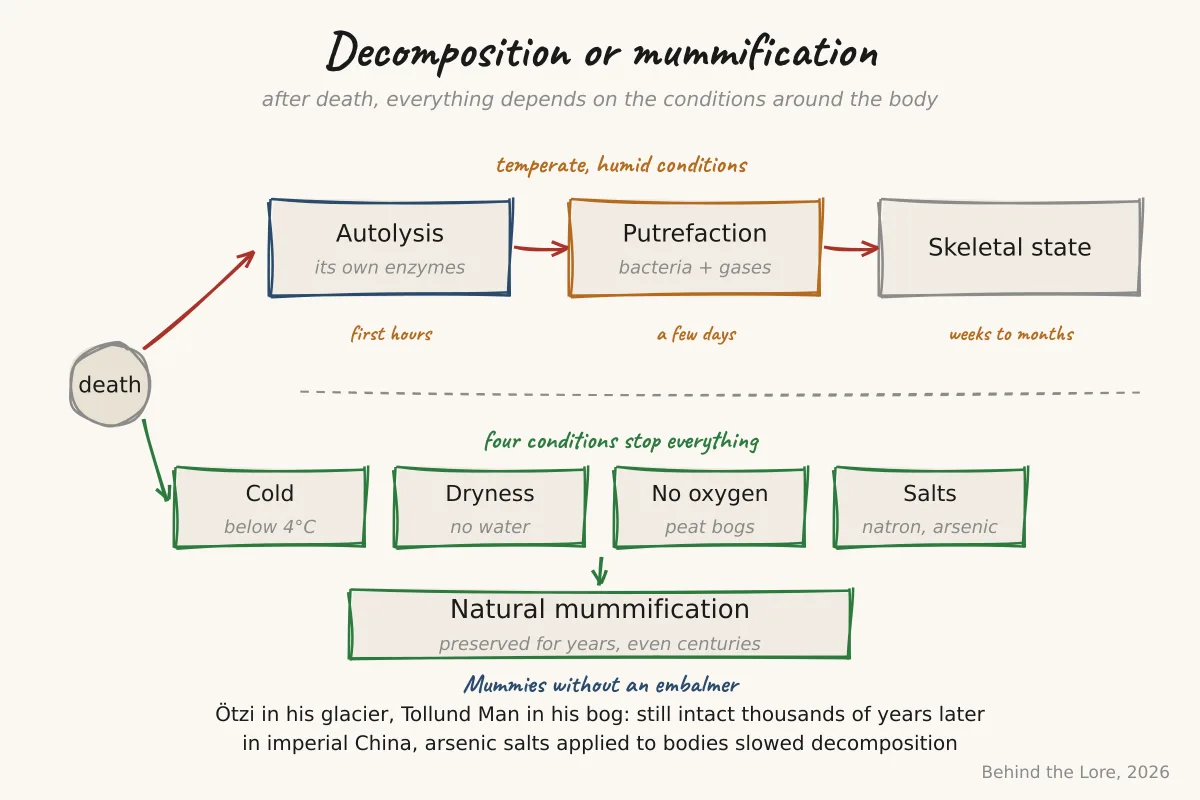
Autolysis begins within the first hours after death. Without oxygen, cells release their own enzymes, which begin digesting tissue from the inside. This process is purely biochemical, independent of any bacteria.
Bacterial putrefaction takes over in the following days. Intestinal bacteria, proliferating unchecked by the host’s immune system, rapidly colonize every organ and produce gases such as methane and hydrogen sulfide, responsible for bloating and the characteristic odor. In a temperate, humid environment, a body is reduced to a skeletal state within a few weeks to a few months.
Four conditions can halt this process and preserve the body:
- Cold: below around 4°C (39°F), bacterial activity slows dramatically. The ice Maomao mentions works on exactly this principle. Bodies found in glaciers or permafrost (such as Ötzi, the Iceman) illustrate how effective this mechanism can be over millennia.
- Dryness: without water, bacteria cannot multiply and enzymes become inactive. Hot, dry desert environments mummify bodies naturally, as shown by the mummies of the Taklamakan Desert or certain regions of Africa.
- Lack of oxygen: an anaerobic environment prevents aerobic bacteria from developing. In peat bogs, the combination of acidity, anaerobiosis, and sphagnan (a natural antiseptic from sphagnum moss) produces bog bodies, some of which are thousands of years old.
- Preserving salts: natron, a mixture of sodium carbonate and bicarbonate, was used in Egyptian embalming to rapidly dehydrate bodies and inhibit bacteria. Arsenic, in the form of arsenite or arsenic trioxide, was used as a funerary preservative in many cultures, notably in imperial China, where arsenical salts were applied to bodies to slow their decomposition [Wikipedia] . This connects directly to the entry on orpiment and arsenic, where the same arsenic compounds Maomao handles as pigment or poison turn out to have also served as agents of bodily preservation.
Saponification is a special case: under cold, wet conditions, the body’s fats can turn into adipocere, a waxy, stable substance that coats tissues and locks them into a state of prolonged preservation. This phenomenon is well documented in forensic medicine for bodies recovered from aquatic environments or damp clay soils.
Going further
Sources
Published on
Keep investigating
Auto-suggested from shared concepts, disciplines, episodes, or characters.
Hypothermia
In The Apothecary Diaries, cold threatens lives. We explain hypothermia, why cold-water immersion is so dangerous, and how to rewarm safely.
Mercury
In The Apothecary Diaries, quicksilver goes into a court poison. We explain mercury, its toxicity, and the immortality elixirs that killed emperors.
Orpiment and Arsenic
In The Apothecary Diaries, a yellow pigment poisons slowly. We explain orpiment, arsenic, and the chronic poisoning of court painters.
The Caesarean Section
Before antisepsis and anesthesia, caesarean section almost always killed the mother. We explain why, and what changed everything in the 19th century.
Bear Bile
Why did bear bile, a traditional TCM remedy, lead to a modern drug? UDCA dissolves gallstones and treats the liver.