Bear Bile: From TCM to Modern Medicine
Story context (click to hide this block) (click to show this block)
This paragraph may contain plot information.
Maomao describes a bear’s dried gallbladder as a highly prized remedy for digestive troubles, bitter, certainly, but effective. She presents it without surprise or mystery, as an ordinary pharmacopoeia product, on par with other animal or plant-based drugs she handles daily. The mention is brief, almost mundane for an apothecary of her level, and that very casualness is what makes the moment instructive.
The subject in depth
Bile is a fluid produced by the liver, stored in the gallbladder, and released into the small intestine during meals [Wikipedia] . Its main function is to emulsify dietary fats: it acts as a biological detergent, breaking large lipid droplets into micelles that pancreatic enzymes can then digest. Bile salts, derived from cholesterol, are the active agents of this emulsification.
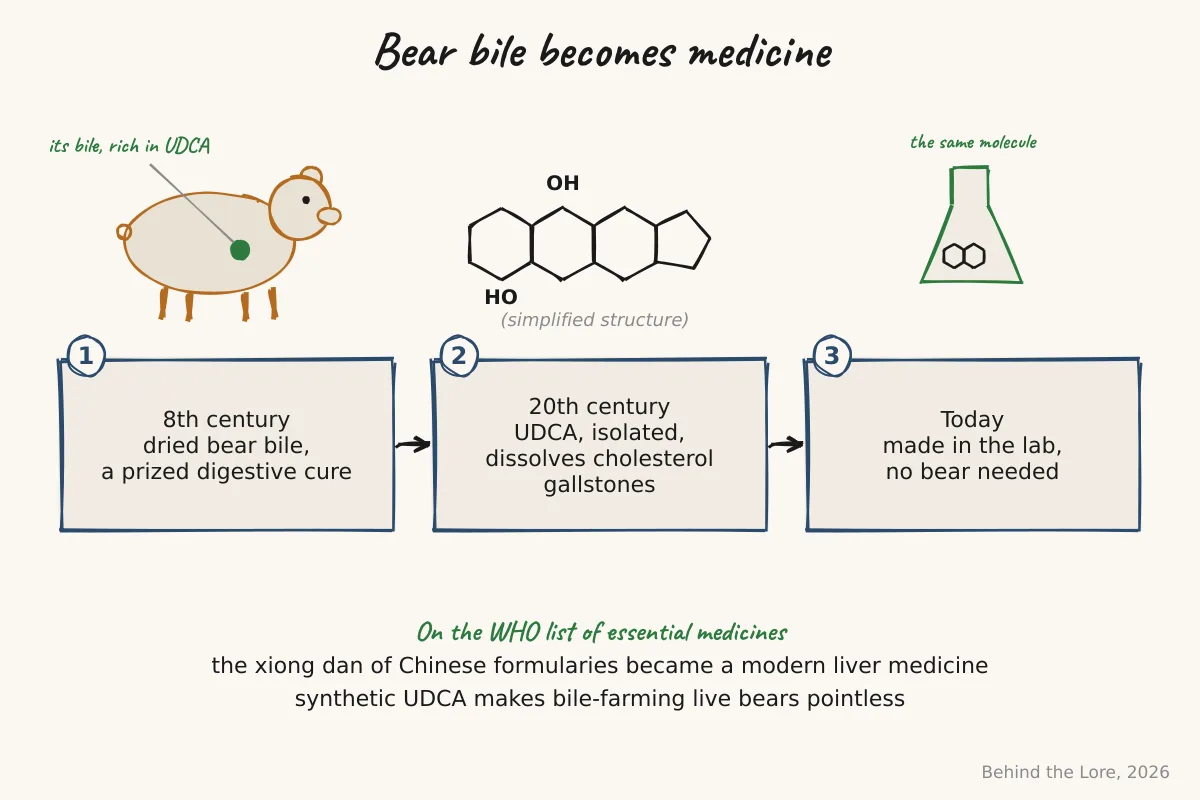
In bears specifically, bile is unusually rich in ursodeoxycholic acid, often abbreviated UDCA [Wikipedia] . Unlike primary bile salts, which can be irritating at high concentrations, UDCA is a hydrophilic bile acid that is gentle on mucous membranes. It acts through several complementary mechanisms: it changes the composition of bile by reducing the proportion of toxic bile salts, it promotes the dissolution of cholesterol-rich gallstones by making bile less saturated, and it exerts a cytoprotective effect on liver cells (hepatocytes) and bile duct cells.
This is a rare case of continuity between traditional pharmacopoeia and evidence-based medicine. Classical Chinese formularies have mentioned bear bile, xiong dan, since at least the 8th century. Modern pharmacology isolated and characterized UDCA in the 20th century, and Japanese teams demonstrated in the 1970s-1980s its clinical efficacy in dissolving gallstones and improving liver markers in diseases such as primary biliary cholangitis or intrahepatic cholestasis of pregnancy. It is now on the WHO list of essential medicines, produced by chemical synthesis from bile acids sourced from the food industry.
Going further
Sources
Published on
Keep investigating
Auto-suggested from shared concepts, disciplines, episodes, or characters.
Fugu and Tetrodotoxin
In The Apothecary Diaries, Maomao loves fugu and its poison. We explain tetrodotoxin, how it paralyzes, and why there's no antidote.
Aconite
In The Apothecary Diaries, aconite poisons even through honey. We explain aconitine, its action on nerves, and why it shows no mercy.
Orpiment and Arsenic
In The Apothecary Diaries, a yellow pigment poisons slowly. We explain orpiment, arsenic, and the chronic poisoning of court painters.
False Pregnancy
A swollen belly, missing periods, milk without pregnancy: The Apothecary Diaries describes pseudocyesis. The hormonal and psychological mechanism.
Earthworms in Medicine
Maomao thinks of earthworms as a fever remedy. We explain dilong in traditional Chinese medicine and the lumbrokinases studied in modern pharmacology.