Fugu and Tetrodotoxin: The Fish That Paralyzes
Story context (click to hide this block) (click to show this block)
This paragraph may contain plot information.
Maomao, who tests poisons on herself more out of passion than duty, talks about fugu with unsettling relish. What fascinates her isn’t so much the fish’s flesh as the slight tingling left by its poison, a sign she’s come close to the dangerous dose. Later, faced with a mass poisoning, she recites the exact clinical picture from memory: numbness, spreading paralysis, preserved consciousness, and the idea that everything depends on which organ was eaten and where it came from.
The subject in depth
Fugu is a pufferfish of the Tetraodontidae family [Wikipedia] . Its poison, tetrodotoxin, is not distributed randomly through its body: it concentrates mainly in the liver, ovaries, and skin, while the flesh contains little to none. This is why preparing fugu is a regulated art, consisting of cleanly removing the most heavily laden organs without contaminating the rest.
Tetrodotoxin is one of the most powerful natural neurotoxins known
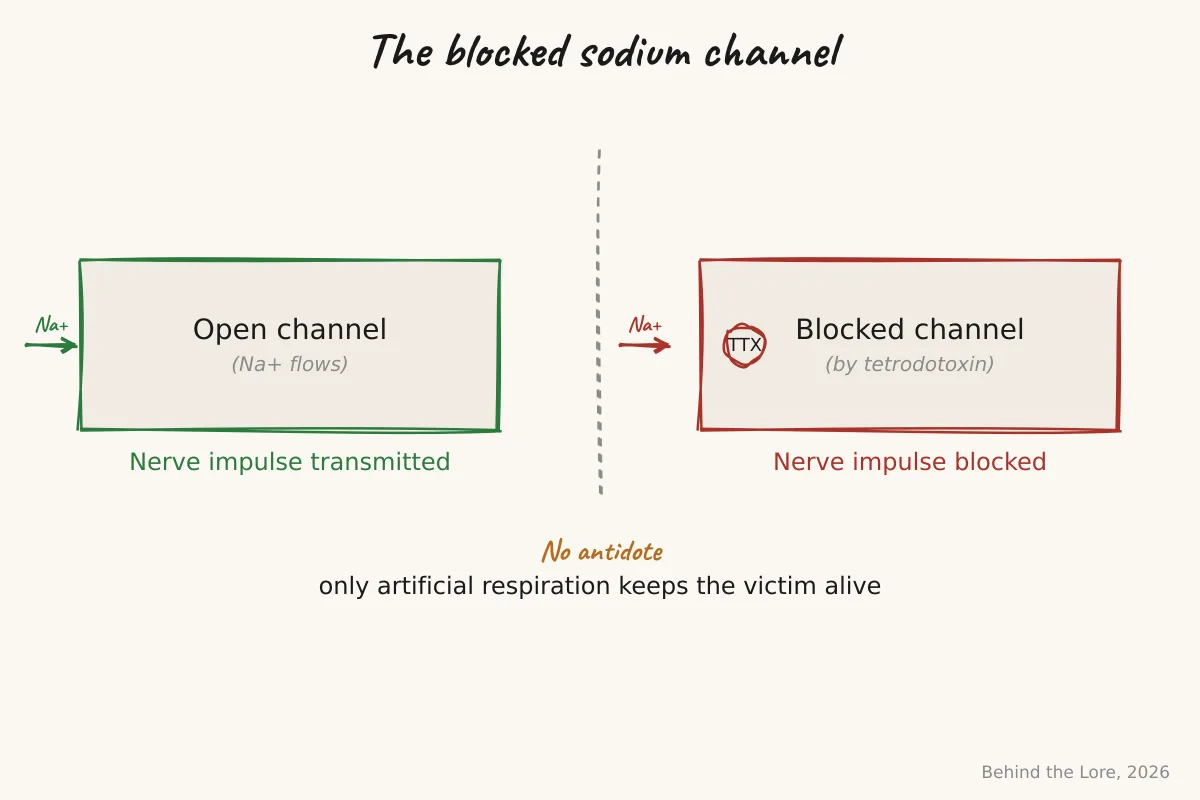
[Wikipedia] . Its mechanism is surgically precise: it binds to voltage-gated sodium channels, the tiny pores that let sodium ions into nerve and muscle cells. This influx of sodium is what triggers and propagates the nerve impulse. By plugging these channels, the toxin cuts communication: nerves stop transmitting, muscles stop contracting.
The clinical outcome is cruel. The first symptoms are tingling and numbness of the lips and tongue, followed by paralysis spreading to the limbs and trunk. The decisive point is that the victim stays lucid while their muscles stop responding, including the respiratory muscles. Death comes from asphyxiation, sometimes in under an hour. There is no antidote: the only effective treatment is artificial respiration, maintained until the body clears the toxin, after which full recovery is possible.
An often-overlooked detail: fugu does not manufacture its own poison. It accumulates it from its diet, via bacteria in the marine food chain. This is why toxicity varies from one individual to another depending on species, region, and season, exactly as Maomao points out, and why farm-raised fugu fed differently can turn out to be nearly harmless.
Going further
Sources
Published on
Keep investigating
Auto-suggested from shared concepts, disciplines, episodes, or characters.
Lead White Makeup
In The Apothecary Diaries, white makeup kills courtesans. We explain why this ceruse-based cosmetic caused deadly lead poisoning.
Datura
In The Apothecary Diaries, datura is used to induce sleep and feign death. We explain its alkaloids, its toxicity, and its role in the history of anesthesia.
Saxitoxin and Toxic Shellfish
In The Apothecary Diaries, unknown seaweed sends a bureaucrat into a coma. We explain saxitoxin, red tides, and why some shellfish can kill.
Food Allergy
In The Apothecary Diaries, a fish soup nearly kills. We explain IgE, histamine, anaphylaxis, and the risks of desensitization.
Sensory Detection of Poison
Maomao inspects the soup by sight and smell. We explain the food-taster method, how silver tarnishes, and why arsenic went undetected.