Saxitoxin: when shellfish turn poisonous
Story context (click to hide this block) (click to show this block)
This paragraph may contain plot information.
When a bureaucrat falls into a coma after a fish dinner, suspicion immediately falls on fugu. Maomao rules it out methodically: the fugu’s viscera were found intact in the trash, and the flesh is not known to be toxic for the species served at court. Searching the kitchens, she finds imported seaweed preserved in brine, harvested from a distant region unfamiliar to the local cooks. She immediately recognizes the risk: a foodstuff harmless where it comes from can be lethal elsewhere, and this stockpiled seaweed should never have ended up on a plate. It was the seaweed, not the fugu, that struck the man down.
The subject in depth
What the series describes without naming it corresponds to a real, well-documented mechanism: paralytic shellfish poisoning, known by the acronym PSP [Wikipedia] . The central toxin of this syndrome is saxitoxin, a small organic molecule produced not by the mollusks themselves, but by single-celled microalgae, mainly dinoflagellates like Alexandrium or certain cyanobacteria [Wikipedia] .
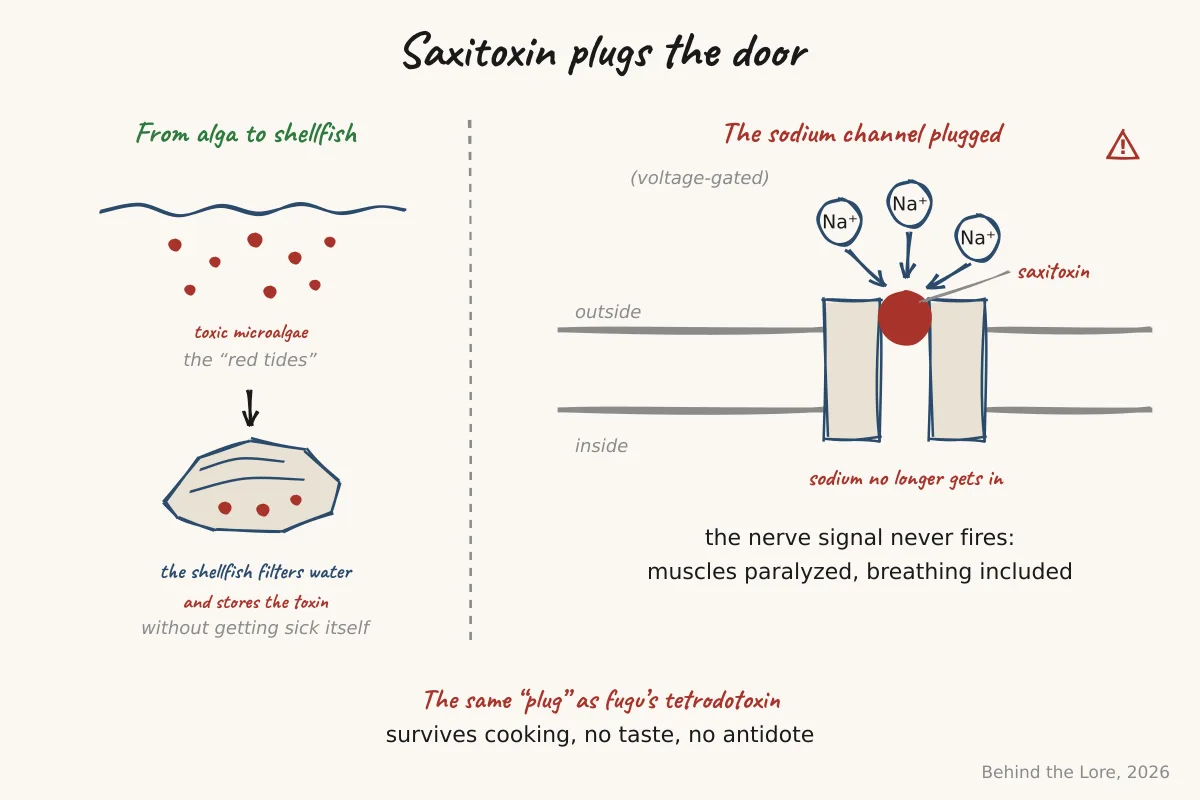
These microalgae occasionally proliferate in certain coastal waters, forming what are called algal blooms, sometimes referred to as red tides when cell density is high enough to color the water’s surface [Wikipedia] . During these events, bivalve mollusks such as mussels, clams, and oysters filter large volumes of water and accumulate saxitoxin in their tissues without being affected themselves: they are biologically adapted to this toxin, whose target in their nervous system differs from that in vertebrates.
Saxitoxin’s mechanism of action is the same as that of tetrodotoxin in fugu, which makes the comparison between the two substances especially illuminating. Both target voltage-gated sodium channels, the membrane proteins that let sodium into nerve and muscle cells to trigger an electrical signal [Wikipedia] . Saxitoxin lodges in the channel like a plug, blocks sodium entry, and prevents the signal from firing. The result: motor nerves stop transmitting commands to the muscles, which become immobilized. Breathing depends on muscles, and it is respiratory failure that kills in severe poisoning.
This mechanism should be clearly distinguished from that of aconitine, which acts in the opposite way, forcing sodium channels to stay open rather than blocking them. Saxitoxin and tetrodotoxin share the same target and the same large-scale effect (paralysis and coma) but they have no chemical relationship: one comes from a land plant, another from a marine bacterium associated with certain fish, the third from a microalga. Three different molecules, one shared vulnerability in our nervous system.
Saxitoxin’s particular danger in shellfish comes from two characteristics. First, the toxin is heat-stable: cooking does not destroy it, unlike most protein-based toxins. A contaminated shellfish remains toxic after boiling or grilling. Second, the toxin changes neither the taste nor the smell of the mollusk: nothing gives away its presence at the moment of eating. Together, these two properties make it a food risk that is particularly difficult to detect without laboratory analysis.
There is no antidote to saxitoxin. Managing a severe poisoning relies on artificial ventilation to sustain breathing while the toxin is cleared from the body, which can take several hours. Outcomes depend entirely on how quickly care is provided.
Going further
Sources
Published on
Keep investigating
Auto-suggested from shared concepts, disciplines, episodes, or characters.
Fugu and Tetrodotoxin
In The Apothecary Diaries, Maomao loves fugu and its poison. We explain tetrodotoxin, how it paralyzes, and why there's no antidote.
Aconite
In The Apothecary Diaries, aconite poisons even through honey. We explain aconitine, its action on nerves, and why it shows no mercy.
Mercury
In The Apothecary Diaries, quicksilver goes into a court poison. We explain mercury, its toxicity, and the immortality elixirs that killed emperors.
Fungal Bioluminescence
In The Apothecary Diaries, a glowing mushroom is mistaken for a chanterelle. We explain fungal bioluminescence and this dangerous mix-up.
Frog Skin
Frog skin is both a respiratory organ and a chemical arsenal. Protective mucus, bufotoxins, batrachotoxin, and chan su in traditional medicine.