Fungal Bioluminescence
Story context (click to hide this block) (click to show this block)
This paragraph may contain plot information.
During an evening of ghost stories, one tale describes a will-o’-the-wisp glimpsed at the edge of a forest by terrified villagers. Maomao, unimpressed, quickly identifies the source: a basket of mushrooms carried at night, whose diffuse glow was enough to fuel the legend. She names the culprit, the jack-o’-lantern mushroom, and explains that it is often confused with the chanterelle, a highly sought-after edible mushroom. Its luminescence, far from being a harmless quirk, signals severe toxicity. The scene closes on a clear-eyed conclusion: the will-o’-the-wisp superstition had no basis beyond a misidentified mushroom in the dark.
The subject in depth
Bioluminescence refers to the production of light by a living organism through a biochemical reaction [Wikipedia] . The general principle rests on the oxidation of a molecule called luciferin by an enzyme, luciferase. The energy released by this reaction is not dissipated as heat but emitted directly as visible photons: this is called cold light, which distinguishes bioluminescence from simple incandescence.
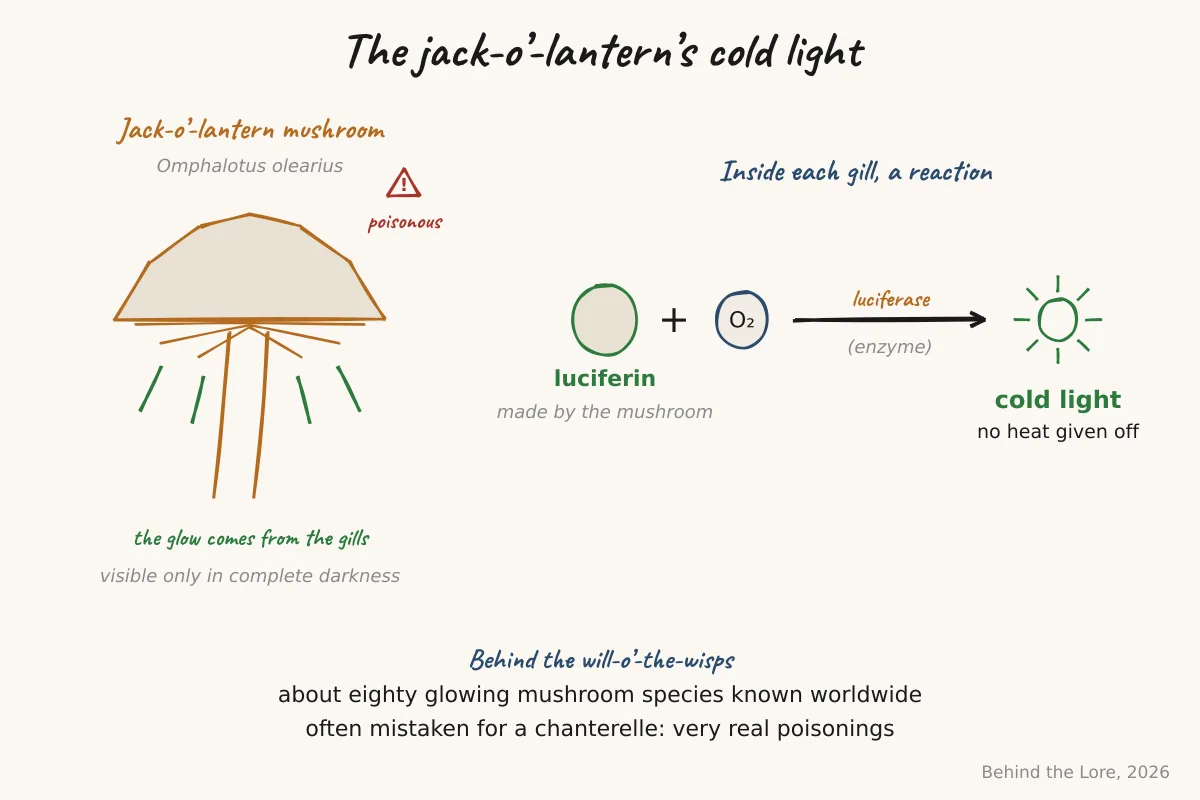
In fungi, the mechanism was long poorly understood. Recent research has shown that fungal luciferin is a derivative of hispidin, a phenolic compound distinct from the luciferins known in fireflies or jellyfish. About eighty species of fungi are now recognized as bioluminescent, found across the globe.
The jack-o’-lantern mushroom (Omphalotus olearius) is the best-documented European species [Wikipedia] . Its greenish-blue glow is emitted by the gills beneath the cap. It is only perceptible to the naked eye in complete darkness and on fresh specimens: in daylight or once dried, nothing gives away this trait. The mushroom grows at the base of olive trees, oaks, and other broadleaf trees, often in clusters, from late summer through autumn.
Confusion with the chanterelle (Cantharellus cibarius) causes nearly all poisonings from the jack-o’-lantern mushroom. The two mushrooms share misleading traits: an orange to tawny color, an irregular cap, a forest habitat, and an overlapping picking season. Yet they can clearly be told apart on close inspection. The chanterelle shows thick, forked, anastomosing ridges under the cap, whereas the jack-o’-lantern mushroom has true gills, narrow, crowded, and decurrent, a vivid yellow-orange [Web] . The smell also differs: pleasantly fruity for the chanterelle, sharp and strong for its lookalike.
The toxicity of the jack-o’-lantern mushroom comes from compounds called omphalotins, recently characterized cyclic peptides. Poisoning causes intense gastrointestinal symptoms: nausea, repeated vomiting, diarrhea, abdominal cramps. Symptoms begin thirty minutes to three hours after ingestion and persist for several hours, sometimes a full day. The outcome is rarely fatal for a healthy adult, but severe and painful. In individuals weakened by malnutrition or a pre-existing illness, tolerance is markedly lower.
Going further
Sources
Published on
Keep investigating
Auto-suggested from shared concepts, disciplines, episodes, or characters.
Fugu and Tetrodotoxin
In The Apothecary Diaries, Maomao loves fugu and its poison. We explain tetrodotoxin, how it paralyzes, and why there's no antidote.
Carbon Monoxide
In The Apothecary Diaries, embers bring guests down at a party. We explain carbon monoxide, why it suffocates without warning, and the right thing to do.
Aconite
In The Apothecary Diaries, aconite poisons even through honey. We explain aconitine, its action on nerves, and why it shows no mercy.
Saxitoxin and Toxic Shellfish
In The Apothecary Diaries, unknown seaweed sends a bureaucrat into a coma. We explain saxitoxin, red tides, and why some shellfish can kill.
Frog Skin
Frog skin is both a respiratory organ and a chemical arsenal. Protective mucus, bufotoxins, batrachotoxin, and chan su in traditional medicine.