Carbon Monoxide: the invisible killer
Story context (click to hide this block) (click to show this block)
This paragraph may contain plot information.
During an overheated reception, Maomao feels herself starting to nod off and notices that with so many people crowded together, there’s enough to make anyone suffocate. When several ladies faint, she doesn’t cry illness or bad omen: she orders them moved near the openings and explains that in a confined space, embers foul the air. In a few words, she diagnoses a poisoning and prescribes the right response, where others would have spoken of weakness or a curse.
The subject in depth
When a fuel burns, it combines with oxygen from the air. If oxygen is plentiful, combustion is complete and produces mostly carbon dioxide. But in an enclosed space, where the air doesn’t circulate well, oxygen runs short and combustion becomes incomplete: it then releases carbon monoxide [Wikipedia] . Embers in a closed room therefore combine two dangers at once: they deplete the air’s oxygen and load it with carbon monoxide.
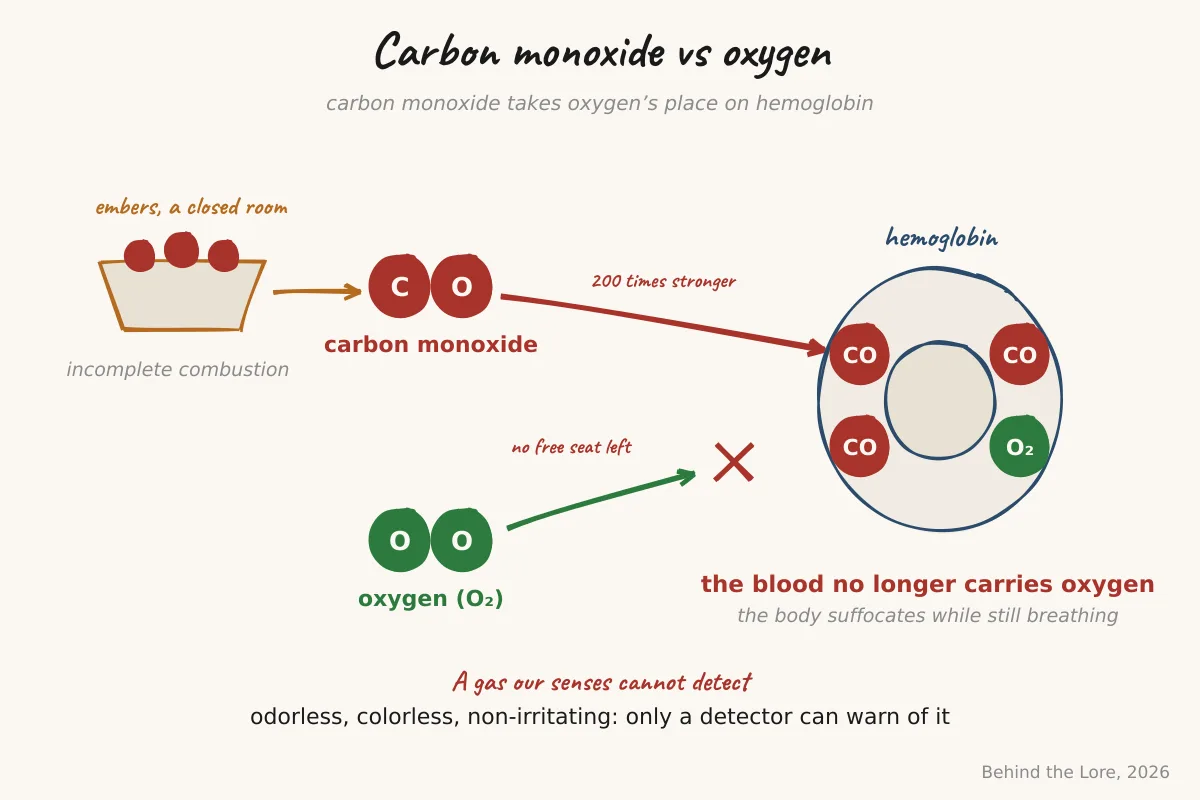
This gas is particularly insidious because it is completely odorless, colorless, and non-irritating: nothing warns of its presence. Its danger lies in a chemical affinity. Hemoglobin, the protein in red blood cells that carries oxygen, binds to carbon monoxide about two hundred times more strongly than to oxygen. As soon as there is even a little in the air, it takes oxygen’s place on hemoglobin, which can no longer supply the organs. The body suffocates from the inside, even while it keeps breathing.
The symptoms are all the more treacherous because they resemble ordinary fatigue: headaches, nausea, dizziness, drowsiness, then loss of consciousness and, if exposure continues, death. Many victims fall asleep without understanding what is happening to them. Maomao’s response is precisely right: faced with a collective faintness in a heated, closed room, opening up and evacuating into the open air is exactly the correct move, because fresh air lets oxygen gradually reclaim its place on hemoglobin.
Going further
Sources
Published on
Keep investigating
Auto-suggested from shared concepts, disciplines, episodes, or characters.
Dehydration and Rehydration
In The Apothecary Diaries, Maomao treats heatstroke with salted, sweetened water. We explain dehydration and why salt is vital.
Hypothermia
In The Apothecary Diaries, cold threatens lives. We explain hypothermia, why cold-water immersion is so dangerous, and how to rewarm safely.
Activated Charcoal
In The Apothecary Diaries, Maomao gives activated charcoal in an emergency. Why does it work? How does adsorption trap toxins? Its real limits.
Antiseptic Alcohol
In The Apothecary Diaries, a distilled alcohol is called a highly effective disinfectant. We explain why ethanol kills germs, and at what concentration.
Fungal Bioluminescence
In The Apothecary Diaries, a glowing mushroom is mistaken for a chanterelle. We explain fungal bioluminescence and this dangerous mix-up.