Activated Charcoal: An Antidote by Adsorption
Story context (click to hide this block) (click to show this block)
This paragraph may contain plot information.
When Maomao reaches the two unconscious victims, her first instinct is sharp: no water, charcoal. She instinctively rules out the insufficient emesis already attempted and immediately calls for activated charcoal. Once she has it, she mixes it with simples and has both patients swallow it. The rest of the episode reveals the poisoning was from nicotine extracted by maceration in alcohol: the quickly administered charcoal was the right move, and so was refusing water, since water would have altered gastric acidity and promoted absorption of the poison.
The subject in depth
Activated plant charcoal is not the ordinary black ash of a wood fire. It is obtained by carbonizing organic material, usually wood, coconut shell, or bamboo, then subjecting it to activation: either thermal, by injecting steam at very high temperature, or chemical, by treatment with phosphoric acid or zinc chloride. This process opens and widens a network of micropores inside each grain [Wikipedia] .
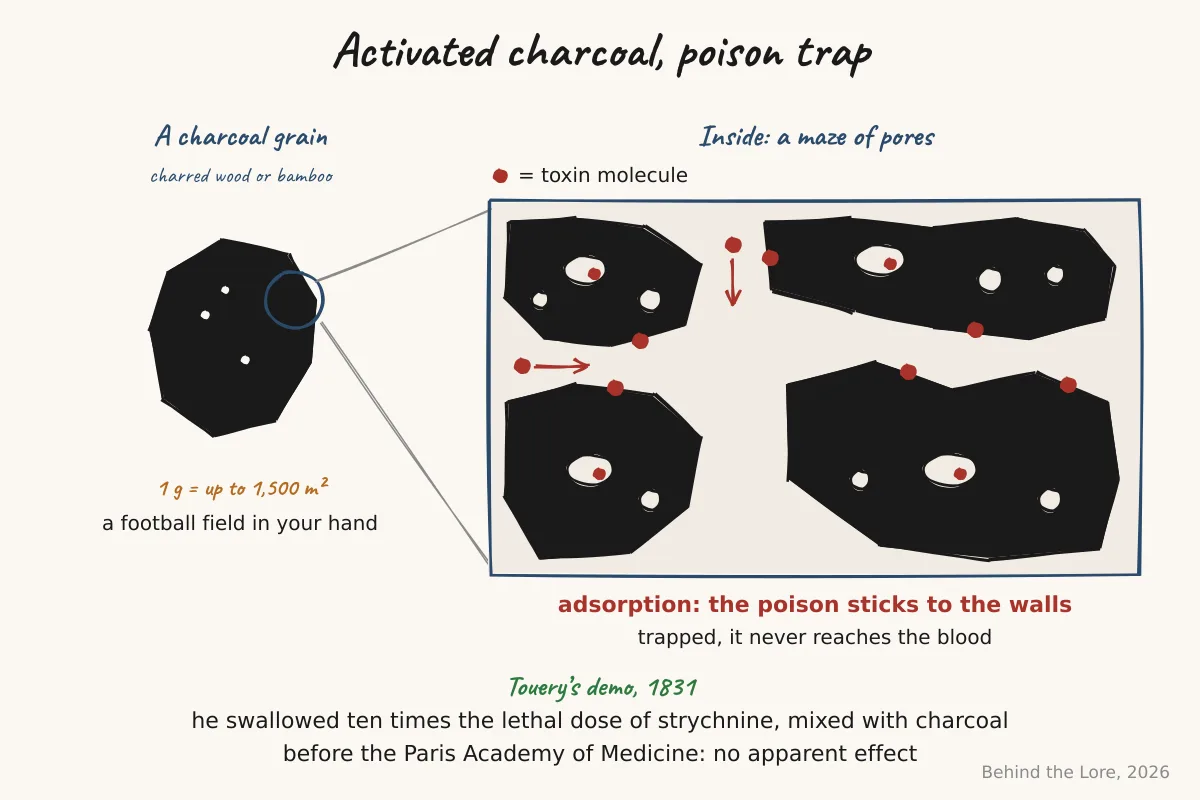
The result is a structure whose internal surface area can reach 500 to 1,500 square meters per gram, the equivalent of a football field in the palm of your hand. This surface area is what makes all the difference in toxicology.
Adsorption, not absorption. Adsorption (with a “d”) is a surface phenomenon: toxin molecules attach to the pore walls through weak van der Waals forces and electrostatic interactions, without any chemical reaction. They are immobilized, unable to cross the intestinal lining and reach the bloodstream. Absorption (without a “d”), by contrast, refers to a substance passing through a biological membrane into the blood, exactly what charcoal prevents for the molecules it captures.
In clinical practice, activated charcoal is given orally, suspended in water, at a dose of 1 g/kg of body weight in adults, within the first hour after ingesting the toxin. Past that window, part of the poison has already been absorbed, and charcoal can no longer pull it back out: it only captures what remains in the digestive tract, not what is already circulating in the blood.
Charcoal is particularly effective against alkaloids like nicotine, organic-based drugs (aspirin, paracetamol, antidepressants, beta-blockers), many organic pesticides, and most toxic plants. Its limits are just as important: it does not adsorb heavy metals (lead, mercury, arsenic), simple alcohols (ethanol, methanol), strong acids and bases, lithium, or cyanides. In those cases, other specific antidotes are needed.
Going further
- Nicotine and Tobacco
- Aconite and the Absence of a Specific Antidote
- Discipline: Pharmacology
- Discipline: Medicine
- Discipline: Chemistry
Sources
Published on
Keep investigating
Auto-suggested from shared concepts, disciplines, episodes, or characters.
Nicotine and Tobacco
In The Apothecary Diaries, macerated tobacco serves as a poison. We explain nicotine, its acute toxicity, and why diluting a poison can make it worse.
Orpiment and Arsenic
In The Apothecary Diaries, a yellow pigment poisons slowly. We explain orpiment, arsenic, and the chronic poisoning of court painters.
Aconite
In The Apothecary Diaries, aconite poisons even through honey. We explain aconitine, its action on nerves, and why it shows no mercy.
Induced Vomiting
Making someone vomit to clear a poison: an old intuition that modern medicine has largely abandoned. Risks, contraindications, the history of ipecac.
Senku's Soap
Senku makes soap in Dr Stone: we explain the chemistry of saponification, its ingredients, its history, and how to reproduce it at home.