Induced Vomiting: A Discarded Reflex
Story context (click to hide this block) (click to show this block)
This paragraph may contain plot information.
When Maomao reaches the two unconscious victims, she reports that she started by making them vomit, but that the emesis was insufficient. She doesn’t dwell on it and moves straight to activated charcoal. This quick shift from induced vomiting to the adsorbent is, in its own way, clinically sound: Maomao judges that the first measure wasn’t enough and that she needs to move on. The scene doesn’t call the principle of emesis into question, but it does show that it isn’t a solution in itself.
The subject in depth
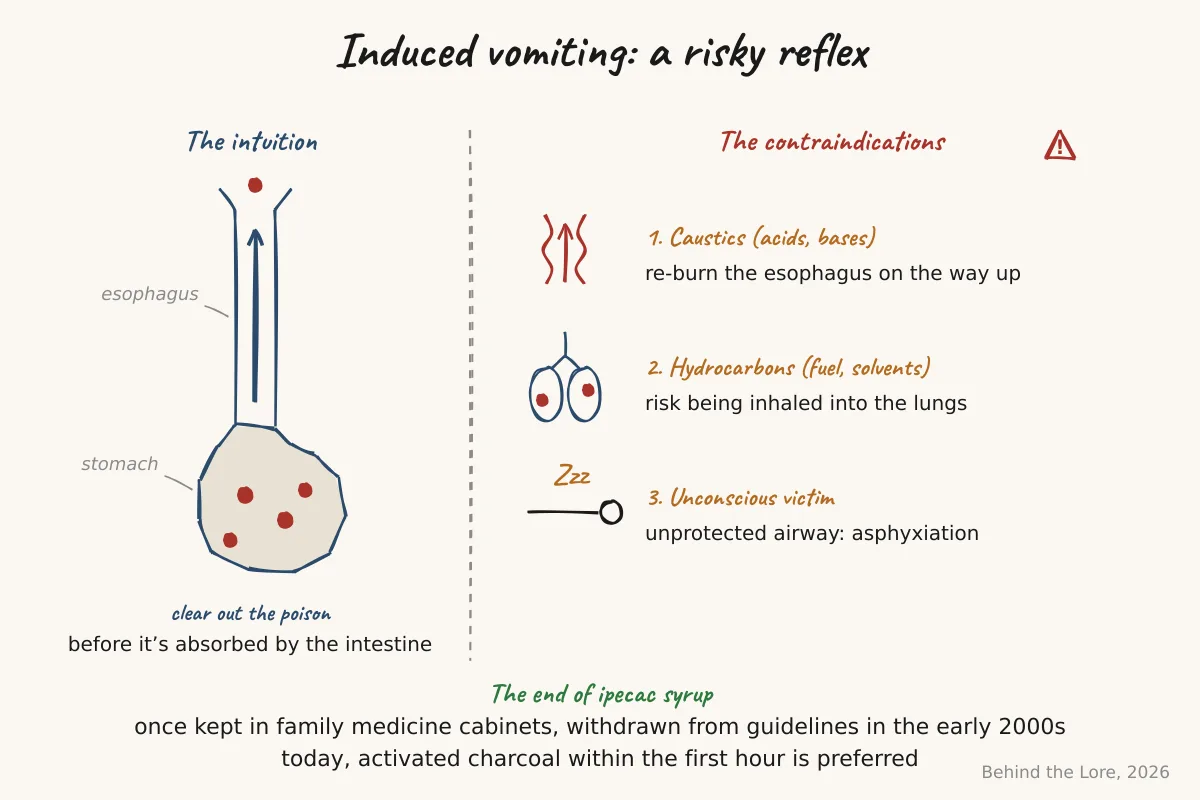
The idea of making someone vomit right after they’ve ingested poison is intuitively logical: evacuate the substance before it’s absorbed by the intestine. This reasoning dominated emergency medicine for centuries [Wikipedia] .
Historically used emetics are numerous. Copper sulfate, tartar emetic (potassium antimony tartrate), ipecac, and, more simply, inserting a finger or an object to the back of the throat to trigger the gag reflex through mechanical stimulation of the soft palate. This so-called mechanical method is instantaneous, requires no chemical substance, and likely corresponds to what Maomao does first on the victims [Wikipedia] .
The problem lies in the physiopathology of vomiting itself. The cardia opens and the stomach contents rise under strong pressure toward the esophagus, pharynx, and mouth. This reverse trajectory is not without consequences.
Three families of contraindications make induced vomiting dangerous, even deadly.
The first concerns caustic substances: strong acids, strong bases, concentrated bleach. These products burn the mucous membranes on the way down; bringing them back up re-burns the same tissue on the reverse path, worsening the damage to the esophagus and mouth and increasing the risk of perforation.
The second concerns hydrocarbons: gasoline, petroleum, solvents. These low-viscosity liquids have a strong tendency to enter the airway during vomiting. Aspiration pneumonia can set in within hours, far more serious than the original digestive poisoning.
The third concerns the victim’s neurological state. If they show impaired consciousness, marked drowsiness, or seizures, their airway protection reflex is compromised. Vomiting in this state amounts to flooding the lungs with vomit, which can kill faster than the poison itself. The episode’s two victims are precisely in this state: unconscious or heavily obtunded, which is why Maomao quickly abandons emesis.
A fourth practical limitation applies as well: the effectiveness of emesis drops rapidly over time. Beyond 30 to 60 minutes after ingestion, much of the poison has already migrated to the small intestine and is no longer reachable by vomiting.
Going further
Sources
Published on
Keep investigating
Auto-suggested from shared concepts, disciplines, episodes, or characters.
Nicotine and Tobacco
In The Apothecary Diaries, macerated tobacco serves as a poison. We explain nicotine, its acute toxicity, and why diluting a poison can make it worse.
Aconite
In The Apothecary Diaries, aconite poisons even through honey. We explain aconitine, its action on nerves, and why it shows no mercy.
Orpiment and Arsenic
In The Apothecary Diaries, a yellow pigment poisons slowly. We explain orpiment, arsenic, and the chronic poisoning of court painters.
Activated Charcoal
In The Apothecary Diaries, Maomao gives activated charcoal in an emergency. Why does it work? How does adsorption trap toxins? Its real limits.
Fugu and Tetrodotoxin
In The Apothecary Diaries, Maomao loves fugu and its poison. We explain tetrodotoxin, how it paralyzes, and why there's no antidote.