Nicotine: tobacco's poison
Story context (click to hide this block) (click to show this block)
This paragraph may contain plot information.
Investigating a suspicious death staged as a lovers’ suicide, Maomao turns her attention to tobacco leaves, which she judges ideal for making a discreet poison. One technical detail stops her: she’s reminded that gastric juices limit the poison’s absorption, and that it would have needed to be diluted in water to become truly effective. She then reconstructs the crime’s preparation, tobacco left to macerate in alcohol to extract its active principle.
The subject in depth
Tobacco is a plant of the genus Nicotiana, in the same large family as datura and the potato, the nightshades [Wikipedia] . Its active molecule, nicotine, is an alkaloid found mainly in the leaves. In small doses, it’s the substance that makes tobacco addictive; in large doses, it’s a formidable poison, one of the most toxic in the plant kingdom relative to its weight.
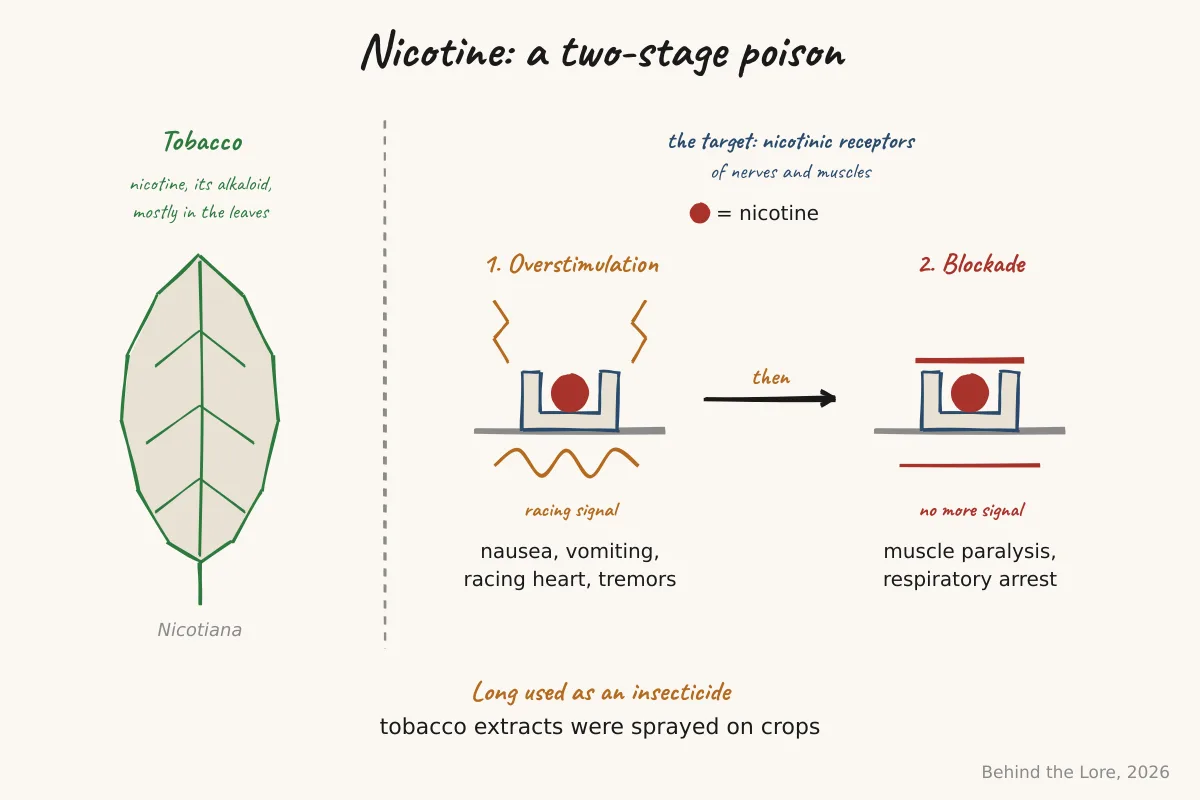
Nicotine acts on targets called nicotinic acetylcholine receptors, present in the nervous system and at the junction between nerves and muscles [Wikipedia] . At toxic doses, the effect unfolds in two stages: first an intense stimulation of these receptors, with nausea, vomiting, salivation, a racing heart, and tremors, then a blockade, which produces muscular paralysis. As with other paralyzing poisons, it’s the failure of the breathing muscles that kills. The course can be very fast, because nicotine passes quickly into the blood.
The most refined point in the episode is the remark about dilution. It seems counterintuitive: how could diluting a poison make it more dangerous? The explanation lies in nicotine’s chemistry: it’s a base. Concentrated and acidic, it is poorly absorbed by the stomach, whose environment is itself highly acidic. Diluted in a large volume of water, it is swallowed in greater volume, passes further down the digestive tract, and is absorbed more thoroughly. The amount of poison doesn’t change, but the fraction actually absorbed by the body does increase. Jinshi’s reasoning is therefore pharmacologically sound: it isn’t the dose ingested alone that matters, but the dose that actually reaches the bloodstream.
Going further
Sources
Published on
Keep investigating
Auto-suggested from shared concepts, disciplines, episodes, or characters.
Datura
In The Apothecary Diaries, datura is used to induce sleep and feign death. We explain its alkaloids, its toxicity, and its role in the history of anesthesia.
Aconite
In The Apothecary Diaries, aconite poisons even through honey. We explain aconitine, its action on nerves, and why it shows no mercy.
Activated Charcoal
In The Apothecary Diaries, Maomao gives activated charcoal in an emergency. Why does it work? How does adsorption trap toxins? Its real limits.
Induced Vomiting
Making someone vomit to clear a poison: an old intuition that modern medicine has largely abandoned. Risks, contraindications, the history of ipecac.
Rhododendron and Mad Honey
In The Apothecary Diaries, a tainted honey and a burned plant cause poisoning. We explain rhododendron's grayanotoxins and the famous mad honey.