Senku's soap: the chemistry of saponification
In Dr Stone
Soap is one of Senku’s very first creations: early in the series, he lists it among the uses of the calcium carbonate he gets from seashells (along with fertilizer and mortar), back when he is surviving alongside Taiju, one of the demonstrations that reveal his scientific potential to Tsukasa. Later, in Kohaku’s village, that soap resurfaces in the bubble scene that leaves Kinro and Ginro dumbfounded: Senku’s “sorcery” is just chemistry, wood ash and animal fat, a process humanity has known for millennia.
The subject in depth
Triglycerides (fats) react with a strong base, typically sodium hydroxide (NaOH) or potassium hydroxide (KOH), extractable from wood ash, to yield a fatty-acid salt (the soap proper) and glycerol. The soap molecule is amphiphilic: its polar head loves water, its carbon tail loves fats. That is what allows it to “dissolve” greasy dirt into water.
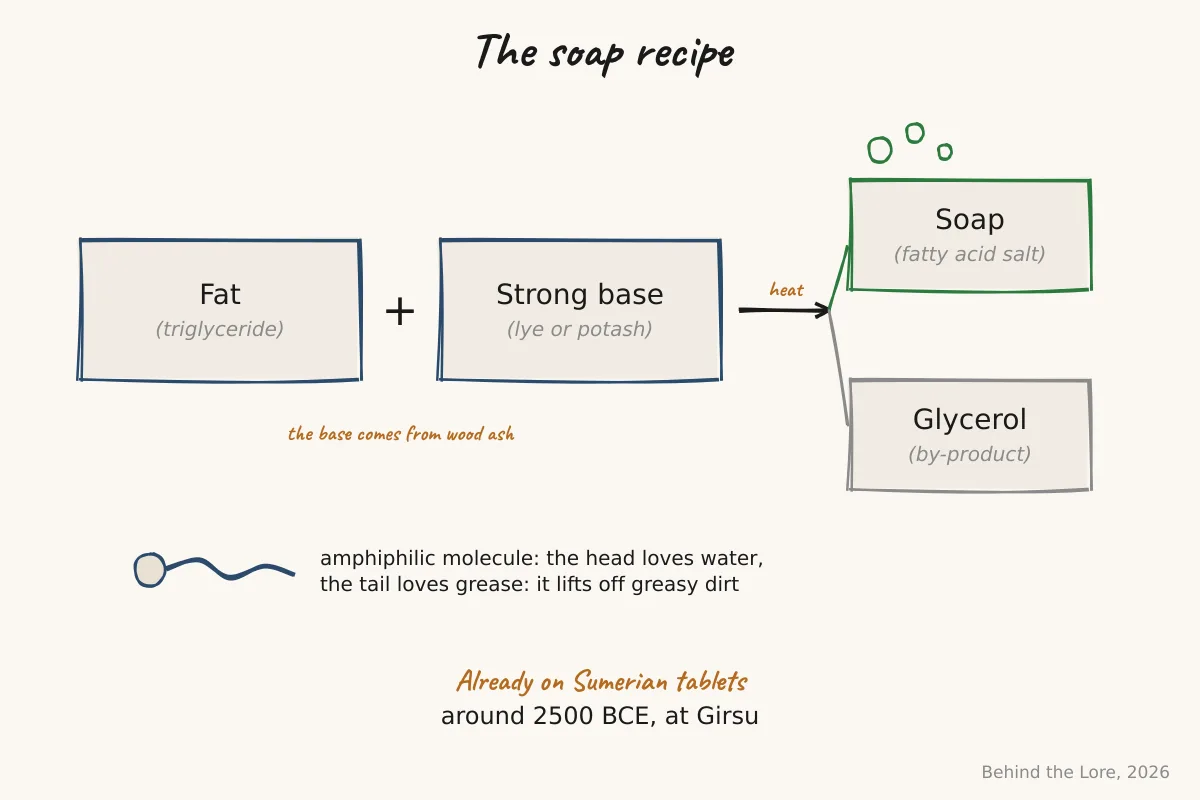
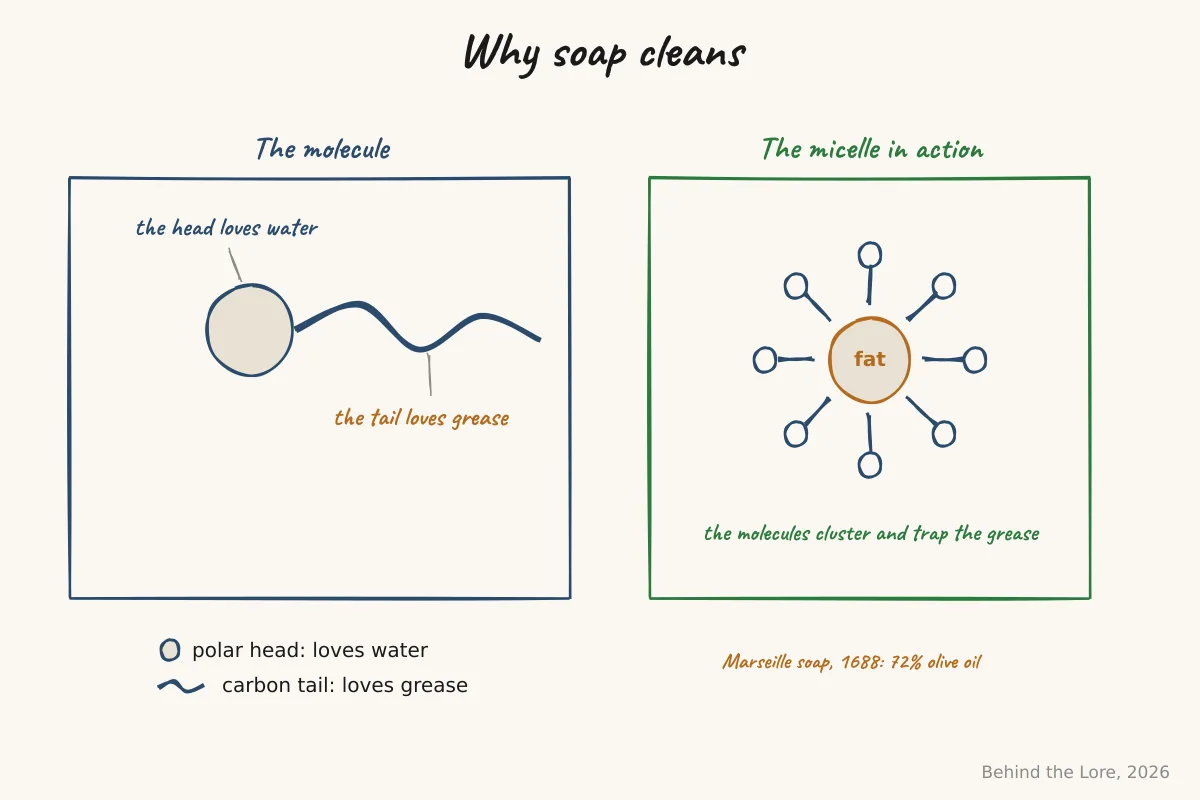
Deeper into the mechanism: the nucleophilic attack of the hydroxide ion on the carbonyl ester carbon releases glycerol and forms the carboxylate anion, which pairs with the cation to form the salt, the soap. Soft soaps (potash-based) stay pasty at room temperature; hard soaps (lye) solidify. Above a certain concentration (the critical micelle concentration, CMC), molecules aggregate into micelles that trap oils inside.
Going further
- Saponification, cross-cutting concept entry
- Discipline: Chemistry, all chemistry entries on the site
Published on
Updated on
Going further
Auto-suggested from shared concepts, disciplines, episodes, or characters.
Activated Charcoal
In The Apothecary Diaries, Maomao gives activated charcoal in an emergency. Why does it work? How does adsorption trap toxins? Its real limits.
Wine
Senku makes wine in Dr Stone S1E1: we explain alcoholic fermentation, wild yeasts, the natural 16% limit, and how to reproduce it at home.
Acetanilide
Senku makes acetanilide in Dr Stone. We explain this historical painkiller and fever reducer, an ancestor of paracetamol, and why it was abandoned.
Black Powder
Senku makes gunpowder in Dr Stone. We explain its composition (saltpeter, charcoal, sulfur), the chemical reaction, and its history.
Brandy
Senku turns his wine into brandy by distillation: we explain medieval eau-de-vie, alchemical aqua vitae, and how you get to 40-proof spirit.