Antiseptic alcohol: why it disinfects
Story context (click to hide this block) (click to show this block)
This paragraph may contain plot information.
Early in the episode, Maomao draws on the alcohol supply set aside for the medical pavilion, a sign that the substance is already part of the ordinary care arsenal. Shenryu goes further, offering Maomao a flask he describes as highly effective distilled alcohol for disinfecting. The mention of distillation is not incidental: it implies a concentration reached through a deliberate technical process, unlike a simple wine or an alcoholic infusion. Later, Maomao even considers using this alcohol as a reactive agent to extract herself from a difficult situation, a reminder that a flammable, high-proof solution can serve purposes beyond medicine.
The subject in depth
Ethyl alcohol, or ethanol, has been recognized as an antiseptic since Antiquity, even though its molecular mechanism was only understood much later [Wikipedia] . It acts on microorganisms through two complementary pathways.
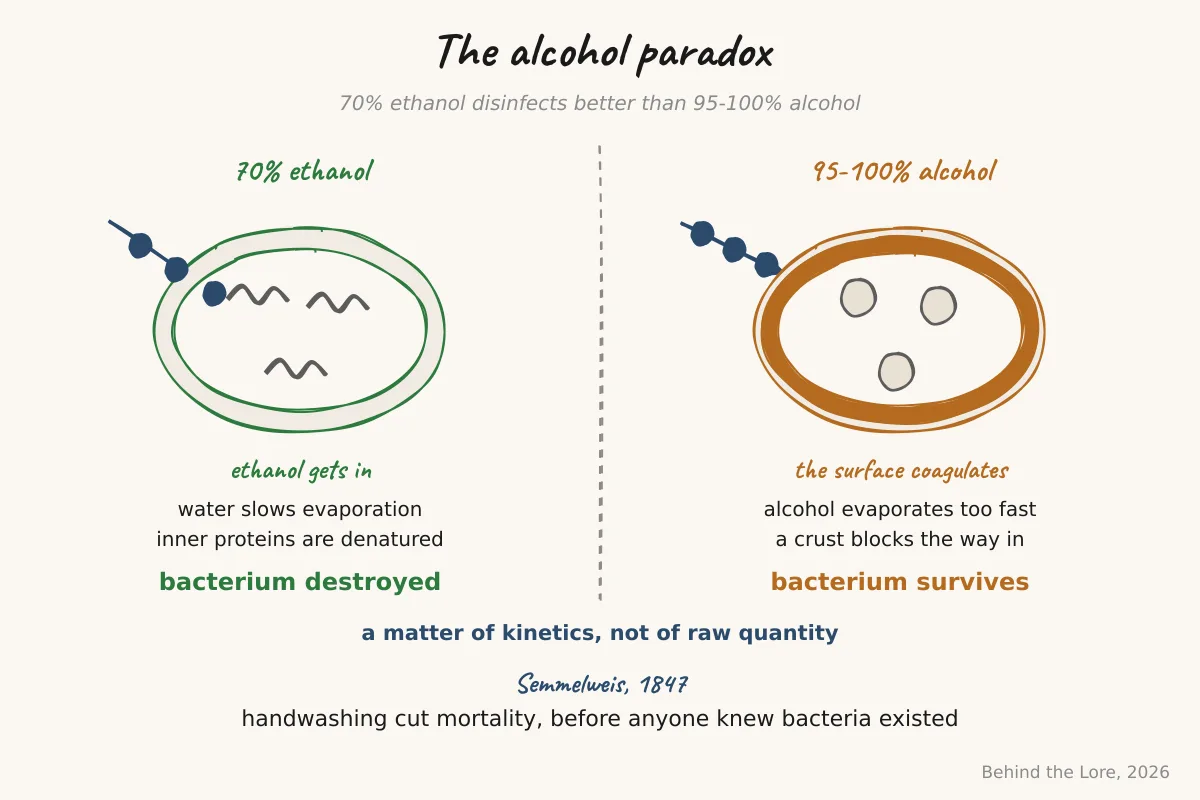
The first is protein denaturation. Ethanol disrupts the hydrogen bonds and hydrophobic interactions that hold bacterial proteins in their three-dimensional shape. These proteins lose their shape and therefore their function, halting the vital processes of the bacterium or virus. The second pathway is the dissolution of lipid membranes: ethanol disorganizes the phospholipid bilayer that envelops the bacterial cell, or the envelope of so-called enveloped viruses, making them permeable until they lyse [Wikipedia] .
A concentration of 70% by volume (70% v/v) is the most effective, and this is a counter-intuitive result: one might expect a more concentrated alcohol to be more powerful. But a 95-100% ethanol instantly coagulates the proteins on the bacterium’s outer wall, forming a sort of protective crust that keeps the alcohol from penetrating inside. At 70%, the presence of water slows evaporation, giving the ethanol time to cross that surface and reach the cytoplasm. It’s a matter of kinetics, not of raw quantity of active ingredient.
Antiseptic alcohol has significant limits. It is inactive against bacterial spores, the dormant resistant forms that certain bacteria (such as Clostridium) form under unfavorable conditions. Spores have a thick, impermeable wall that resists alcoholic denaturation. Likewise, non-enveloped viruses (such as noroviruses) are less sensitive than enveloped viruses. Alcohol also doesn’t clean surfaces soiled with organic matter, which mechanically shields microorganisms: a prior wash with water and soap is then necessary.
Going further
Sources
Published on
Keep investigating
Auto-suggested from shared concepts, disciplines, episodes, or characters.
Dehydration and Rehydration
In The Apothecary Diaries, Maomao treats heatstroke with salted, sweetened water. We explain dehydration and why salt is vital.
Mercury
In The Apothecary Diaries, quicksilver goes into a court poison. We explain mercury, its toxicity, and the immortality elixirs that killed emperors.
Aconite
In The Apothecary Diaries, aconite poisons even through honey. We explain aconitine, its action on nerves, and why it shows no mercy.
Drinking Water and Waterborne Diseases
Why does boiling water make it safe to drink? Cholera, dysentery, typhoid: we explain waterborne diseases and the story of John Snow.
Activated Charcoal
In The Apothecary Diaries, Maomao gives activated charcoal in an emergency. Why does it work? How does adsorption trap toxins? Its real limits.