Boiled Water and Waterborne Diseases
Story context (click to hide this block) (click to show this block)
This paragraph may contain plot information.
Treating a maidservant who has been feverish and exhausted for two weeks, Maomao immediately asks for water and specifies that it must be boiled. She then has the patient drink it in small sips. The gesture serves a double purpose: decontamination and rehydration. The scene lasts less than thirty seconds, yet it condenses two thousand years of preventive medicine into a single instruction.
The subject in depth
Natural water is not sterile. Rivers, wells, and springs can harbor bacteria, viruses, protozoa, and parasites originating from human or animal waste, decomposing carcasses, or contaminated soil. These microorganisms do not change the taste or appearance of water, which is exactly why contaminated water can kill without anyone suspecting a thing.
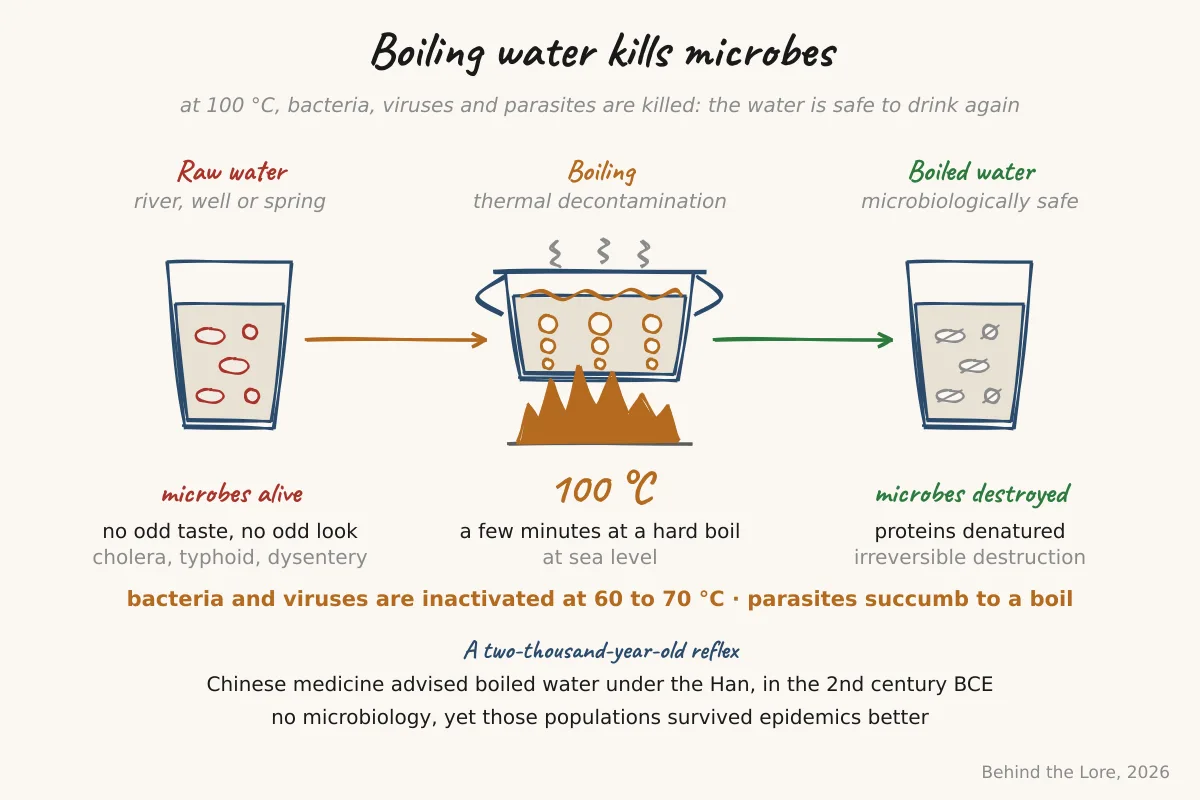
Heating water to a boil (100 °C at sea level) kills nearly all of the pathogens involved
[Wikipedia] . Bacteria such as Vibrio cholerae (cholera), Salmonella typhi (typhoid), or Shigella (bacterial dysentery) are inactivated within minutes at 60 to 70 °C. Enteric viruses are destroyed in the same temperature range. Most protozoan cysts (amoebas, Giardia) are somewhat more resistant but still succumb to a full rolling boil. After a few minutes at a hard boil, water becomes microbiologically safe to drink again.
The mechanism is thermal: heat denatures the microorganisms’ proteins, disrupts their membranes, and destroys their nucleic acids. Without these functional structures, they can no longer reproduce or infect a host. The decontamination is irreversible.
Diseases spread by water
Waterborne diseases are among the deadliest in history [Wikipedia] . A few representative examples:
- Cholera is caused by Vibrio cholerae, a bacterium that colonizes the small intestine and triggers massive watery diarrhea. The resulting dehydration can kill within hours. Seven global pandemics have been documented since the 19th century.
- Typhoid is caused by Salmonella typhi, transmitted through water or food contaminated with fecal matter. It causes prolonged high fever and deep exhaustion, and, left untreated, can lead to intestinal perforation.
- Dysentery (amoebic or bacillary, depending on the agent) causes bloody diarrhea. The amoebic form (Entamoeba histolytica) can migrate to the liver and cause abscesses.
John Snow and the Broad Street pump
The proof that contaminated water spreads disease is fairly recent on the scale of history. In 1854, during a cholera outbreak in London, physician John Snow mapped the deaths street by street. He noticed that nearly all the victims drew water from the same public pump, on Broad Street. He convinced the authorities to remove the pump handle: the outbreak stopped.
Snow did not yet know about Vibrio cholerae, which Robert Koch would isolate in 1883. He had no microscope. But his epidemiological reasoning, linking a water source to a cluster of disease cases, laid the foundation of what we now call field epidemiology. The experimental evidence won out over the dominant theory of the time, the miasma theory, which held that disease spread through foul air rather than through water.
Going further
Sources
Published on
Keep investigating
Auto-suggested from shared concepts, disciplines, episodes, or characters.
Dehydration and Rehydration
In The Apothecary Diaries, Maomao treats heatstroke with salted, sweetened water. We explain dehydration and why salt is vital.
Carbon Monoxide
In The Apothecary Diaries, embers bring guests down at a party. We explain carbon monoxide, why it suffocates without warning, and the right thing to do.
Quarantine and Isolation
In The Apothecary Diaries, a contagious patient is isolated. The history of quarantine, fomites, and isolation long before germs were understood.
Miasma Theory
In The Apothecary Diaries, incense is burned to ward off illness. We explain miasma theory, its kernel of truth, and how Pasteur overturned it.
Antiseptic Alcohol
In The Apothecary Diaries, a distilled alcohol is called a highly effective disinfectant. We explain why ethanol kills germs, and at what concentration.