Miasma Theory
Story context (click to hide this block) (click to show this block)
This paragraph may contain plot information.
When Maomao learns that the sick servant’s room reeked of incense, she immediately grasps the logic behind the act: someone burned incense to mask the smell of the illness, convinced that the smell itself was the cause or the vector. For Maomao, it’s as much a diagnostic clue as a window onto the medical beliefs of her time. She doesn’t comment on whether they’re correct, but the scene alone raises the question: does incense actually cure anything?
The subject in depth
Miasma theory is one of the oldest and most enduring in the history of medicine
[Wikipedia] . It starts from an empirical observation: severe diseases like malaria, cholera, and plague seem more frequent near swamps, sewers, pits, and decomposing corpses. The conclusion that seemed to follow was that the air itself, laden with these foul emanations, carried the disease. The Greek word “miasma” literally means defilement or pollution.
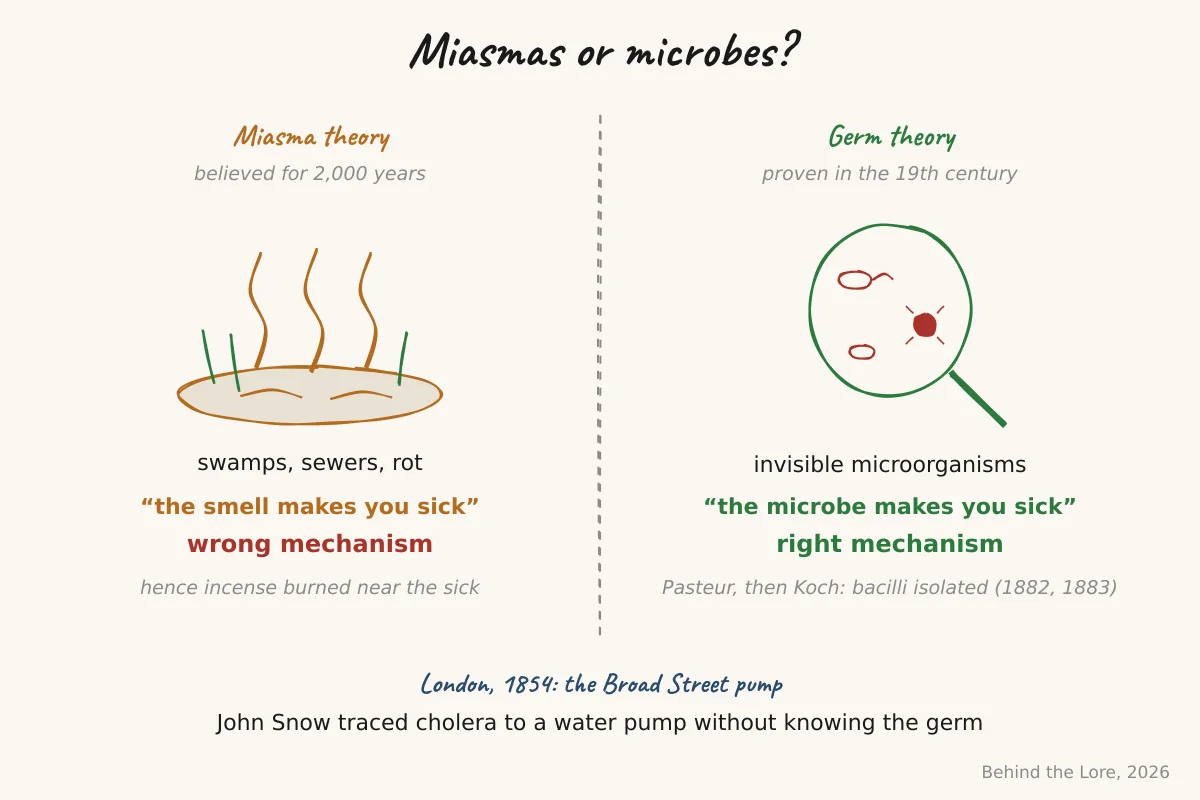
This idea appears in Hippocrates (fifth century BCE) and runs through all of Western and Arab medicine in the Middle Ages. It isn’t unique to Europe: similar notions appear in traditional Chinese medicine, where certain ailments were attributed to “bad qi” or harmful emanations from the earth. Treatment therefore consisted of fleeing pestilential places, ventilating spaces, and neutralizing odors with olfactory counterpoints: incense, burnt herbs, vinegar, aromatic flowers.
Incense in particular served a double function. Practically, its thick smoke covered the smell of the sick and of decomposing bodies. Symbolically, in many traditions rising smoke purified a space of its visible and invisible defilements. These two dimensions reinforced each other, which explains why the practice persisted for centuries.
The break came in the nineteenth century, thanks to several converging advances
[Wikipedia] . Louis Pasteur demonstrated that fermentation and putrefaction are caused by living microorganisms, not by the spontaneous degradation of matter. Robert Koch isolated specific bacteria for specific diseases: the tuberculosis bacillus in 1882, the cholera bacterium in 1883. Germ theory, or the microbial theory of disease, then definitively replaced miasma theory: it isn’t smells that kill, but microscopic pathogens that those smells can accompany without being their cause.
Going further
Sources
Published on
Keep investigating
Auto-suggested from shared concepts, disciplines, episodes, or characters.
Carbon Monoxide
In The Apothecary Diaries, embers bring guests down at a party. We explain carbon monoxide, why it suffocates without warning, and the right thing to do.
Mercury
In The Apothecary Diaries, quicksilver goes into a court poison. We explain mercury, its toxicity, and the immortality elixirs that killed emperors.
Quarantine and Isolation
In The Apothecary Diaries, a contagious patient is isolated. The history of quarantine, fomites, and isolation long before germs were understood.
Drinking Water and Waterborne Diseases
Why does boiling water make it safe to drink? Cholera, dysentery, typhoid: we explain waterborne diseases and the story of John Snow.
Autopsy and Forensic Medicine
In The Apothecary Diaries, a body is examined. We explain autopsy, post-mortem signs, and the birth of forensic medicine.