Quarantine and isolation: breaking contagion
Story context (click to hide this block) (click to show this block)
This paragraph may contain plot information.
When Maomao arrives at the Crystal Pavilion to treat a servant who has been coughing for two weeks, she quickly reaches a diagnosis of contagion. She states the principle with a clinical precision unusual for a servant girl: the patient must be isolated to avoid any risk of contamination; even if the risk is low, she remains contagious. The story stresses that the servant had not received this care because she was seen as unimportant. Maomao corrects that with the same logic she applies to any problem: observe the facts, reason it through, act.
The subject in depth
Isolating a sick person rests on a simple idea: if the patient cannot transmit the pathogen to others, the epidemic dies out for lack of new hosts. This principle predates the discovery of bacteria and viruses by several centuries. Hebrew texts (Leviticus) and ancient Chinese sources already recommend keeping lepers or plague victims away from the community, not from knowledge of the responsible germ, but from repeated observation: staying near a sick person increases one’s own chances of becoming sick [Wikipedia] .
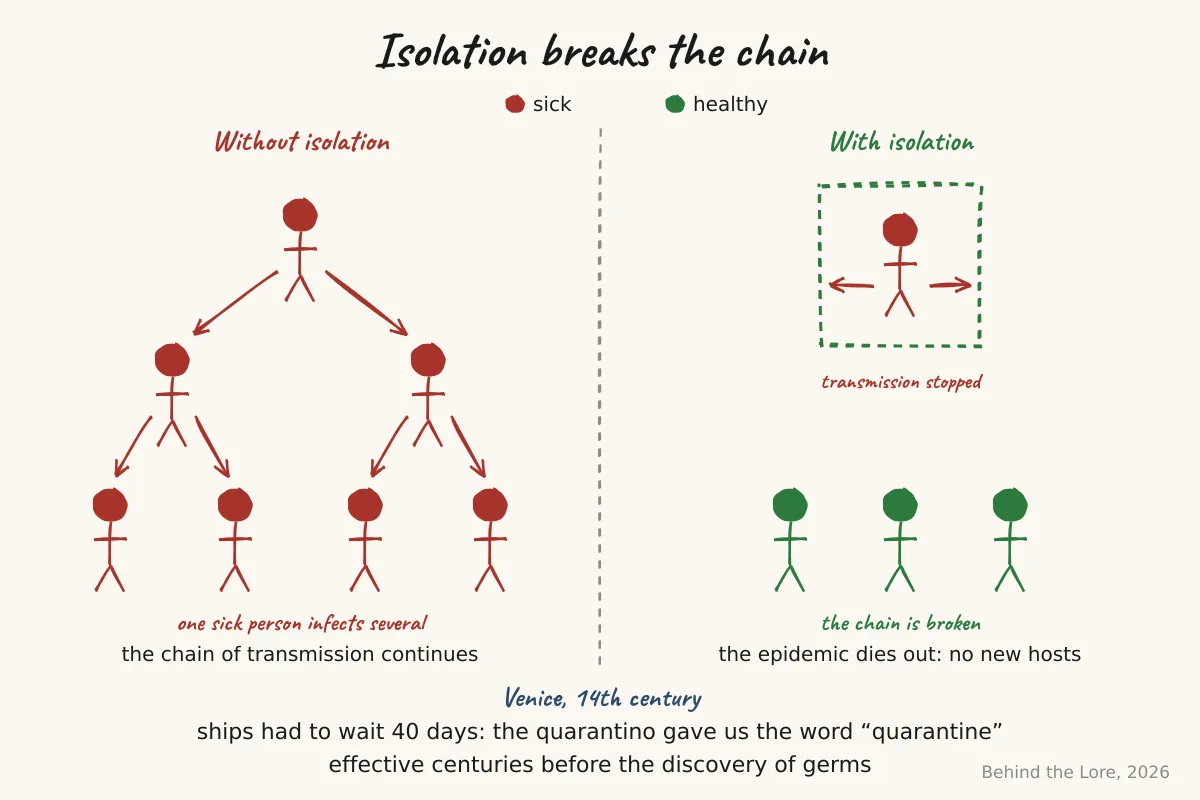
The word “quarantine” comes directly from this empirical practice. In 1377, the Republic of Ragusa (present-day Dubrovnik) imposed on travelers coming from plague-affected regions a thirty-day waiting period, the trentino. Venice extended this to forty days, the quarantino, giving the word its modern form. The reasoning was not microbiological: Venetian authorities knew nothing about bacteria. But they observed that a person who appeared healthy on arrival could fall ill days later and infect the city. Forty days allowed the disease to show itself if it was present, or allowed officials to conclude the person was not carrying it.
The concept of fomites completes this logic. The word, borrowed from Latin (fomes, “tinder”), refers to any inanimate object capable of carrying and transmitting an infectious agent: clothing, bedding, dishes, doorknobs. A cloth that has been in contact with a sick person can retain viable pathogens for hours or even days, depending on the species involved. This idea, formulated as early as the 16th century by the Veronese physician Girolamo Fracastoro in his treatise on contagion, predates the microbiology of Pasteur and Koch by three centuries [Wikipedia] . Fracastoro already distinguished three modes of transmission: direct contact, fomites, and contagion at a distance. That framework has held up remarkably well.
The effectiveness of isolation does not depend on understanding the underlying mechanism. What matters is reducing the number of contacts between an infectious source and susceptible individuals. In modern terms, this is described as reducing the basic reproduction number (R0): if each sick person transmits the disease to fewer than one other person on average, the epidemic shrinks and eventually dies out. Strict isolation of a single case is enough to push this number below 1 when transmission is mainly person to person.
Going further
- Dehydration and Rehydration
- Discipline: Medicine
- Discipline: Microbiology
- Discipline: History of Science
Sources
Published on
Keep investigating
Auto-suggested from shared concepts, disciplines, episodes, or characters.
Dehydration and Rehydration
In The Apothecary Diaries, Maomao treats heatstroke with salted, sweetened water. We explain dehydration and why salt is vital.
Mercury
In The Apothecary Diaries, quicksilver goes into a court poison. We explain mercury, its toxicity, and the immortality elixirs that killed emperors.
Drinking Water and Waterborne Diseases
Why does boiling water make it safe to drink? Cholera, dysentery, typhoid: we explain waterborne diseases and the story of John Snow.
Miasma Theory
In The Apothecary Diaries, incense is burned to ward off illness. We explain miasma theory, its kernel of truth, and how Pasteur overturned it.
Antiseptic Alcohol
In The Apothecary Diaries, a distilled alcohol is called a highly effective disinfectant. We explain why ethanol kills germs, and at what concentration.