Detecting poison with your senses
Story context (click to hide this block) (click to show this block)
This paragraph may contain plot information.
At the imperial banquet, Maomao follows the food-taster’s method: she first examines the liquid to check that it stays clear where it meets the cup, then sniffs it for any suspicious odor. Finding nothing out of the ordinary, she concludes within seconds that there’s no sign of an obvious poison. This brief, precise gesture condenses a centuries-old practice that entrusted a third party (the food taster) with the first line of defense against poisoning.
The subject in depth
The principle behind sensory detection rests on the visible or perceptible physicochemical properties of certain toxic substances [Wikipedia] . The eye looks for cloudiness (a precipitate forming on contact with the vessel), or a color change in the drink or dish. The nose looks for an abnormal smell: sulfur gives off a rotten-egg odor, some solvents an acrid sharpness, hydrogen cyanide a faint scent of bitter almonds. The tongue, finally, can signal unusual bitterness or a tingling sensation.
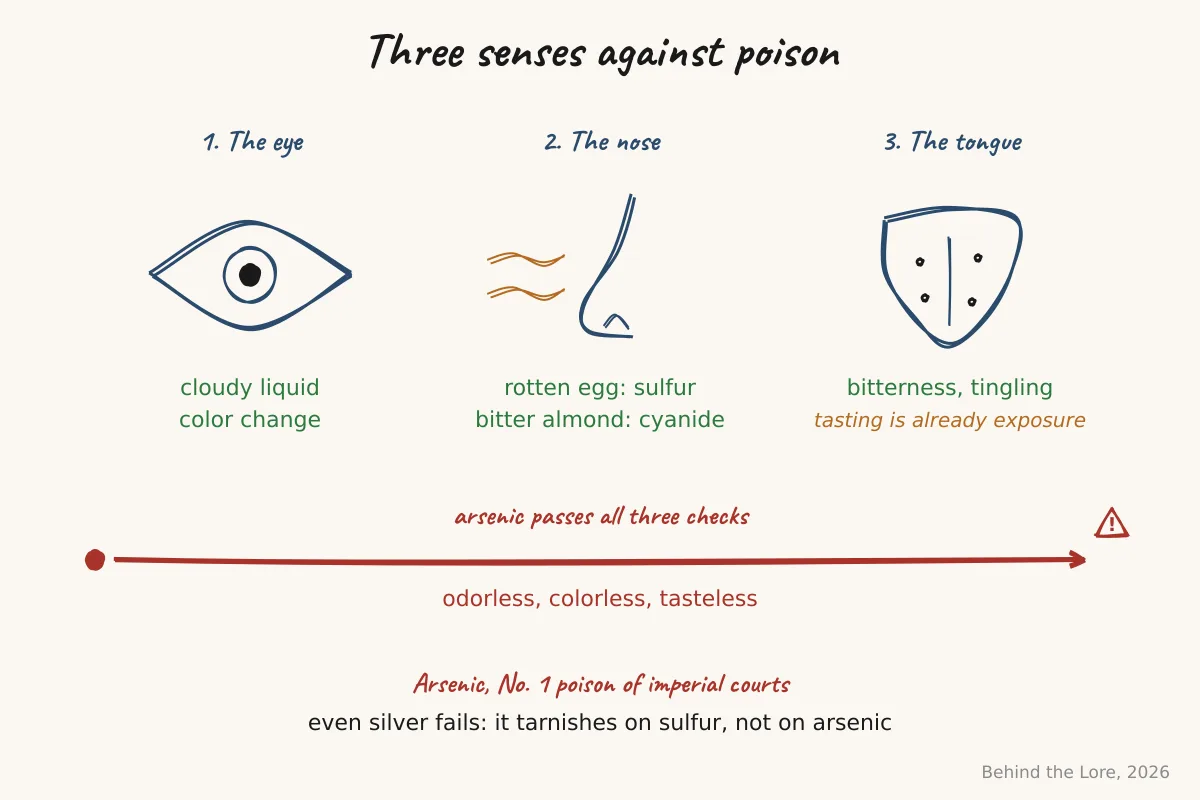
This third channel, taste, is the most ambivalent. A tingling on the tongue can indicate the presence of pungent alkaloids or acids, and some plant poisons are indeed bitter at sub-lethal concentrations. But detecting a poison by taste already means bringing it into contact with the oral mucosa, which absorbs certain molecules directly: fugu’s tetrodotoxin, for instance, crosses the oral mucosa within seconds. Sensory information can therefore arrive too late.
A complementary technique, attested in several imperial courts, involved using silverware. Metallic silver tarnishes on contact with hydrogen sulfide and certain sulfur compounds
[Wikipedia] . A silver cup, spoon, or knife dipped into a dish could thus reveal the presence of sulfur compounds released by decomposition or by certain sulfur-based poisons. This test had real value, but only for one specific category of substances.
The fundamental limitation of all these methods lies in the very chemistry of history’s most-used poisons. Arsenic, by far the most widespread poison in the Chinese, Roman, and European imperial courts, is odorless, tasteless, and colorless in its trioxide form
[Wikipedia] . It did not tarnish silver (tarnishing requires sulfides, not pure arsenic). A silver spoon could therefore not detect it. Tetrodotoxin, the other substance mentioned in the episode, is likewise odorless and colorless at a toxic dose. A food taster faced with either poison would notice nothing unusual, and would simply be poisoned without knowing it.
Going further
- Orpiment and Arsenic
- Fugu and Tetrodotoxin
- Nicotine as a Poison
- Discipline: Toxicology
- Discipline: History of Science
Sources
Published on
Keep investigating
Auto-suggested from shared concepts, disciplines, episodes, or characters.
Fugu and Tetrodotoxin
In The Apothecary Diaries, Maomao loves fugu and its poison. We explain tetrodotoxin, how it paralyzes, and why there's no antidote.
Orpiment and Arsenic
In The Apothecary Diaries, a yellow pigment poisons slowly. We explain orpiment, arsenic, and the chronic poisoning of court painters.
Nicotine and Tobacco
In The Apothecary Diaries, macerated tobacco serves as a poison. We explain nicotine, its acute toxicity, and why diluting a poison can make it worse.
Lead White Makeup
In The Apothecary Diaries, white makeup kills courtesans. We explain why this ceruse-based cosmetic caused deadly lead poisoning.
Food Allergy
In The Apothecary Diaries, a fish soup nearly kills. We explain IgE, histamine, anaphylaxis, and the risks of desensitization.