Lead White Makeup: The Court's Poison
Story context (click to hide this block) (click to show this block)
This paragraph may contain plot information.
It all begins with a rumor of a curse at the Eastern Palace: the emperor’s concubines’ children are falling ill and dying. Maomao quickly understands there’s nothing supernatural about it. The white makeup the favorites cover themselves in is a poison, and it poisons the infants they nurse as well. Later, faced with a craftsman worn down by the same ailments, she recognizes a signature she knows well: stomach pain, bloodless complexion, melancholy. The metal responsible is always the same.
The subject in depth
The white makeup in question is ceruse, that is, basic lead carbonate [Wikipedia] . It was obtained by exposing lead sheets to vinegar fumes, then to carbon dioxide gas: a white crust formed on the surface, which was scraped off and ground. The result is a dense, opaque white powder that clings well to skin and hides complexion irregularities. No mineral pigment available at the time matched this white, which explains its success despite its already dubious reputation.
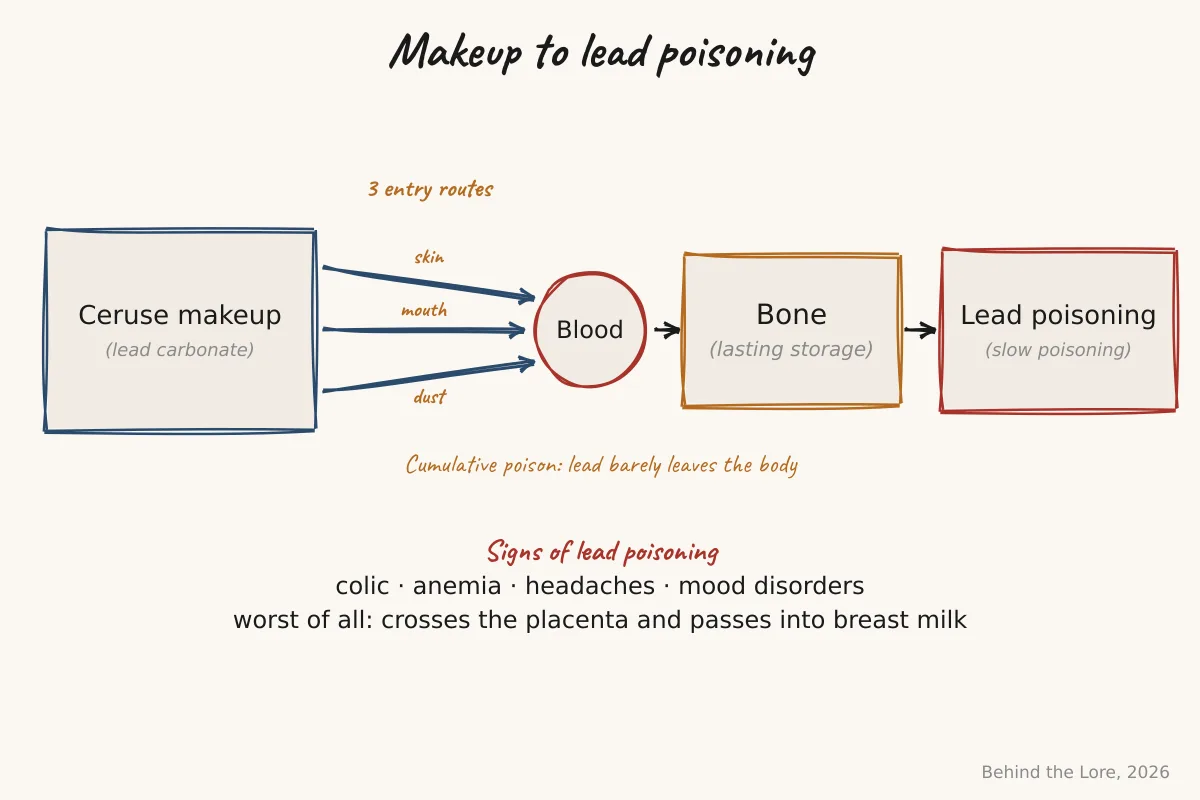
The problem is that lead is a cumulative poison. It enters through three routes at once: in small amounts through the skin, orally when the makeup touches the lips or fingers that then touch food, and above all through the dust inhaled while applying the powder. Once in the blood, lead barely leaves the body. It takes the place of calcium and settles durably in the bones, from which it is slowly released over years [Wikipedia] .
This accumulation produces the clinical picture of lead poisoning [Wikipedia] . The first signs are subtle and misleading: fatigue, abdominal colic, anemia that gives a pale complexion. Then comes damage to the nervous system, with headaches, mood disturbances, and, at high doses, seizures. This is exactly the list Maomao recites to pin down the cause of the illness: stomach pain, anemia, nausea, melancholy. The poison acts by disrupting several enzymes, in particular those that make hemoglobin, which explains the anemia, and by disturbing transmission between neurons.
The most serious consequences involve pregnancy and children. Lead crosses the placenta and passes into breast milk. The nervous system of the fetus and infant is extremely sensitive to it: miscarriages, stillbirths, and developmental delays are the classic consequences of a poisoned mother. The “curse” striking the palace’s children is therefore not a metaphor, it’s toxicology.
The subject in depth, continued: why this particular white
A fair question arises: why keep using a product already suspected of being dangerous? Because lead gives an opaque, long-lasting, and cheap white that no alternative could match as well. Rice or chalk powders covered poorly and ran; some recipes even added mercury, another heavy metal, or red cinnabar based on mercury for the lips [Wikipedia] . The court thus traded immediate beauty for a delayed, invisible risk, easy to blame on anything but the makeup.
Going further
Sources
Published on
Keep investigating
Auto-suggested from shared concepts, disciplines, episodes, or characters.
Fugu and Tetrodotoxin
In The Apothecary Diaries, Maomao loves fugu and its poison. We explain tetrodotoxin, how it paralyzes, and why there's no antidote.
Datura
In The Apothecary Diaries, datura is used to induce sleep and feign death. We explain its alkaloids, its toxicity, and its role in the history of anesthesia.
Physic Garden
The physic garden is the cradle of plant-based pharmacopoeia. Monasteries, universities, imperial China: the history of a centuries-old place of knowledge.
Mercury
In The Apothecary Diaries, quicksilver goes into a court poison. We explain mercury, its toxicity, and the immortality elixirs that killed emperors.
Elixirs of Immortality
Several Chinese emperors were killed by elixirs meant to make them immortal. Waidan alchemy, cinnabar, mercury, and arsenic explained.