The Physic Garden: A Living Pharmacopoeia
Story context (click to hide this block) (click to show this block)
This paragraph may contain plot information.
As early as the first episode, before her talent is even revealed at court, Maomao mentions that she makes a detour by the physic garden while delivering remedies. This seemingly minor detail immediately establishes her relationship with knowledge: she does not simply dispense ready-made preparations, she maintains a direct connection with the plants themselves. The physic garden is her field laboratory, the place where she observes, gathers, and verifies what she prepares.
The subject in depth
The word “simple” designates, in pre-modern pharmacological tradition, a medicinal plant used alone, without mixing: as opposed to compound preparations that combine several ingredients, a simple is the elementary building block of plant-based therapeutics [Wikipedia] . A physic garden is therefore, literally, the place where these building blocks are grown, observed, and harvested.
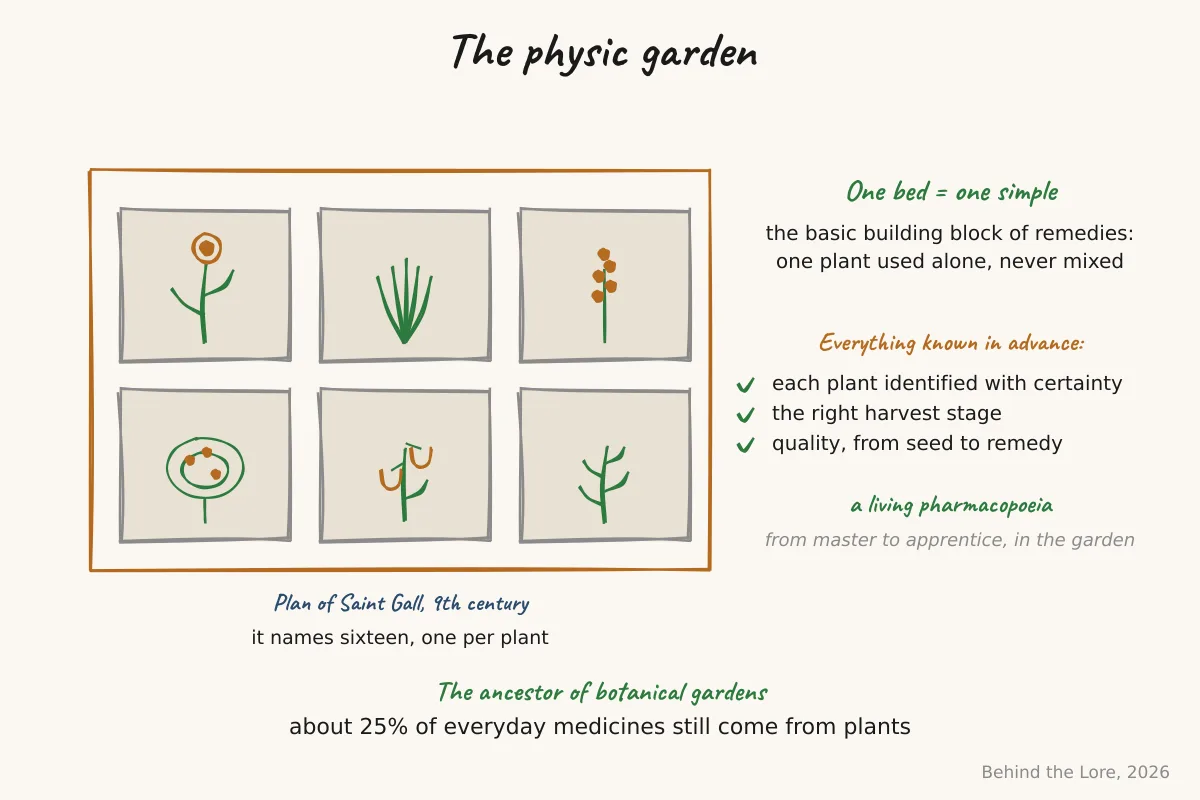
The idea of gathering useful plants in one organized space is ancient and found across cultures. It answers a practical need: having on hand plants whose quality, stage of maturity, and identification are known with certainty. An apothecary who grows their own simples controls the entire chain, from seed to preparation, and does not depend on the approximations of trade.
This knowledge, accumulated plant by plant, gave rise to the great compendiums of pre-modern pharmacopoeia. The Chinese tradition formalized this body of knowledge in works such as the Shennong Bencao Jing, a materia medica compiled during the Han era, describing several hundred plants, minerals, and animal substances along with their properties and uses
[Wikipedia] . In Europe, Dioscorides’ Materia Medica, written in the first century CE, played the same role for more than fifteen centuries. These texts were the reference works that apothecaries studied, annotated, and corrected through experience.
Growing simples requires precise knowledge of each plant: its growth cycle, the active part (root, leaf, flower, bark), the harvest season, the drying method. Some plants must be harvested at a precise stage for their active compounds to be concentrated. Others see their composition vary with sun exposure, soil quality, or altitude. What we would today call empirical knowledge of pharmacognosy was then passed down from master to apprentice, in the garden itself, by observing the living plants.
Going further
Sources
Published on
Keep investigating
Auto-suggested from shared concepts, disciplines, episodes, or characters.
Aconite
In The Apothecary Diaries, aconite poisons even through honey. We explain aconitine, its action on nerves, and why it shows no mercy.
Datura
In The Apothecary Diaries, datura is used to induce sleep and feign death. We explain its alkaloids, its toxicity, and its role in the history of anesthesia.
Nicotine and Tobacco
In The Apothecary Diaries, macerated tobacco serves as a poison. We explain nicotine, its acute toxicity, and why diluting a poison can make it worse.
Lead White Makeup
In The Apothecary Diaries, white makeup kills courtesans. We explain why this ceruse-based cosmetic caused deadly lead poisoning.
Emmenagogue and Abortive Plants
Jasmine, mugwort, rue, chili pepper: were these plants, said to trigger periods or end a pregnancy, really effective? The history and pharmacology behind them.