Elixirs of Immortality: Chinese Alchemy
Story context (click to hide this block) (click to show this block)
This paragraph may contain plot information.
Over the course of the episode, Maomao recalls that the famous “resurrection potion” is said to have originated from repeated attempts to discover an elixir of youth. She knows this quest is doomed to fail, but something in her (an apothecary’s pride) keeps her from losing interest. The remark is not incidental: it condenses, in a few words, one of the darkest paradoxes of historical pharmacology, a search for life that mostly manufactured death.
The subject in depth
Waidan, which can be translated as “external alchemy,” designates the branch of Chinese alchemy that sought immortality by manufacturing a substance to ingest [Wikipedia] . Its counterpart, neidan, aimed at inner transformation through meditation and breathing, but it was waidan that dominated imperial practice until the middle of the first millennium.
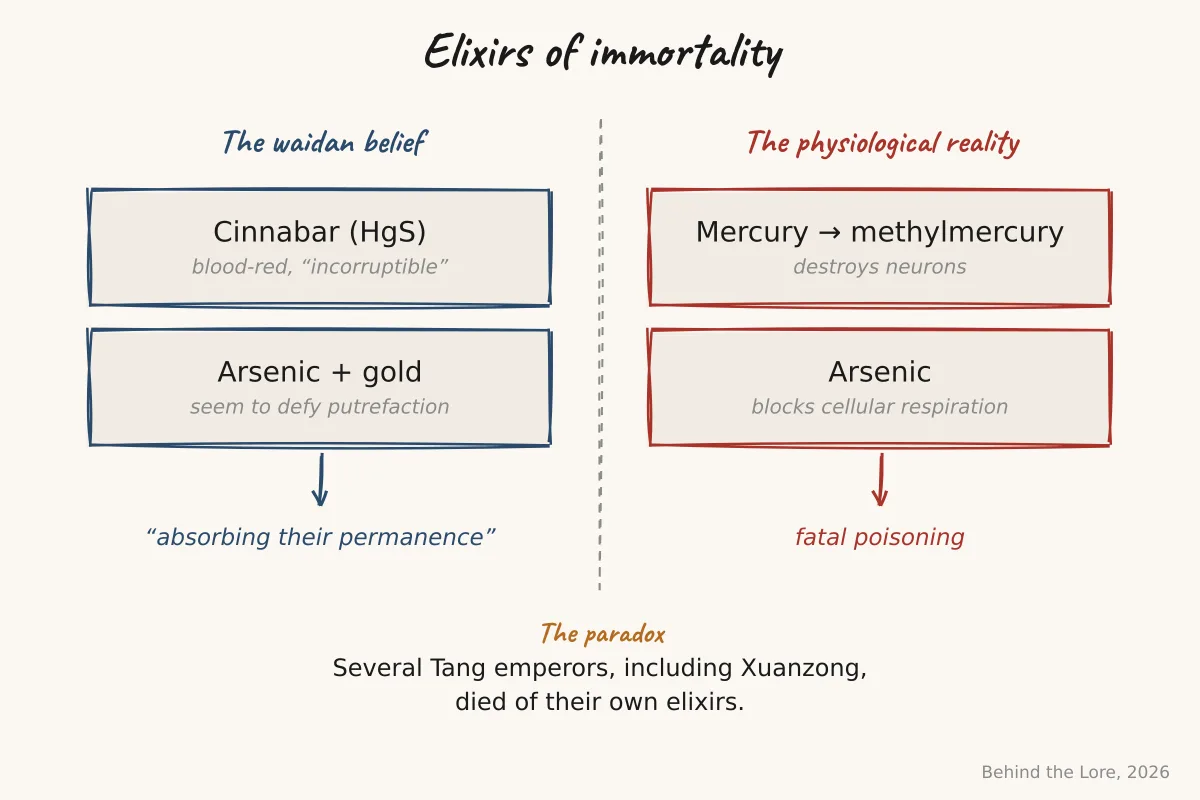
The prime material of these preparations was cinnabar, a bright red ore composed of mercury sulfide. Alchemists credited it with particular virtues: its color evoked blood and life, and it seemed to resist corruption where organic matter decomposed. When heated, cinnabar turns into liquid mercury, and heating it further “reincarnates” it back into red cinnabar, a transformation cycle that seemed to mimic perpetual death and rebirth. Alchemists saw this as proof that the substance held the secret of permanence.
To this were added arsenic, often in the form of realgar (red arsenic sulfide) or orpiment (yellow arsenic sulfide), and sometimes gold reduced to leaf or powder [Wikipedia] . The reasoning was internally coherent: gold does not rust, arsenic and mercury seem to defy putrefaction, so absorbing these substances should transmit their permanence to the human body.
The problem is that this analogical reasoning does not hold up against physiology. Elemental mercury, once absorbed, is converted by intestinal bacteria into methylmercury, an organic form that crosses the blood-brain barrier and destroys neurons. The symptoms are progressive: tremors, vision disturbances, dementia, death. Arsenic, for its part, inhibits the enzymes of the cellular respiratory chain and causes, at high doses, sudden acute poisoning, and at repeated doses, chronic multi-organ damage.
Historical texts have preserved the names of several Tang dynasty emperors, notably Xuanzong, and other rulers who consumed these elixirs on the advice of their court alchemists and died under circumstances consistent with such poisonings. The practice declined over the centuries as its lethal effects became harder to deny, but the quest for chemical immortality left deep traces in pharmacopoeia and in the history of science.
Going further
- Mercury
- Orpiment and Arsenic
- Aconite
- Discipline: History of Science
- Discipline: Chemistry
- Discipline: Toxicology
Sources
Published on
Keep investigating
Auto-suggested from shared concepts, disciplines, episodes, or characters.
Mercury
In The Apothecary Diaries, quicksilver goes into a court poison. We explain mercury, its toxicity, and the immortality elixirs that killed emperors.
Orpiment and Arsenic
In The Apothecary Diaries, a yellow pigment poisons slowly. We explain orpiment, arsenic, and the chronic poisoning of court painters.
Aconite
In The Apothecary Diaries, aconite poisons even through honey. We explain aconitine, its action on nerves, and why it shows no mercy.
Lead White Makeup
In The Apothecary Diaries, white makeup kills courtesans. We explain why this ceruse-based cosmetic caused deadly lead poisoning.
Plant Ashes
In The Apothecary Diaries, ash is scattered to repel insects. We explain potash, alkalinity, and the ancient uses of wood ash.