Plant Ashes
Story context (click to hide this block) (click to show this block)
This paragraph may contain plot information.
Thrown into the vermin pit, Maomao doesn’t panic. She identifies the snakes, takes advantage of their winter torpor, then scatters ashes around herself to keep insects away. The gesture is brief, almost mundane for an apothecary, but it draws on very precise knowledge: ashes don’t repel insects through smell or magic, but through chemistry.
The subject in depth
When wood burns completely, only its mineral constituents remain, that’s ash. This grey powder is not uniform: it holds a mix of mineral salts whose composition varies by wood species [Wikipedia] . The most important chemical component is potassium carbonate (K2CO3), historically called potash, which generally makes up 5 to 15% of dry ash mass. It also contains calcium oxide (lime), magnesium carbonate, phosphate, and traces of sulfur, silica, and iron.
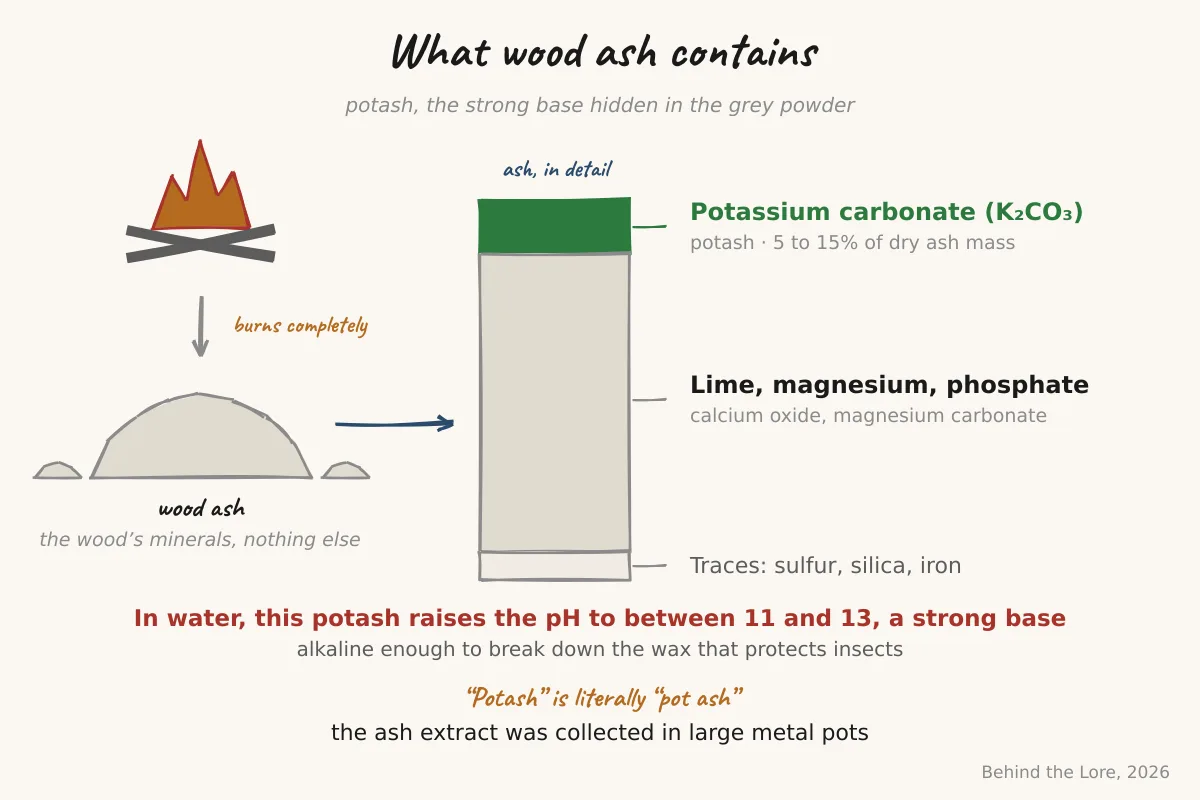
Potash is a strong base. Dissolved in water, it produces hydroxide ions (OH⁻) and raises the pH to values between 11 and 13 [Wikipedia] . It is this alkalinity that gives ashes their effectiveness against insects. The integument of arthropods (insects, mites) is covered by a thin waxy layer, the cuticle, which lets them retain their body water. Prolonged contact with alkaline ash chemically degrades this wax and causes rapid water loss from the insect’s body, a phenomenon called desiccation. At the same time, OH⁻ ions disrupt cell membranes and denature certain proteins. The insect flees the contact or, if it can’t escape, dies.
Potash also holds a central place in the history of industrial chemistry. Before the Solvay process was developed in the 19th century, ash was the only common source of solid alkaline base. It was leached in water, and the filtrate evaporated to concentrate the potash, yielding an alkaline solution used everywhere. Ash lye was used to degrease laundry, to make soap by reacting with fats (saponification), and to prepare glass. Farmers spread ash over fields as a potassium fertilizer and to correct soil acidity. The word “potash” itself comes from “pot ash”: the extract was collected in large metal pots.
Going further
Sources
Published on
Keep investigating
Auto-suggested from shared concepts, disciplines, episodes, or characters.
Mercury
In The Apothecary Diaries, quicksilver goes into a court poison. We explain mercury, its toxicity, and the immortality elixirs that killed emperors.
Aconite
In The Apothecary Diaries, aconite poisons even through honey. We explain aconitine, its action on nerves, and why it shows no mercy.
Elixirs of Immortality
Several Chinese emperors were killed by elixirs meant to make them immortal. Waidan alchemy, cinnabar, mercury, and arsenic explained.
Diapause and Hibernation
In The Apothecary Diaries, snakes numbed by the cold let Maomao act safely. We explain torpor, hibernation, and diapause.
Hypothermia
In The Apothecary Diaries, cold threatens lives. We explain hypothermia, why cold-water immersion is so dangerous, and how to rewarm safely.