Hibernation and Diapause: Surviving Without Eating
Story context (click to hide this block) (click to show this block)
This paragraph may contain plot information.
Thrown into a pit crawling with vermin, Maomao makes an observation that likely saves her life: in this cold season, the snakes living in the well are in a lethargic state. She can approach them, identify the venomous specimens, and neutralize them without exposing herself to a bite. This precise zoological knowledge turns a deadly situation into a manageable problem.
The subject in depth
Ectothermy and thermal dependence
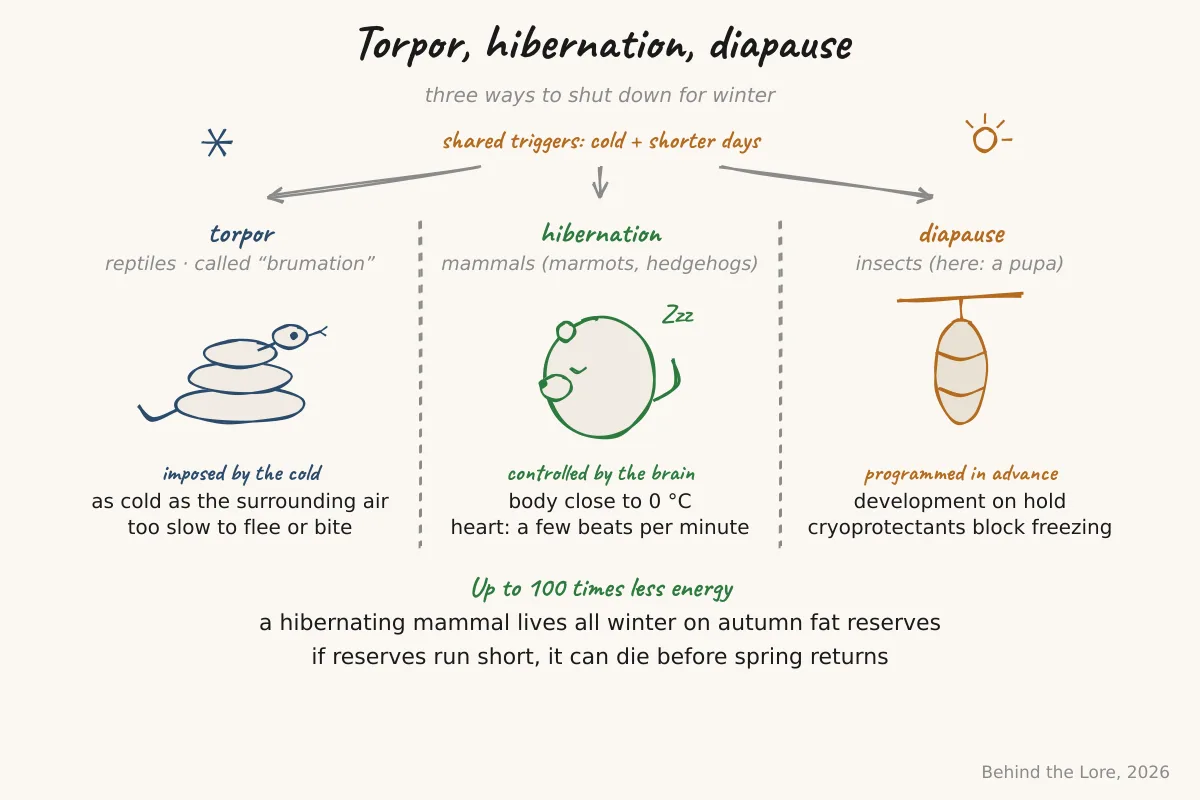
Reptiles, like all ectotherms (or poikilotherms), do not generate their own body heat. Their body temperature closely tracks that of the surrounding environment [Wikipedia] . Below a certain threshold, the enzymes that control muscle contraction, digestion, and nerve transmission slow to a crawl: the snake can no longer hunt, flee, or even trigger the venom-injection reflex with any precision. This cold-induced torpor is sometimes called brumation in reptiles, to distinguish it from mammalian hibernation.
Brumation is not ordinary sleep. The reptile stays conscious and can wake up in mild weather, drink water, or shift position, but its activity level remains minimal. The main trigger is falling temperature, often amplified by a shortening photoperiod, the reduction in day length as winter approaches. Together, these two environmental signals tell the animal that food is about to become scarce and that it needs to cut its energy expenditure.
Hibernation in mammals
In some mammals, the process goes further and is more tightly regulated. True hibernation, seen in marmots, hedgehogs, and some bats, involves an active drop in body temperature, sometimes close to zero degrees Celsius, a reduction in heart rate from several hundred beats per minute down to just a few, and slowed breathing. This deep shutdown is controlled by the brain and can be triggered or interrupted according to the animal’s needs [Wikipedia] .
The energy payoff is considerable: a hibernating animal uses ten to a hundred times less energy than when active. It lives off fat reserves built up during autumn. If those reserves run short, it can die before spring returns.
Diapause in insects
Insects use a different but comparably effective strategy: diapause. This is a programmed halt in development, triggered well before unfavorable conditions actually arrive [Wikipedia] . The main cue is photoperiod: the shortening of daylight, detected as early as late summer, sets off a hormonal cascade that locks the developmental cycle at a specific stage (egg, larva, pupa, or adult, depending on the species).
Diapause differs from torpor in that it is not simply a passive slowdown. It is an active, genetically programmed physiological state that protects the insect against cold, desiccation, and toxins. An insect in diapause can withstand deeply subzero temperatures thanks to natural cryoprotectants produced within its cells. It exits this state once conditions turn favorable again, guided once more by photoperiod and temperature.
One principle, many mechanisms
Reptile torpor, mammalian hibernation, and insect diapause all answer the same biological imperative: getting through a period of energy scarcity by cutting expenditure to the bare minimum. The triggers are shared (cold and photoperiod) but the depth of the shutdown and the molecular mechanisms involved vary considerably across animal groups.
Going further
Sources
Published on
Keep investigating
Auto-suggested from shared concepts, disciplines, episodes, or characters.
Hypothermia
In The Apothecary Diaries, cold threatens lives. We explain hypothermia, why cold-water immersion is so dangerous, and how to rewarm safely.
Carbon Monoxide
In The Apothecary Diaries, embers bring guests down at a party. We explain carbon monoxide, why it suffocates without warning, and the right thing to do.
Elixirs of Immortality
Several Chinese emperors were killed by elixirs meant to make them immortal. Waidan alchemy, cinnabar, mercury, and arsenic explained.
Plant Ashes
In The Apothecary Diaries, ash is scattered to repel insects. We explain potash, alkalinity, and the ancient uses of wood ash.
Diabetes
In The Apothecary Diaries, an all-sugar diet hints at diabetes. We explain blood glucose, insulin, and the historic sign of sweet urine.