Diabetes: sugar, insulin, and blood glucose
Story context (click to hide this block) (click to show this block)
This paragraph may contain plot information.
During a conversation about a senior official’s eating habits, Maomao learns that he had given up smoked meats and rock salt to live almost entirely on sweets. Her reaction is immediate: eating like that, he was bound to develop diabetes. Her interlocutor brushes the remark aside, eager to stay on the trail of the poisoning case, but it reveals the precision of Maomao’s clinical eye. In a few words, she draws a link between excess sugar and metabolic disease that modern medicine took centuries to formalize.
The subject in depth
Diabetes mellitus refers to a group of diseases characterized by chronic hyperglycemia, that is, a blood glucose level that stays persistently too high [Wikipedia] . There are several forms, two of which dominate: type 1, an autoimmune condition in which the pancreas stops making insulin, and type 2, by far the most common, in which cells gradually become resistant to insulin until the pancreas eventually wears out.
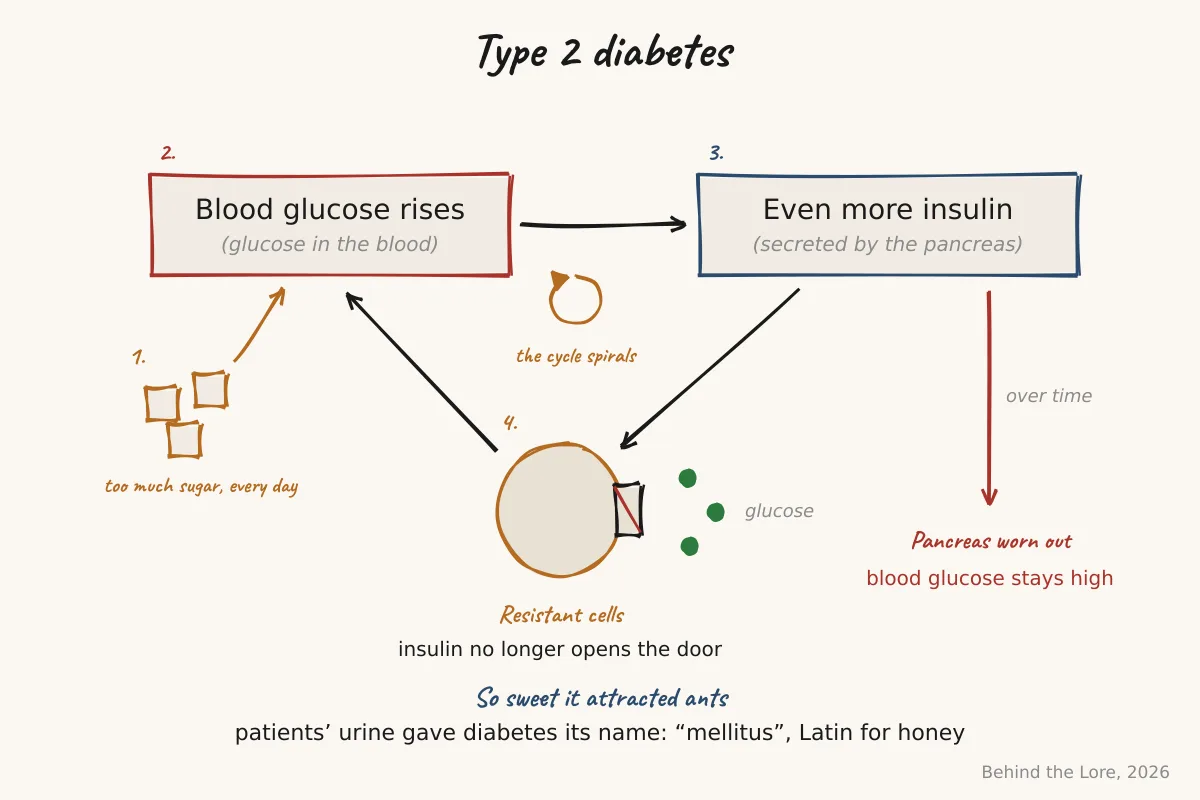
Insulin is the key hormone in this system [Wikipedia] . Secreted by the pancreas after a meal, it acts as a signal that opens cells’ doors to glucose: without it, glucose circulates in the blood without being taken up, and blood glucose rises
[Wikipedia] . In type 2 diabetes, the process is gradual: a chronically excessive carbohydrate intake forces the pancreas to secrete large amounts of insulin constantly. Cells, saturated with this signal, become resistant, the pancreas has to produce even more insulin, and the cycle spirals until the beta cells that make it burn out.
This link between a very sugary diet and type 2 diabetes is real, even though the causality is more complex than a simple sugar-equals-diabetes equation: heredity, obesity, a sedentary lifestyle, and overall diet quality each play a role. But a diet very high in fast-digesting sugars is indeed an established risk factor.
The disease’s very name carries its history. The Greek word diabētēs means “siphon” or “one who passes through,” referring to intense thirst and abundant urination. The adjective mellitus, from the Latin for “honey,” was added to distinguish this form from diabetes without sugar: physicians in Antiquity and the Middle Ages had observed that patients’ urine tasted sweet, and even attracted ants. This clinical sign is described in the Egyptian Ebers papyrus, in Indian Ayurvedic medicine under the name madhumeha (“honey urine”), and in classical Chinese medicine under the name “thirsting disease.” The discovery of insulin in 1921 by Banting and Best turned the disease from a death sentence into a manageable condition.
The complications of poorly controlled diabetes over the long term affect blood vessels and nerves: retinopathy that can lead to blindness, nephropathy, cardiovascular disease, and peripheral neuropathy, which can, among other effects, impair taste perception, a link worth keeping in mind for the entry on loss of taste in this same episode.
Going further
Sources
Published on
Keep investigating
Auto-suggested from shared concepts, disciplines, episodes, or characters.
Dehydration and Rehydration
In The Apothecary Diaries, Maomao treats heatstroke with salted, sweetened water. We explain dehydration and why salt is vital.
Mercury
In The Apothecary Diaries, quicksilver goes into a court poison. We explain mercury, its toxicity, and the immortality elixirs that killed emperors.
Loss of Taste
In The Apothecary Diaries, Konen could no longer taste salt. We explain ageusia, the decisive role of smell, and the real causes of taste loss.
Foot Binding
In The Apothecary Diaries, a victim's bound feet prove she couldn't have climbed alone. We explain the real bone deformation and its effects.
Bear Bile
Why did bear bile, a traditional TCM remedy, lead to a modern drug? UDCA dissolves gallstones and treats the liver.