Loss of Taste: ageusia and smell
Story context (click to hide this block) (click to show this block)
This paragraph may contain plot information.
Maomao is consulted about the death of senior official Konen. Reviewing his recent behavior, she notes that he had stopped eating rock salt and smoked meats, and drank only very sweet spirits. The explanation she proposes is medical: certain dietary deficiencies or emotional burdens too heavy to bear can cause a loss of the sense of taste. If Konen could no longer taste the salt in his liquor, he was likely suffering from ageusia or hypogeusia, not simple whimsy. This clinical detail, delivered in a few lines, opens up two distinct threads that real medicine confirms.
The subject in depth
What we commonly call “taste” is actually a mixed sensory construction. The taste buds on the tongue, arranged in fungiform, foliate, and circumvallate papillae, detect five basic tastes: sweet, salty, sour, bitter, and umami [Wikipedia] . But these signals represent only a fraction of the overall gustatory experience. Most of the nuance, what’s called “flavor”, comes from retronasal olfaction: volatile molecules released in the mouth travel up behind the palate to the olfactory bulb. This is why a cold that blocks the nose makes food tasteless without affecting the taste buds at all.
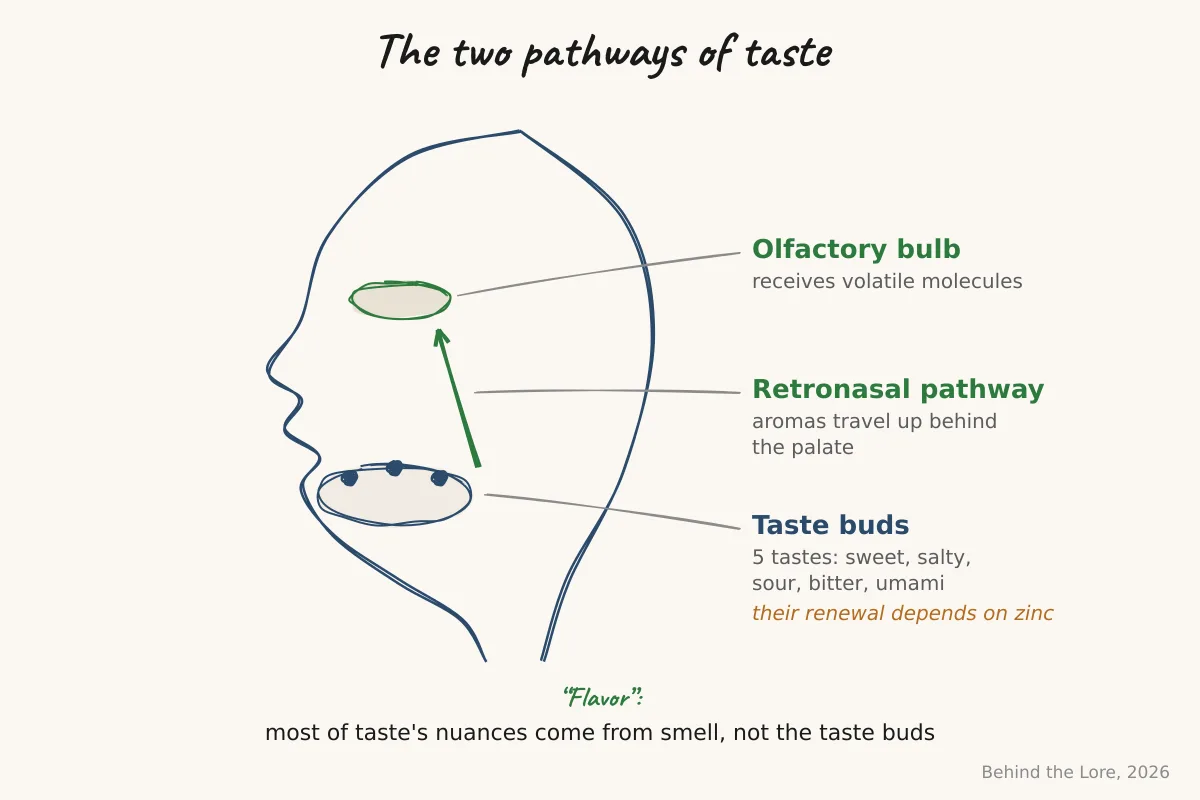
Loss of taste (ageusia) or its reduction (hypogeusia) can therefore have two distinct origins.
Direct gustatory causes affect the taste buds themselves. Zinc deficiency is the best documented: zinc is essential for the renewal of taste cells, which regenerate continuously. An overly restrictive diet, one that’s very sweet and low in protein or zinc-rich foods (meat, whole grains), eventually impairs this regeneration. The rock salt and smoked meats Konen had given up are precisely sources of zinc and minerals. The story quietly points to a link that biochemistry confirms.
Other common causes include direct lesions of the oral mucosa (burns, radiotherapy), certain medications (notably some antibiotics, antiepileptics, and ACE inhibitors), viral infections, and certain neurological diseases such as multiple sclerosis or Parkinson’s disease
Olfactory causes are often overlooked. Any damage to the olfactory nerve (infectious, traumatic, or psychogenic) removes the retronasal dimension of perception. If Konen could no longer taste the salt, it’s possible he could no longer smell the aroma of the rice wine either, and that both senses were impaired at once by a state of distress or illness.
The psychosomatic dimension that Maomao raises is likewise biologically plausible. States of chronic stress or intense emotional shock activate the hypothalamic-pituitary-adrenal axis and can shift the thresholds of olfactory and gustatory perception. Certain dissociative and depressive disorders come with gustatory anhedonia, a loss of pleasure and sometimes of sensory perception documented in the psychiatric literature. Classical Chinese medicine already conceptualized this mind-body link, and Maomao’s observation fits within that tradition.
Going further
Sources
Published on
Keep investigating
Auto-suggested from shared concepts, disciplines, episodes, or characters.
Carbon Monoxide
In The Apothecary Diaries, embers bring guests down at a party. We explain carbon monoxide, why it suffocates without warning, and the right thing to do.
Dehydration and Rehydration
In The Apothecary Diaries, Maomao treats heatstroke with salted, sweetened water. We explain dehydration and why salt is vital.
Diabetes
In The Apothecary Diaries, an all-sugar diet hints at diabetes. We explain blood glucose, insulin, and the historic sign of sweet urine.
Foot Binding
In The Apothecary Diaries, a victim's bound feet prove she couldn't have climbed alone. We explain the real bone deformation and its effects.
Bear Bile
Why did bear bile, a traditional TCM remedy, lead to a modern drug? UDCA dissolves gallstones and treats the liver.