Foot Binding: anatomy of a practice
Story context (click to hide this block) (click to show this block)
This paragraph may contain plot information.
While examining the body of a servant found drowned, Maomao notices that the victim had bound feet. Her companion points out that such small feet are considered a mark of beauty. Maomao draws a decisive forensic conclusion from this: a woman with bound feet would not have had the physical ability to climb, unaided, the wall overlooking the moat. The lack of agility caused by the practice thus becomes proof that the death was not a suicide.
The subject in depth
The human foot is a structure of 26 bones, 33 joints, and roughly a hundred muscles and ligaments, built to bear the body’s weight and propel walking [Wikipedia] . This architecture rests on two longitudinal arches and one transverse arch that absorb impact and distribute forces. Any lasting alteration of these arches profoundly changes the mechanics of walking.
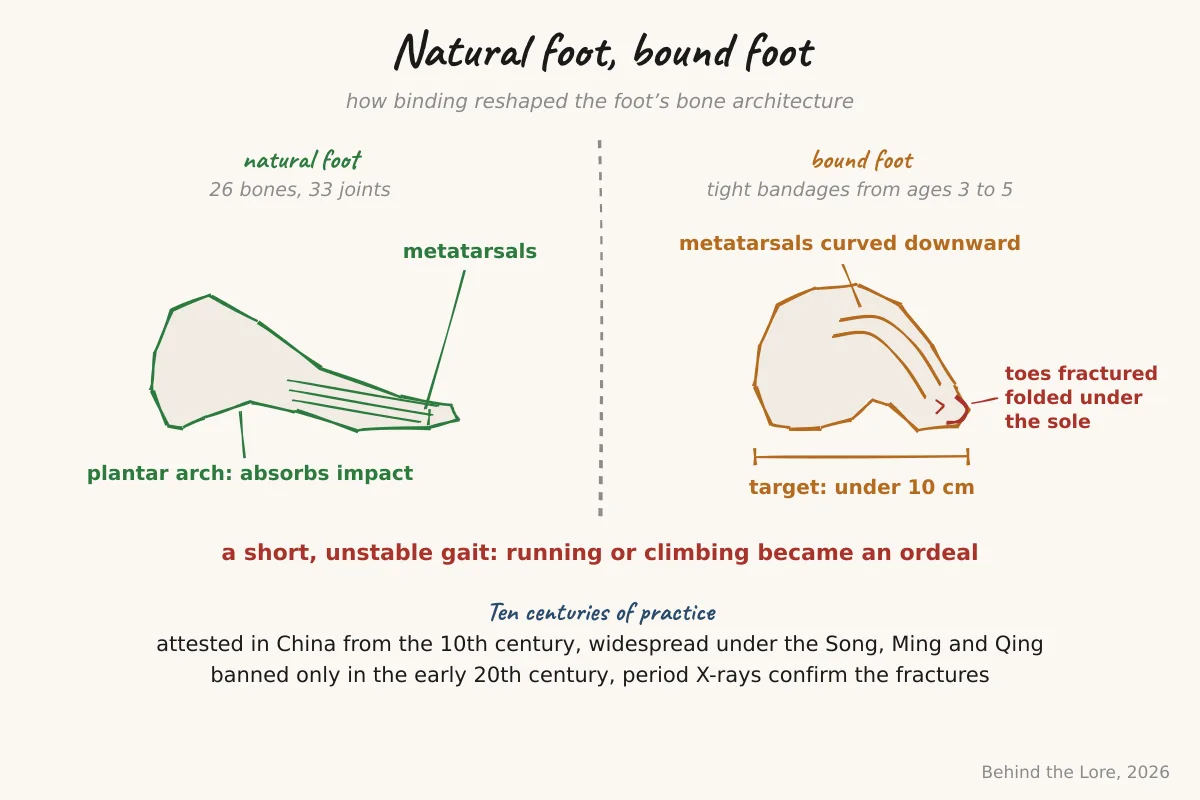
Foot binding, practiced in China for many centuries, acted precisely on this architecture
[Wikipedia] . The process typically began between the ages of three and five, while the bones were still largely cartilaginous and therefore malleable. The feet were first soaked in hot water, sometimes mixed with herbs, to soften the tissue. The four smallest toes were then forcibly folded under the sole and tight bandages applied to hold this position continuously. The constant pressure progressively fractured the phalanges and curved the metatarsals. The tip of the foot and the heel were then compressed toward each other to reduce the foot’s overall length, ideally to under ten centimeters.
The anatomical consequences were irreversible. The fractured bones healed back together in their deformed position. The arch collapsed, the metatarsals curved downward, and the soft tissue of the sole thickened under the pressure. The resulting gait was distinctive: short, hesitant, carried on the heels, requiring constant effort to maintain balance. Running, climbing, squatting, or standing for long periods became physically demanding ordeals.
Beyond the biomechanics, the health effects were severe. Injuries and infections were common under the bandages, including ulcerations and necrosis, sometimes to the point that a toe would detach entirely, which was paradoxically sometimes seen as further reducing the foot’s size. Chronic pain persisted into adulthood, and elderly women with bound feet often showed balance problems and a high risk of falls.
Going further
Sources
Published on
Keep investigating
Auto-suggested from shared concepts, disciplines, episodes, or characters.
Lead White Makeup
In The Apothecary Diaries, white makeup kills courtesans. We explain why this ceruse-based cosmetic caused deadly lead poisoning.
Mercury
In The Apothecary Diaries, quicksilver goes into a court poison. We explain mercury, its toxicity, and the immortality elixirs that killed emperors.
Diabetes
In The Apothecary Diaries, an all-sugar diet hints at diabetes. We explain blood glucose, insulin, and the historic sign of sweet urine.
Loss of Taste
In The Apothecary Diaries, Konen could no longer taste salt. We explain ageusia, the decisive role of smell, and the real causes of taste loss.
Autopsy and Forensic Medicine
In The Apothecary Diaries, a body is examined. We explain autopsy, post-mortem signs, and the birth of forensic medicine.