Autopsy and forensic medicine
Story context (click to hide this block) (click to show this block)
This paragraph may contain plot information.
When the conspirator Suirei is found dead, a physician confirms her death and performs an autopsy. Maomao secures permission to visit the morgue and conducts her own examination of the body. She checks the physical signs, observes the corpse’s characteristics, and draws conclusions about the circumstances of death: she suspects the death was staged rather than real, something the official autopsy failed to detect. This sequence places the post-mortem examination at the narrative pivot of the episode.
The subject in depth
An autopsy is the systematic examination of a body after death, carried out to determine the cause, the circumstances, and, if necessary, the time of death [Wikipedia] . The physician or examiner proceeds in a set order, looking for signs that change predictably over the hours and days following death.
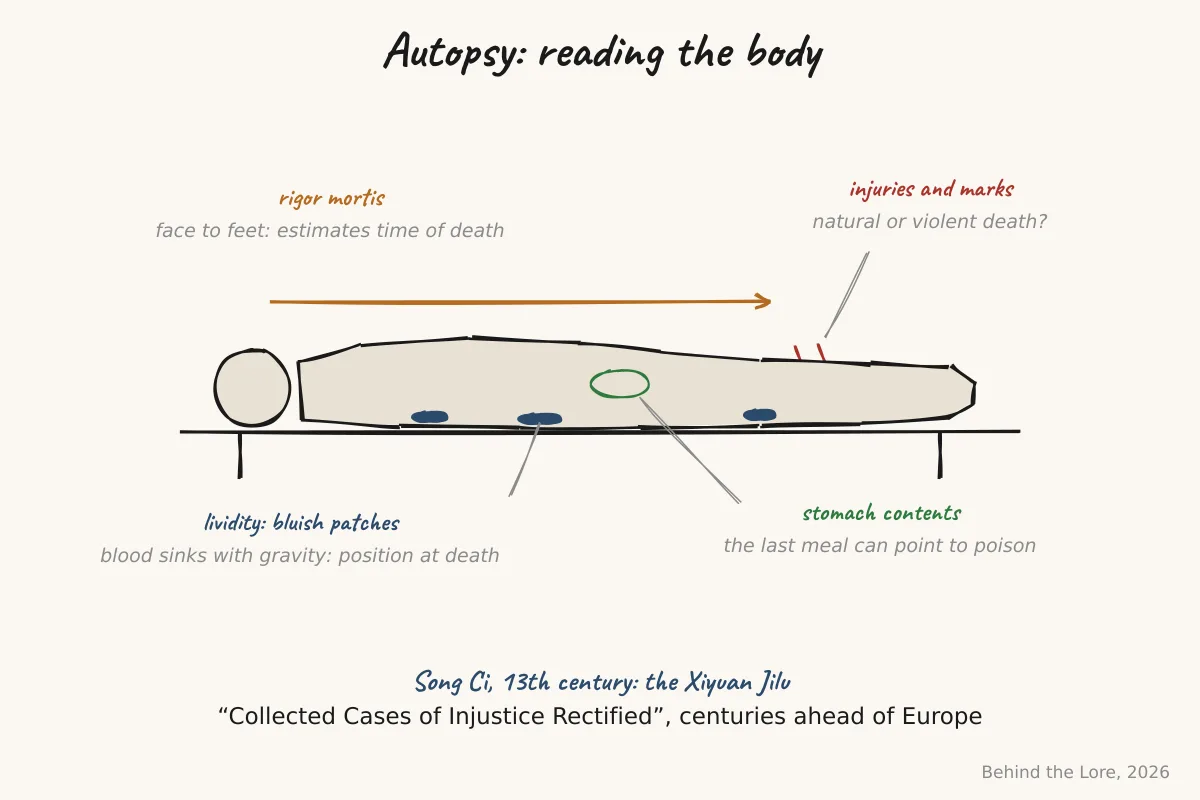
The main signs examined are as follows. Lividity (livor mortis) consists of bluish patches that appear on the body’s lower-lying areas, where blood pools under gravity once circulation stops. Their location and whether they shift can help estimate the body’s position at the time of death and whether it was moved afterward. Rigor mortis is a muscular stiffening that sets in a few hours after death, progressing from the face to the lower limbs before resolving in the same order. Its degree gives a rough estimate of the time of death. Stomach contents, examined during internal autopsy, indicate the nature and digestion of the last meal, which can point toward poisoning or help refine the time of death. Finally, external and internal injuries (bruises, ligature marks, hemorrhages, signs of strangulation) help distinguish a natural death from a violent one.
Forensic medicine as a codified discipline has particularly old roots in China
[Wikipedia] . In the 13th century, the magistrate and physician Song Ci (宋慈, 1186–1249) wrote the Xiyuan Jilu (洗冤集錄, literally “Collected Cases of Injustice Rectified”), a five-volume treatise describing in detail the techniques for examining a body, distinguishing types of wounds, telling drowning apart from strangulation, and methods for distinguishing natural death from murder. This manual is considered one of the world’s earliest works of forensic medicine. It was reprinted and annotated for centuries, and it stands as a direct ancestor of the practice the series depicts.
In Europe, the formalization of forensic medicine came later. The first systematic European treatises appear in the 16th and 17th centuries, with authors such as Ambroise Paré in France and Paolo Zacchia in Italy. Forensic medicine became fully established as an academic and judicial discipline there in the 19th century, several centuries after the Xiyuan Jilu.
Going further
Sources
Published on
Keep investigating
Auto-suggested from shared concepts, disciplines, episodes, or characters.
Datura
In The Apothecary Diaries, datura is used to induce sleep and feign death. We explain its alkaloids, its toxicity, and its role in the history of anesthesia.
Mercury
In The Apothecary Diaries, quicksilver goes into a court poison. We explain mercury, its toxicity, and the immortality elixirs that killed emperors.
Orpiment and Arsenic
In The Apothecary Diaries, a yellow pigment poisons slowly. We explain orpiment, arsenic, and the chronic poisoning of court painters.
Surgical Sutures
In The Apothecary Diaries, Maomao is recovering from fifteen stitches. The history of suture thread, from Egyptian linen to resorbable catgut and synthetic thread.
Castration and Eunuchs
In The Apothecary Diaries, Jinshi embodies the archetype of the court eunuch. We explain the real effects of castration by age, and the role of testosterone.