Surgical Sutures: Closing Wounds
Story context (click to hide this block) (click to show this block)
This paragraph may contain plot information.
Maomao comes to after a rough night, and the physician reminds her she needs to stay still: fifteen stitches is a lot. The line is short, but it grounds the scene in a precise, historically traceable surgical act. In the setting of a fictional imperial court inspired by medieval China, suturing isn’t a narrative novelty: it’s a technique Maomao, an apothecary’s daughter trained in medicine, treats as a matter of course.
The subject in depth
Closing a wound with sutures relies on a simple mechanical principle: by bringing the tissue edges together and holding them in contact, the gap the body would otherwise have to fill with scar tissue is reduced. The result is a thinner scar, faster healing, and lower infection risk if the wound is kept clean
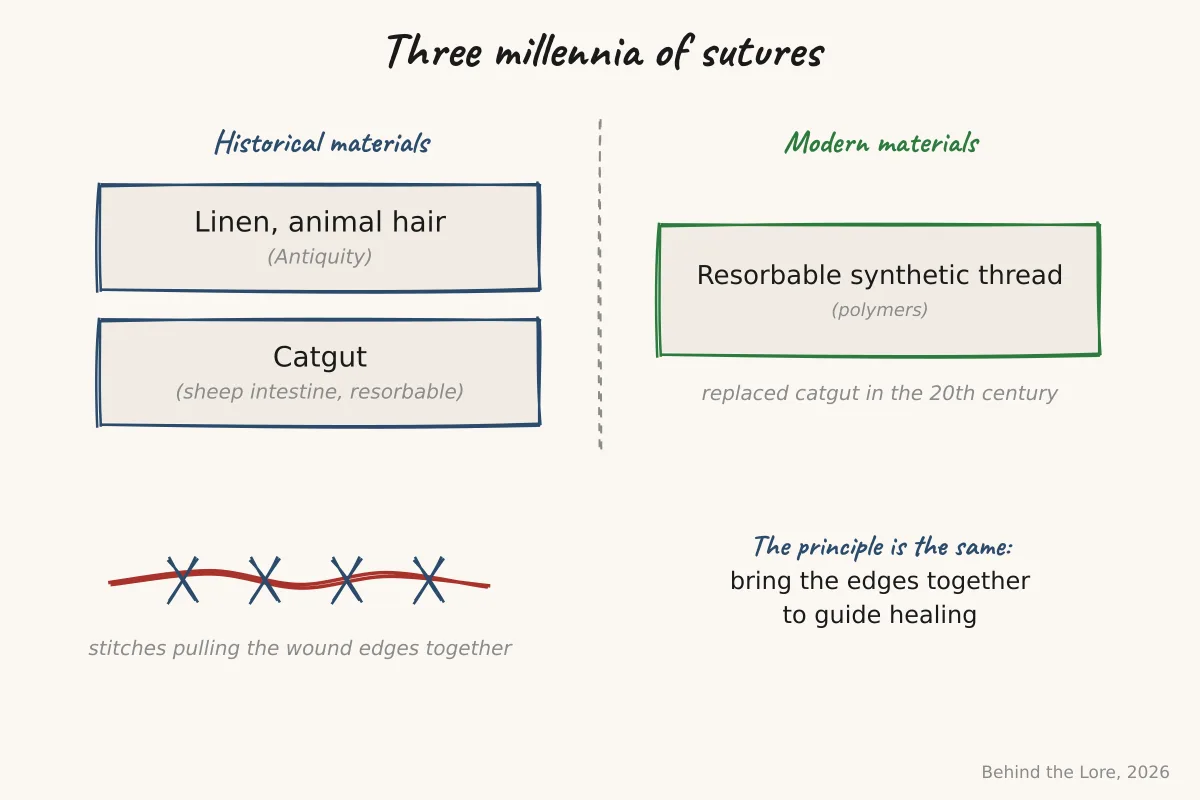
The materials used for suture thread have a history spanning three millennia. The oldest written accounts of sutures appear in the Edwin Smith surgical papyrus from ancient Egypt, dated to around 1600 BCE, which describes closing wounds by bringing the lips together. The Indian treatise Sushruta Samhita, compiled between the first and fourth centuries, lists different threads depending on the depth and location of the wound: horsehair, animal tendons, plant fibers. In China, imperial medicine also included wound-closure techniques, notably in military medical manuals.
Among biological materials, catgut deserves special attention. Made from the submucosa of sheep or cattle intestine, treated and dried into twisted strands, it has one key property: it’s resorbable. The body’s enzymes gradually break it down over days to weeks, which removes the need to remove the thread from deep sutures
[Wikipedia] . The name is misleading, the animal involved isn’t the cat, but likely a shortening of “kit gut,” referring to a stringed musical instrument. Catgut dominated surgery until the twentieth century before being gradually replaced.
A radically different closure technique, but resting on the same idea of bringing edges together, is attested in India, Africa, and South America: using the mandibles of ants or termites as natural staples. The insect’s head is applied to the manually-closed wound, its bite staples the two edges together, and the body is then detached, leaving the head in place until the wound heals. This method shows that a technical solution can be ingenious without being complex, as long as it achieves the desired result: keeping tissue in contact.
The number of stitches is not incidental. Each stitch distributes mechanical tension along the thread and preserves local blood supply between stitches. Too tight, and stitches strangle the tissue and delay healing; too spaced out, and they leave gaps unclosed. Fifteen stitches on a single wound indicate significant length or depth, and above all, real technical skill on the part of the physician who placed them.
Going further
Sources
Published on
Keep investigating
Auto-suggested from shared concepts, disciplines, episodes, or characters.
Mercury
In The Apothecary Diaries, quicksilver goes into a court poison. We explain mercury, its toxicity, and the immortality elixirs that killed emperors.
Aconite
In The Apothecary Diaries, aconite poisons even through honey. We explain aconitine, its action on nerves, and why it shows no mercy.
Autopsy and Forensic Medicine
In The Apothecary Diaries, a body is examined. We explain autopsy, post-mortem signs, and the birth of forensic medicine.
The Caesarean Section
Before antisepsis and anesthesia, caesarean section almost always killed the mother. We explain why, and what changed everything in the 19th century.
Castration and Eunuchs
In The Apothecary Diaries, Jinshi embodies the archetype of the court eunuch. We explain the real effects of castration by age, and the role of testosterone.