Food allergy: IgE and anaphylaxis
Story context (click to hide this block) (click to show this block)
This paragraph may contain plot information.
At the imperial banquet, the dishes meant for Lady Lishu and a minister get swapped. The minister eats the fish soup intended for Lishu and collapses; Maomao saves him by administering an emetic. When she later questions Lady Lishu, the young woman confirms she is allergic to fish. She even describes trying to desensitize herself by gradually exposing her body to small amounts of fish, without success: her airways would tighten, breathing would become difficult, and even a tiny dose triggered violent reactions that took a long time to subside. Maomao sums it up in a dry, accurate line: if someone had done this deliberately, it would be no different from poisoning.
The subject in depth
A food allergy is a type I immune hypersensitivity, also called immediate hypersensitivity
[Web] . It pits the body against food proteins that are, in themselves, perfectly harmless to most people.
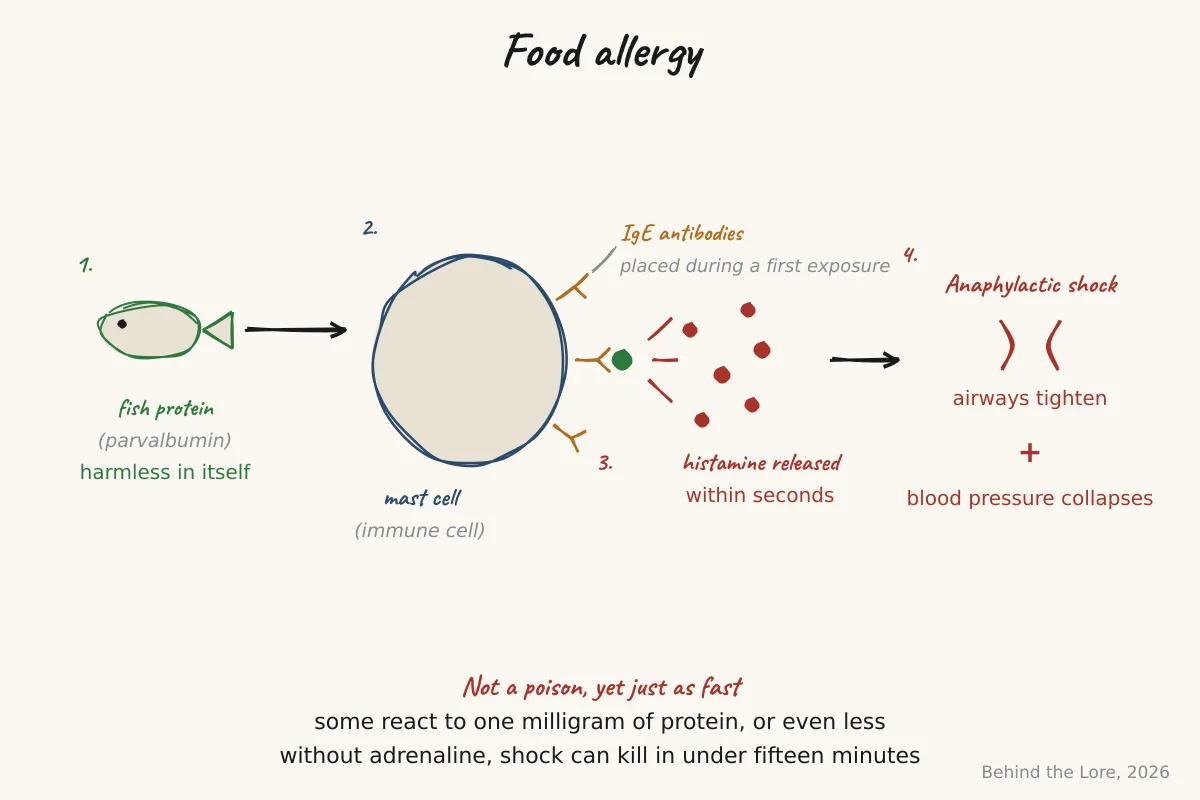
The IgE cascade
During a first exposure to the allergen, some people’s immune systems make a recognition error: they produce IgE-class antibodies specific to that protein, then attach them to the surface of mast cells (cells present in mucous membranes and tissues) and basophils (in the blood). This step, called sensitization, causes no visible symptoms.
On a later exposure, the allergen binds to the IgE already in place and triggers mast cell activation within seconds. The cells then release an arsenal of chemical mediators: histamine foremost, but also prostaglandins, leukotrienes, and tryptase. These mediators produce the symptoms, ranging from simple hives to anaphylactic shock [Web] .
In the case of fish, the major allergen is parvalbumin, a calcium-binding protein present in the muscle tissue of nearly all bony fish. It is heat-stable: cooking does not destroy it, contrary to what allergic people sometimes believe. A cooked soup can therefore trigger the same reaction as raw fish.
From the trigger threshold to anaphylaxis
One of the most fearsome features of IgE allergies is the trigger threshold, which can be extremely low. Some individuals react to trace amounts on the order of a milligram, or even less. This threshold varies from person to person, and in the same individual depending on fatigue, physical exertion, or a concurrent infection.
When the reaction goes beyond hives or rhinitis and affects at least two organs at once, or compromises breathing or circulation, it is called anaphylaxis. The most severe form, anaphylactic shock, combines bronchospasm (a sudden airway constriction that blocks airflow) with cardiovascular collapse (a drop in blood pressure from massive vasodilation and fluid leaking out of the blood vessels). Without prompt adrenaline injection, this can be fatal in under fifteen minutes.
Oral desensitization and its limits
Oral immunotherapy (OIT) consists of exposing the patient to increasing daily doses of the allergen over several months, in order to retrain the immune system toward tolerance. The principle is real and results exist: in several clinical trials on peanut, egg, or milk allergy, a significant proportion of patients achieve partial or complete desensitization.
For fish, results are markedly more disappointing. The wide diversity of parvalbumins across species, their strong resistance to heat and digestion, and the persistence of the IgE response despite treatment make fish OIT one of the most complex immunotherapies in the field. Lady Lishu’s failure, describing airways that tighten even at a tiny amount, matches this clinical picture precisely: a severe allergy with an IgE response too entrenched to be modulated by unsupervised, gradual exposure.
What the scene doesn’t say, but reality demands, is that any attempt at desensitization must take place under strict medical supervision, in a hospital setting for the first doses, with adrenaline on hand. Self-treatment of this kind is potentially fatal.
Going further
Sources
Published on
Keep investigating
Auto-suggested from shared concepts, disciplines, episodes, or characters.
Fugu and Tetrodotoxin
In The Apothecary Diaries, Maomao loves fugu and its poison. We explain tetrodotoxin, how it paralyzes, and why there's no antidote.
Dehydration and Rehydration
In The Apothecary Diaries, Maomao treats heatstroke with salted, sweetened water. We explain dehydration and why salt is vital.
Honey and Infant Botulism
In The Apothecary Diaries, honey kills a baby. We explain infant botulism: why honey is forbidden before age one, and safe afterward.
Sensory Detection of Poison
Maomao inspects the soup by sight and smell. We explain the food-taster method, how silver tarnishes, and why arsenic went undetected.
Bear Bile
Why did bear bile, a traditional TCM remedy, lead to a modern drug? UDCA dissolves gallstones and treats the liver.