False Pregnancy: Real Symptoms, No Baby
Story context (click to hide this block) (click to show this block)
This paragraph may contain plot information.
Maomao recalls cases she observed in the pleasure district: courtesans who had stopped menstruating and whose bellies had swollen, yet who were not carrying a child. She states the principle plainly: an obsessive fixation can reshape the body. In an environment where pregnancy is both hoped for and dreaded, and where anxiety runs chronic, the remark is not only clinical, it is social too.
The subject in depth
Pseudocyesis, from the Greek pseudès (false) and kyesis (pregnancy), refers to the appearance of biologically real signs of pregnancy in the complete absence of an embryo
[Wikipedia] . Signs can include the absence of periods (amenorrhea), abdominal distension that may reach several centimeters, increased breast sensitivity, even milk secretion (galactorrhea), and weight gain. The subjective conviction of being pregnant is often very strong, sometimes unshakeable even in the face of a clinical exam.
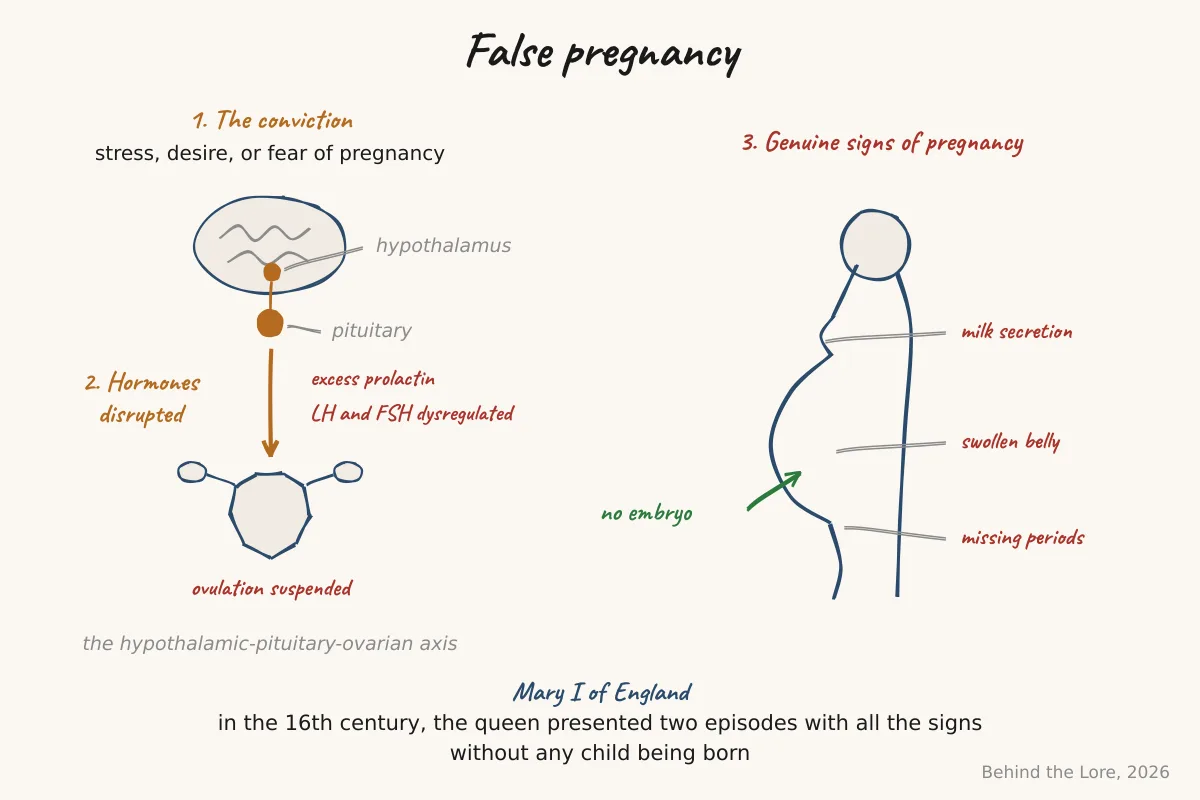
The mechanism is not a simulation or a conscious deception: it is neuroendocrine. Under the effect of intense stress, an obsessive desire for pregnancy, or extreme fear, the hypothalamic-pituitary axis disrupts the production of several key hormones [Wikipedia] . Prolactin, normally secreted in large amounts during pregnancy to prepare for lactation, can rise abnormally. The hormones that regulate the menstrual cycle, notably LH and FSH, become dysregulated and ovulation is suspended. Cortisol, the stress hormone, in turn disrupts the entire reproductive axis. The result is a body that reproduces, point by point, part of the physiology of pregnancy, with no fertilized egg involved at all.
Abdominal distension raises a separate question: unlike the other signs, it is not explained by any single, well-established mechanism. The leading hypotheses combine increased intestinal gas retention linked to stress, relaxation of the abdominal wall muscles, and, in some cases, a postural lordosis that pushes the belly forward. Together, these factors can produce an appearance visually very close to an advanced pregnant belly.
The condition is rare in populations with easy access to medical diagnosis, because an ultrasound is enough to rule out pregnancy. Historically, and in settings with limited medical examination, cases were far more numerous and long-lasting. Pseudocyesis is not unique to humans: it is observed in several mammals, notably dogs, rabbits, and some primates, where it is known as imaginary pregnancy or pseudogestation. In animals, the phenomenon appears to be linked to the same neuroendocrine circuits, which reinforces its deep biological origin rather than a purely cultural one.
Going further
Sources
Published on
Keep investigating
Auto-suggested from shared concepts, disciplines, episodes, or characters.
Hypothermia
In The Apothecary Diaries, cold threatens lives. We explain hypothermia, why cold-water immersion is so dangerous, and how to rewarm safely.
Carbon Monoxide
In The Apothecary Diaries, embers bring guests down at a party. We explain carbon monoxide, why it suffocates without warning, and the right thing to do.
Bear Bile
Why did bear bile, a traditional TCM remedy, lead to a modern drug? UDCA dissolves gallstones and treats the liver.
The Menstrual Cycle and Fertility
Maomao references the empirical knowledge of the fertile window. We explain the phases of the cycle, ovulation, hormones, and what ancient medicine actually knew.
Castration and Eunuchs
In The Apothecary Diaries, Jinshi embodies the archetype of the court eunuch. We explain the real effects of castration by age, and the role of testosterone.