The menstrual cycle: the science of fertility
Story context (click to hide this block) (click to show this block)
This paragraph may contain plot information.
In a conversation about the courtesans of the pleasure district, it’s mentioned that a courtesan who knows her cycle can estimate when she will be most fertile. The line is brief, almost offhand, but it says something important about how practically knowledgeable these women were: no molecular biology, no hormone testing, just an empirical observation of the body precise enough to identify a risky window or, depending on the circumstances, a sought-after one. In an imperial court setting where bearing an heir determined one’s rank, this knowledge carried considerable value.
The subject in depth
The menstrual cycle is the process by which the female body prepares each month for a potential pregnancy [Wikipedia] . Its length varies from 21 to 35 days depending on the individual, with an average of 28 days often used as a teaching reference.
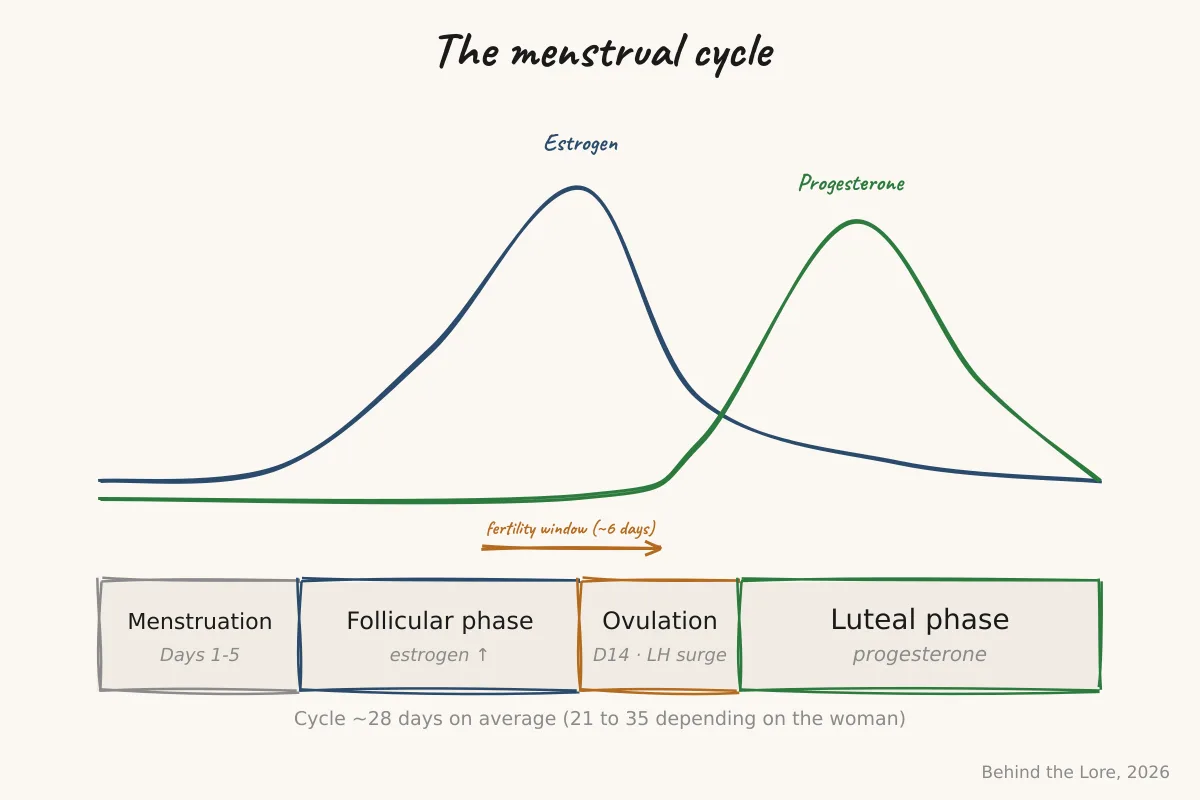
The four phases. The cycle begins with menstruation (the menstrual phase, roughly days 1 to 5): the uterine lining built up during the previous cycle is shed. Next comes the follicular phase: driven by FSH (follicle-stimulating hormone), several ovarian follicles begin maturing in the ovary. One becomes dominant and secretes increasing amounts of estrogen, which rebuilds the uterine lining and prepares the cervix. Around day 12 to 14, estrogen levels peak, triggering a sharp surge of LH (luteinizing hormone), the direct signal for ovulation [Wikipedia] . The ovary releases the egg: this is ovulation. The luteal phase then begins, during which the ruptured follicle turns into the corpus luteum and secretes progesterone. This hormone thickens the uterine lining to favor implantation. Without fertilization, the corpus luteum breaks down after about ten days, estrogen and progesterone levels drop, and menstruation resumes.
The fertility window. The released egg is only viable for 12 to 24 hours. Sperm, on the other hand, can survive in the female reproductive tract for up to five days. The fertility window therefore spans about six days: the five days before ovulation plus the day of ovulation itself. This is what gynecologists Kyusaku Ogino (1924, Japan) and Hermann Knaus (1929, Austria) independently formalized, giving rise to the Ogino-Knaus method, the first attempt at natural contraception based on cycle tracking.
The role of hormones. Estrogen dominates the first half of the cycle: it stimulates follicular growth, thickens the uterine lining, and thins the cervical mucus to ease sperm passage. Progesterone takes over after ovulation: it makes the lining receptive, thickens the mucus to block further sperm, and sustains pregnancy if implantation occurs. The two hormones work in tandem, each dominating one half of the cycle.
Going further
Sources
Published on
Keep investigating
Auto-suggested from shared concepts, disciplines, episodes, or characters.
Lead White Makeup
In The Apothecary Diaries, white makeup kills courtesans. We explain why this ceruse-based cosmetic caused deadly lead poisoning.
Mercury
In The Apothecary Diaries, quicksilver goes into a court poison. We explain mercury, its toxicity, and the immortality elixirs that killed emperors.
Orpiment and Arsenic
In The Apothecary Diaries, a yellow pigment poisons slowly. We explain orpiment, arsenic, and the chronic poisoning of court painters.
Prosopagnosia
In The Apothecary Diaries, Lakan cannot recognize faces. We explain prosopagnosia, the brain's fusiform face area, and this real neurological disorder.
False Pregnancy
A swollen belly, missing periods, milk without pregnancy: The Apothecary Diaries describes pseudocyesis. The hormonal and psychological mechanism.