Prosopagnosia: a brain blind to faces
Story context (click to hide this block) (click to show this block)
This paragraph may contain plot information.
In the final episode of season 1, Maomao explains to Jinshi why Lakan behaves so oddly with the people he meets. He is unable to recognize other people’s faces. He can make out individual features, but not put them together into a whole. To him, every face looks alike. In a few words, she states a diagnosis that, in reality, took decades to be formalized by modern neurology.
The subject in depth
Prosopagnosia, also called face blindness, is a perceptual disorder that makes it impossible to identify a face (even that of a loved one, or one’s own in a mirror) while vision is otherwise normal [Wikipedia] . A person with this disorder sees the eyes, nose, mouth, and hairstyle perfectly well. What they cannot do is merge all these elements into a single overall percept that triggers recognition of an identity.
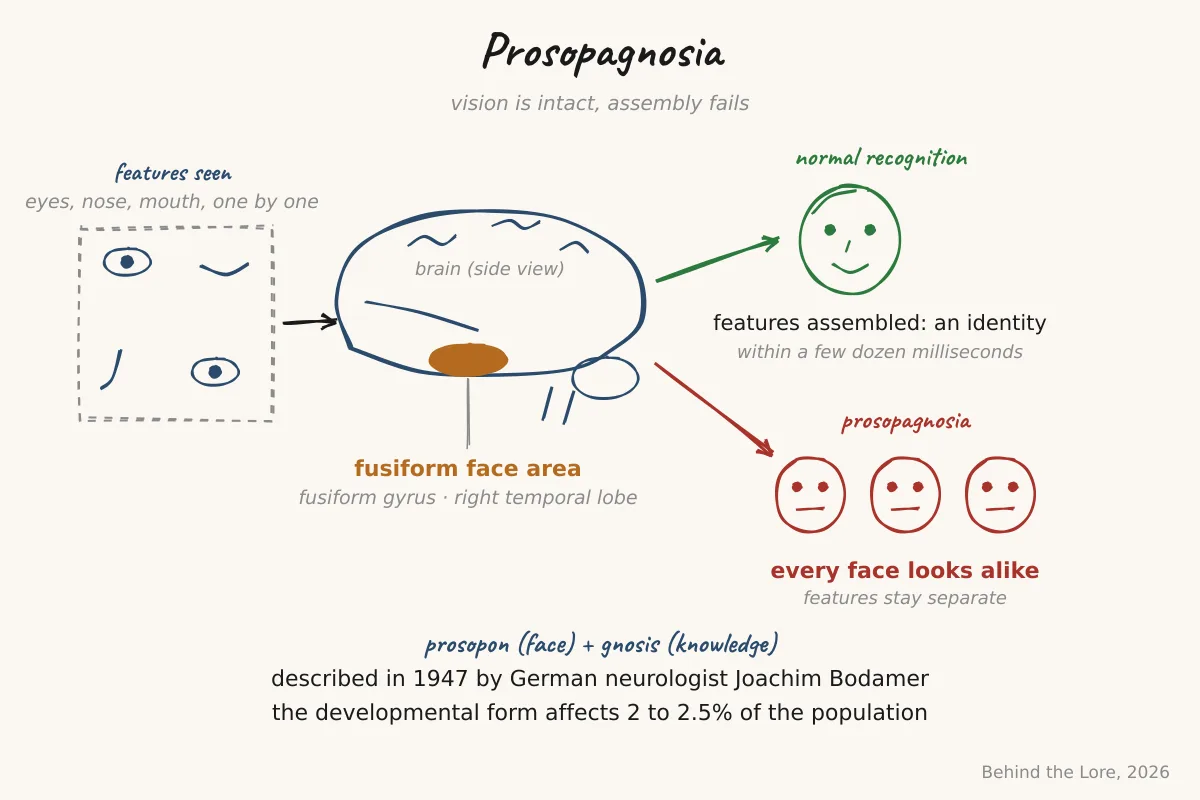
This distinction between perceiving the parts and perceiving the whole is not trivial. Recognizing a face is not adding up features one by one: it relies on so-called holistic, or configural, processing, which grasps the face as an overall configuration. The fusiform face area, a specialized region of the fusiform gyrus in the right temporal lobe, is the brain structure at the heart of this mechanism. When it works normally, it responds selectively to faces seen head-on and builds this overall representation within a few dozen milliseconds.
Neurologists distinguish two main forms. The acquired form follows a localized brain injury, often a vascular or traumatic lesion of the right temporal lobe: recognition was normal, then it disappeared overnight. The developmental form, also called congenital, involves no visible lesion; the person simply never developed the ability to recognize faces, sometimes without knowing why until adulthood. Population studies estimate that this developmental form affects about 2 to 2.5% of people, making it a more common disorder than generally believed.
People with prosopagnosia are not left without resources, though. They learn to identify loved ones through other cues: voice, gait, hairstyle, the context of the encounter, a distinctive piece of clothing. These compensatory strategies work well in familiar environments but break down as soon as the context changes, for example, when someone wears a hat they don’t usually wear, or when you run into a colleague on the street instead of at the office.
Going further
Sources
Published on
Keep investigating
Auto-suggested from shared concepts, disciplines, episodes, or characters.
Carbon Monoxide
In The Apothecary Diaries, embers bring guests down at a party. We explain carbon monoxide, why it suffocates without warning, and the right thing to do.
Honey and Infant Botulism
In The Apothecary Diaries, honey kills a baby. We explain infant botulism: why honey is forbidden before age one, and safe afterward.
Hypothermia
In The Apothecary Diaries, cold threatens lives. We explain hypothermia, why cold-water immersion is so dangerous, and how to rewarm safely.
The Menstrual Cycle and Fertility
Maomao references the empirical knowledge of the fertile window. We explain the phases of the cycle, ovulation, hormones, and what ancient medicine actually knew.
Color Blindness
In The Apothecary Diaries, red-green color blindness unlocks a dynastic mystery. We explain cone cells, the X chromosome, and prevalence.