Red-Green Color Blindness: Genes and Heredity
Story context (click to hide this block) (click to show this block)
This paragraph may contain plot information.
In the Shrine of Choosing, Maomao discovers a labyrinth of colored doors whose inscriptions are legible only to someone who cannot tell red from green. She traces the thread back to the founding myth: the foreign empress dowager who “could see in the dead of night” was not gifted with divine powers. She simply could not distinguish certain colors, and this hereditary trait passed down to her male descendants generation after generation. The women of the line carried the gene without being affected by it and served as “guides” through the shrine. Maomao lays out the reasoning in a few sentences: doors indistinguishable to a normal trichromat are obvious to someone who confuses red and green, and the prevalence of the trait in the West, about one man in ten, explains why the trial could still be passed centuries after the empress dowager’s time.
The subject in depth
Human color vision relies on three types of photoreceptor cells in the retina, the cones, each sensitive to a range of the light spectrum [Wikipedia] . S (short) cones respond to blue-violet, M (medium) cones to green, and L (long) cones to red-orange. Each cone owes its sensitivity to a specific pigment, a protein called opsin, whose shape determines which wavelength it absorbs best. The brain combines the signals from all three types to reconstruct the perceived color: this is trichromacy.
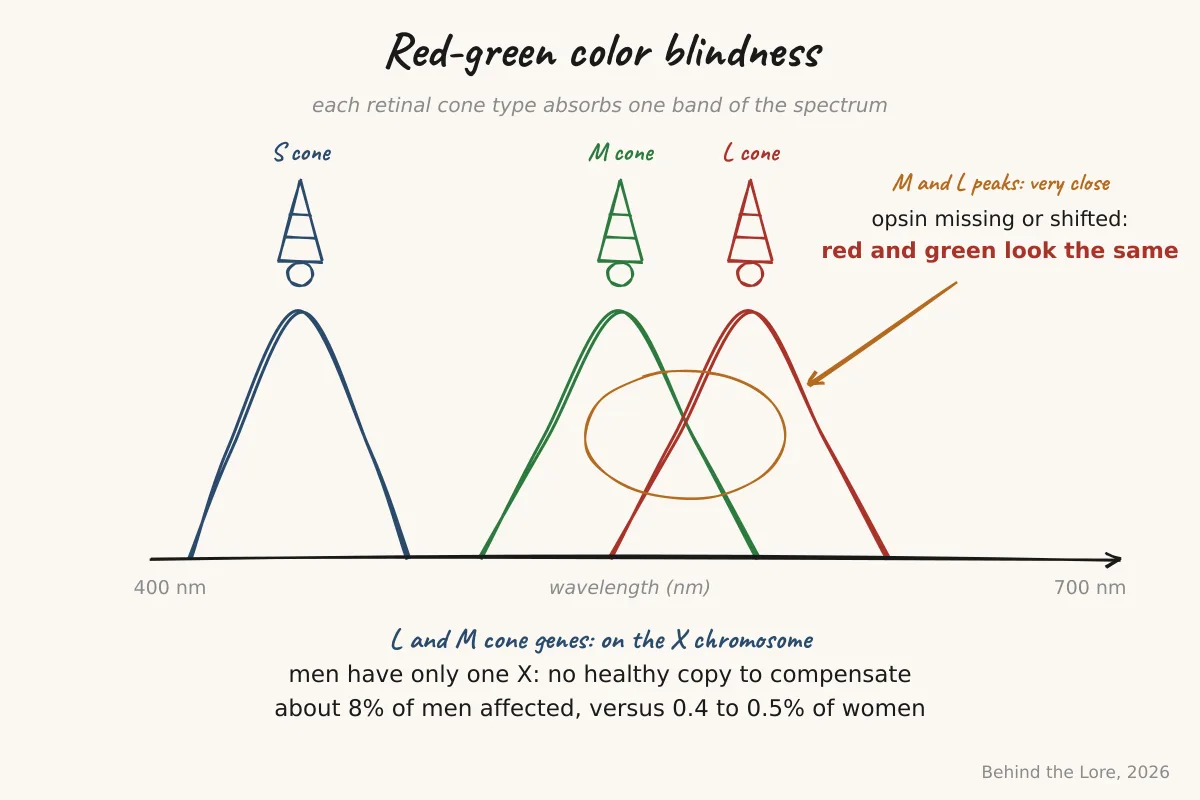
Red-green color blindness occurs when the opsin in the L or M cones is missing, non-functional, or spectrally shifted. If the L cones are affected, it is called protanopia (or protanomaly, depending on severity); if the M cones are affected, deuteranopia (or deuteranomaly) [Wikipedia] . In both cases, the practical result is confusion between red, orange, and green hues, which become difficult or impossible to distinguish. The most common form is deuteranomaly, where the sensitivity of the M cone is simply shifted toward red rather than absent, producing degraded but not totally green-blind vision.
What ties red-green color blindness to the X chromosome is the location of the genes involved. The OPN1LW (red opsin) and OPN1MW (green opsin) genes both sit on the X chromosome, in a region called Xq28. A man (XY) has only one copy of the X chromosome: if that chromosome carries a defective copy of either gene, no healthy copy can compensate for it, and he will be color blind. A woman (XX) has two X chromosomes; a single functional copy is enough to produce normal opsins and compensate for the mutant copy. She becomes a carrier: she passes the gene on to her children without being affected herself in most cases. A son of a carrier has a one-in-two chance of inheriting the X chromosome carrying the mutation, and will be color blind; a daughter of a carrier has a one-in-two chance of becoming a carrier in turn.
This mechanism fully explains the pattern described in the episode: the men of the line are color blind, and the women are the carriers who pass the trait down from generation to generation without ever having to pass the trial themselves.
Going further
Sources
Published on
Keep investigating
Auto-suggested from shared concepts, disciplines, episodes, or characters.
Hypothermia
In The Apothecary Diaries, cold threatens lives. We explain hypothermia, why cold-water immersion is so dangerous, and how to rewarm safely.
Carbon Monoxide
In The Apothecary Diaries, embers bring guests down at a party. We explain carbon monoxide, why it suffocates without warning, and the right thing to do.
Mercury
In The Apothecary Diaries, quicksilver goes into a court poison. We explain mercury, its toxicity, and the immortality elixirs that killed emperors.
Inbreeding
In The Apothecary Diaries, Maomao brings up dynastic inbreeding. We explain why unions between close relatives raise genetic risk.
Night Vision
In The Apothecary Diaries, seeing in the dark is a real biological trait. We explain rods, rhodopsin, and dark adaptation.