Dynastic Inbreeding Explained
Story context (click to hide this block) (click to show this block)
This paragraph may contain plot information.
At the end of the episode set at the Selection Pavilion, Maomao puts forward a surgical hypothesis: excessive inbreeding within the imperial lineage might explain the premature deaths of the previous emperor’s brothers. She frames this as a hypothesis, not a certainty, which is scientifically honest. The episode has already shown that sisters served as both mothers and close relatives to the princes, sketching exactly the pattern of tight kinship at the top of the state.
The subject in depth
Our genome carries two copies of every gene, one inherited from the father, one from the mother. Most people carry a few deleterious recessive alleles, genetic variants capable of causing a disease or serious abnormality when present in two copies. As long as an individual carries only one copy, the functional version supplied by the other parent masks the recessive allele: it stays silent [Wikipedia] .
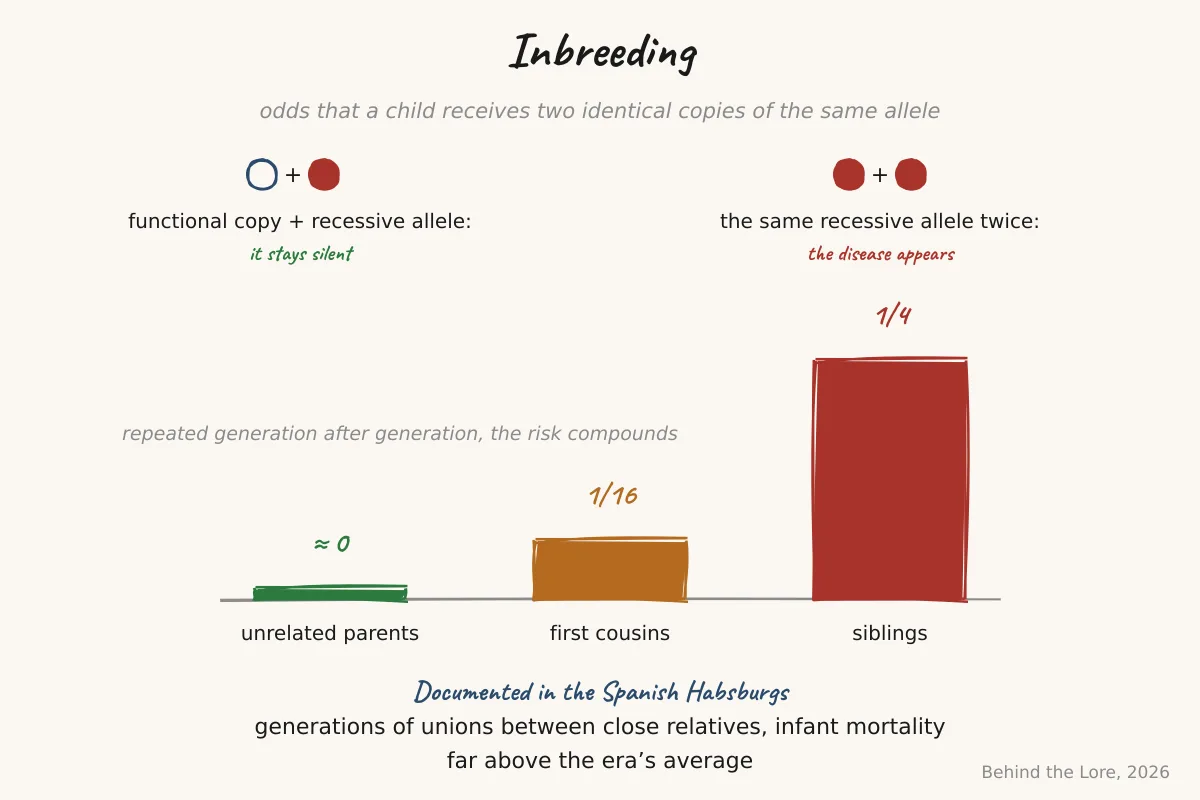
The problem arises when two related individuals have children. Sharing one or more common ancestors, they share a fraction of their genetic makeup, including any deleterious recessive alleles inherited from those shared ancestors. Their offspring therefore run a significantly higher risk of receiving the same deleterious allele from both sides, carrying it in homozygous form, and thus developing the corresponding disease.
This risk is quantified by the inbreeding coefficient, which measures the probability that an individual is homozygous for a given allele because of their relatedness [Wikipedia] . A child of unrelated parents has a coefficient near zero for family alleles. A child of first cousins has a coefficient of 1/16; a child of siblings, 1/4. This increase may seem modest in absolute terms, but it compounds generation after generation if inbred unions continue, accumulating and concentrating deleterious recessive alleles within the lineage.
The overall phenomenon is called inbreeding depression. Statistically, it shows up as higher infant and juvenile mortality, a greater frequency of recessive hereditary diseases, and reduced overall vigor. Conversely, outbreeding (pairing with genetically distant individuals) tends to mask each lineage’s deleterious recessive alleles and produce more robust offspring: this is the phenomenon of heterosis, or hybrid vigor.
Going further
Sources
Published on
Keep investigating
Auto-suggested from shared concepts, disciplines, episodes, or characters.
Color Blindness
In The Apothecary Diaries, red-green color blindness unlocks a dynastic mystery. We explain cone cells, the X chromosome, and prevalence.
Night Vision
In The Apothecary Diaries, seeing in the dark is a real biological trait. We explain rods, rhodopsin, and dark adaptation.
Bear Bile
Why did bear bile, a traditional TCM remedy, lead to a modern drug? UDCA dissolves gallstones and treats the liver.
Castration and Eunuchs
In The Apothecary Diaries, Jinshi embodies the archetype of the court eunuch. We explain the real effects of castration by age, and the role of testosterone.
Cordyceps
In The Apothecary Diaries, Maomao imagines a fungus that could grow on humans. We explain cordyceps, the real 'zombie' parasite of insects.