Night Vision: Rods and Rhodopsin
Story context (click to hide this block) (click to show this block)
This paragraph may contain plot information.
During the trial at the selection pavilion, Maomao connects the founding myth of the foreign empress dowager, said to have “seen in pitch darkness,” to a precise biological trait: good night vision paired with red-green color confusion. This supposedly divine gift turns out not to be a miracle but a quirk of the retina, plausible in people with red-green color blindness.
The subject in depth
The retina contains two types of photoreceptors. Cones, concentrated at the center, distinguish colors but require abundant light. Rods, far more numerous (roughly one hundred twenty million versus six million cones), are spread across the periphery and are specialized in detecting faint light
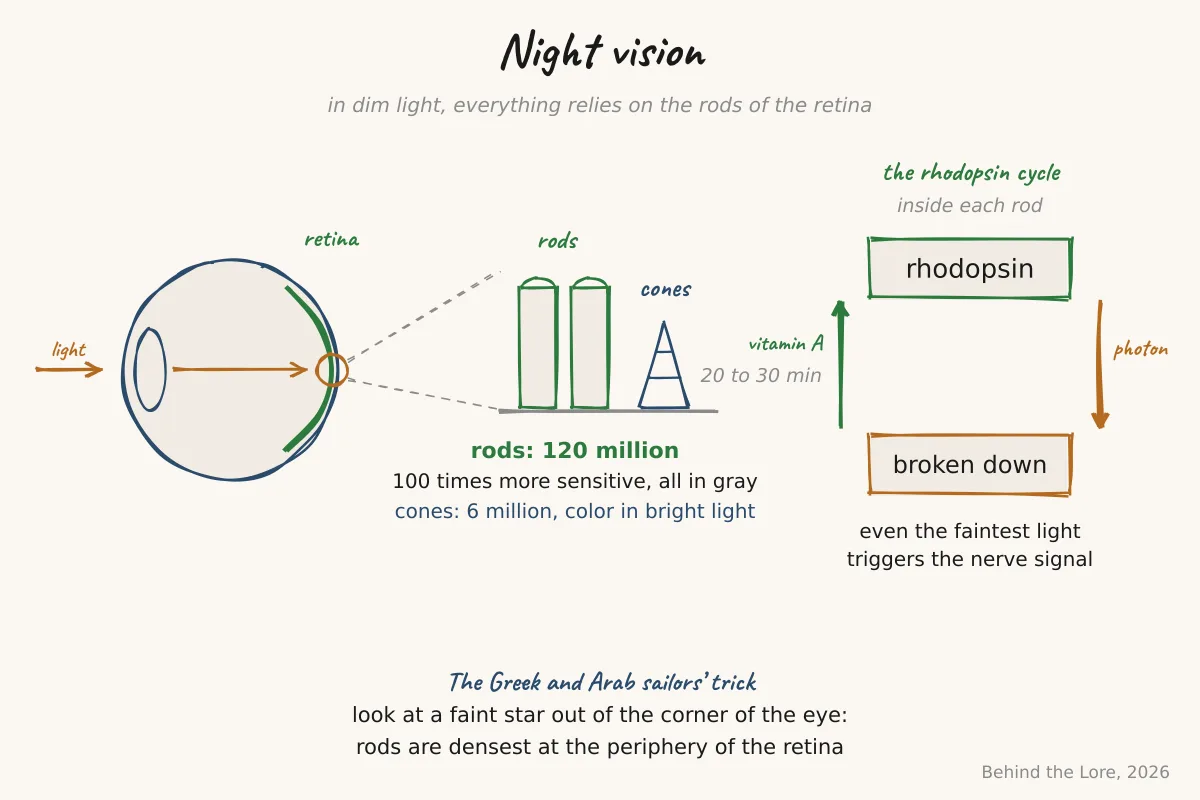
What makes rods so sensitive is their pigment: rhodopsin. This molecule is formed from a protein, opsin, bound to a derivative of vitamin A. When a photon strikes rhodopsin, it changes shape and triggers a cascade of nerve signals, even for a tiny amount of light [Wikipedia] . Rhodopsin is then broken down and slowly regenerated, which is why dark adaptation takes time: it takes twenty to thirty minutes in darkness for rods to reach full sensitivity.
Rods do have an important limitation, though: they contain only one type of opsin, insensitive to differences in wavelength between colors. They detect the amount of light, not its hue. Night vision is therefore vision in shades of gray, a universal constant in humans.
Vitamin A deficiency directly disrupts this system. Without a sufficient intake, rhodopsin fails to regenerate properly, resulting in hemeralopia: difficulty seeing in darkness, commonly known as “night blindness.” It’s one of the best-documented consequences of a diet poor in vitamin A.
Going further
Sources
Published on
Keep investigating
Auto-suggested from shared concepts, disciplines, episodes, or characters.
Hypothermia
In The Apothecary Diaries, cold threatens lives. We explain hypothermia, why cold-water immersion is so dangerous, and how to rewarm safely.
Mercury
In The Apothecary Diaries, quicksilver goes into a court poison. We explain mercury, its toxicity, and the immortality elixirs that killed emperors.
Color Blindness
In The Apothecary Diaries, red-green color blindness unlocks a dynastic mystery. We explain cone cells, the X chromosome, and prevalence.
Inbreeding
In The Apothecary Diaries, Maomao brings up dynastic inbreeding. We explain why unions between close relatives raise genetic risk.
Bear Bile
Why did bear bile, a traditional TCM remedy, lead to a modern drug? UDCA dissolves gallstones and treats the liver.