Cordyceps: The Parasitic Fungus
Story context (click to hide this block) (click to show this block)
This paragraph may contain plot information.
At the end of the episode, after showing that fungi have grown on a body buried in the palace gardens, Maomao lets her thoughts drift to a question: what if a fungus grew directly on humans, what would it be for? The reverie is brief, almost murmured, but it touches on a well-documented biological reality. What Maomao glimpses is exactly what cordyceps do to insects: they take them over, make them act to their advantage, then turn them into a platform for spore production. The episode is in fact titled “Corpse Fungus,” a literal translation of the Chinese name for this type of organism.
The subject in depth
The term “cordyceps” historically referred to a genus of fungi in the order Hypocreales, most of whose entomopathogenic species have since been reclassified into the neighboring genus Ophiocordyceps [Wikipedia] . In everyday usage, the word “cordyceps” covers this whole group of arthropod-parasitizing fungi, and that is the sense used here.
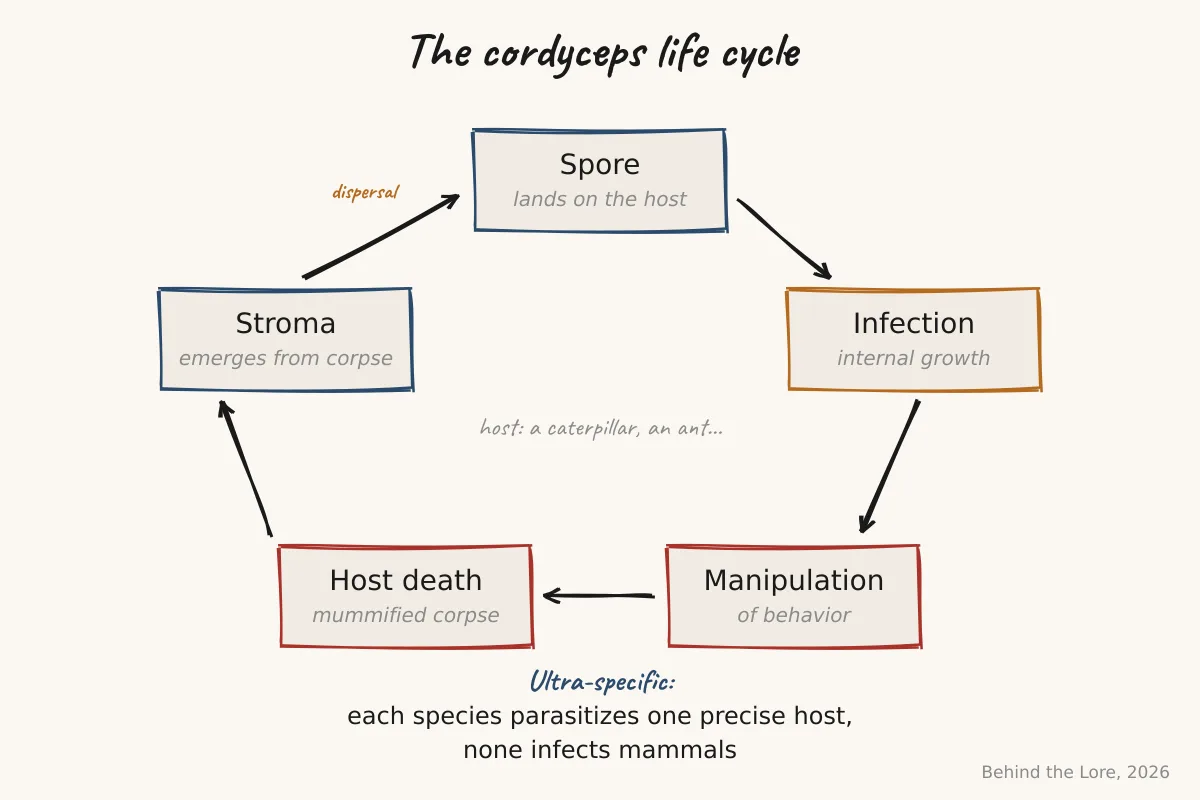
Their life cycle follows an implacable logic. A spore released into the environment lands on the cuticle of a suitable host insect. It germinates, breaks through the outer shell, and begins developing inside the body, gradually feeding on non-vital tissue to keep the host alive as long as possible. At an advanced stage of infection, the fungus takes control of the insect’s behavior. Ophiocordyceps unilateralis, which parasitizes tropical carpenter ants, is the most studied example: the infected ant climbs a plant stem to a precise height, clamps onto it with its mandibles, and dies in that position. The fungus then grows its stroma (an elongated structure) from the corpse’s head, and releases its spores onto the ants passing below. The elevated position maximizes dispersal.
This behavioral-manipulation mechanism is remarkable because it is ultra-specific: each cordyceps species parasitizes one precise host, or a very closely related group of hosts. The chemical recognition between fungus and host relies on molecular signals unique to each parasite-host pair, which makes a jump to a non-target species biologically very unlikely. This specificity is the key to understanding why a cordyceps infecting humans belongs to fiction, not to real biology.
Among the species best documented for their use in traditional medicine, Ophiocordyceps sinensis holds a special place [Wikipedia] . Known in Chinese as dong chong xia cao (literally “winter worm, summer grass”) and in Tibetan as yartsa gunbu, this caterpillar fungus parasitizes the larvae of the moth Thitarodes tibetanus in the Tibetan alpine grasslands, between 3,500 and 5,000 meters in altitude. The visible result is a mummified larva from which a brown fungal stroma emerges. Harvested and dried, these composite bodies have been used for centuries in Chinese and Tibetan pharmacopoeia as tonics believed to boost vitality, improve physical performance, and act as aphrodisiacs. Their rarity and the difficulty of harvesting at altitude make them one of the most expensive natural products in the world.
It is important to separate these traditional uses from what science actually validates: certain molecules isolated from cordyceps, such as cordycepin (3’-deoxyadenosine), are the subject of pharmacological research. In vitro and animal-model studies show promise for certain immunomodulatory and anti-inflammatory activities, but rigorous human clinical trials remain insufficient to validate the most widespread performance claims.
Going further
- Aconite
- Rhododendron and mad honey
- Honey and infant botulism
- Discipline: Biology
- Discipline: Medicine
Sources
Published on
Keep investigating
Auto-suggested from shared concepts, disciplines, episodes, or characters.
Honey and Infant Botulism
In The Apothecary Diaries, honey kills a baby. We explain infant botulism: why honey is forbidden before age one, and safe afterward.
Aconite
In The Apothecary Diaries, aconite poisons even through honey. We explain aconitine, its action on nerves, and why it shows no mercy.
Rhododendron and Mad Honey
In The Apothecary Diaries, a tainted honey and a burned plant cause poisoning. We explain rhododendron's grayanotoxins and the famous mad honey.
Bear Bile
Why did bear bile, a traditional TCM remedy, lead to a modern drug? UDCA dissolves gallstones and treats the liver.
Earthworms in Medicine
Maomao thinks of earthworms as a fever remedy. We explain dilong in traditional Chinese medicine and the lumbrokinases studied in modern pharmacology.