Castration and Eunuchs: Biology and History
Story context (click to hide this block) (click to show this block)
This paragraph may contain plot information.
The episode is titled “The Eunuch and the Courtesan” and places Jinshi at the center of a banquet where the courtesans’ eyes never leave him. His beauty is described as unsettling, androgynous, out of the ordinary: soft features, a distinctive voice, a slender frame. The show doesn’t explain it through a line of physiology dialogue, but it sets up the archetype of the court eunuch, whose distinctive appearance is not a narrative accident but the reflection of precise endocrinological reality.
The subject in depth
Testosterone is the male sex hormone produced mainly by the testes [Wikipedia] . Its action unfolds mostly at puberty: it triggers the voice change by making the laryngeal cartilage grow, stimulates facial and body hair, speeds the closure of the growth plates (the growing zones of the long bones), and increases muscle mass. Surgical castration removes this production [Wikipedia] .
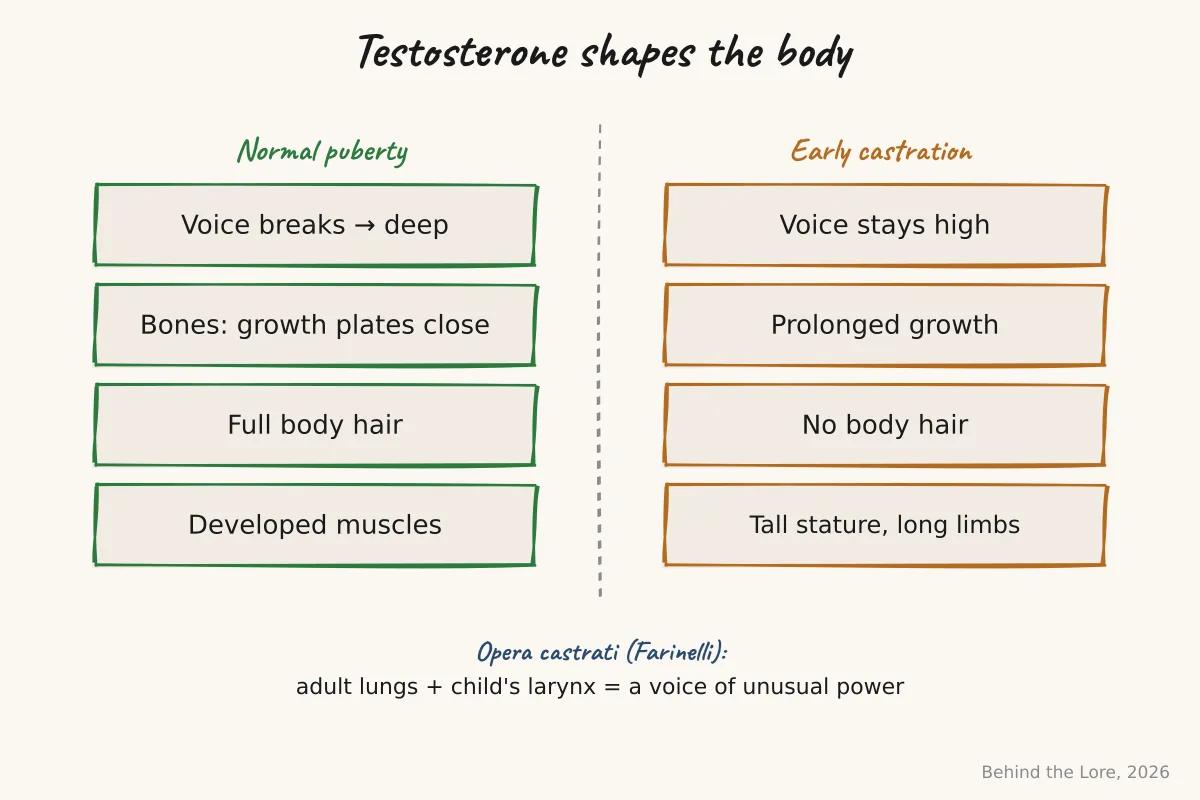
The age at which castration occurs radically changes its effects.
Before puberty, testosterone has not yet acted on these targets. The larynx does not undergo the growth that causes the voice to break: it stays high-pitched, close to a child’s voice, with an extended upper range. The long bones, deprived of the closure signal testosterone provides, keep growing longer than normal, resulting in elongated limbs and often tall stature, with a limb-to-torso ratio doctors call eunuchoid proportions. Male hair growth stays absent or very limited, facial features retain a fineness close to adolescence, and muscle mass remains lower than that of a non-castrated adult male.
After puberty, the effects differ. The voice has already broken, the bones have already closed their growth plates: voice and stature no longer change. Castration then causes a gradual decline in libido, loss of muscle mass, and reduced hair growth, but without the characteristic morphological profile of eunuchs castrated early.
It is therefore exclusively prepubertal castration that produces the appearance described in the show: a slender stature, a beardless face, a high voice, and a silhouette halfway between male and female morphology.
Going further
- Mercury and Cinnabar
- Orpiment and Arsenic
- Discipline: Medicine
- Discipline: History of Science
- Discipline: Biology
Sources
Published on
Keep investigating
Auto-suggested from shared concepts, disciplines, episodes, or characters.
Mercury
In The Apothecary Diaries, quicksilver goes into a court poison. We explain mercury, its toxicity, and the immortality elixirs that killed emperors.
Orpiment and Arsenic
In The Apothecary Diaries, a yellow pigment poisons slowly. We explain orpiment, arsenic, and the chronic poisoning of court painters.
Autopsy and Forensic Medicine
In The Apothecary Diaries, a body is examined. We explain autopsy, post-mortem signs, and the birth of forensic medicine.
Physic Garden
The physic garden is the cradle of plant-based pharmacopoeia. Monasteries, universities, imperial China: the history of a centuries-old place of knowledge.
Bear Bile
Why did bear bile, a traditional TCM remedy, lead to a modern drug? UDCA dissolves gallstones and treats the liver.