Public baths and hygiene: were hot baths actually healthy?
Story context (click to hide this block) (click to show this block)
This paragraph may contain plot information.
Maomao, Shisui and Xiaolan head to the communal baths of the inner palace. Maomao describes an arrangement by rank: a private room for the favorites, another for the consorts, a large shared pool for the maids, while common folk make do with a quick wipe-down. The soap from the infirmary stings the eyes, and the first dip is cut short: the water is scalding, and they have to wait for it to cool a little before getting in.
The subject in depth
Long before modern soaps, public baths and hygiene went hand in hand. A public bath is a place of bodily hygiene shared by people who do not live in the same home, and access to it has often been restricted by sex, religion or social rank [Wikipedia] . The court Maomao describes follows exactly this logic.
What does a hot bath do to the body?
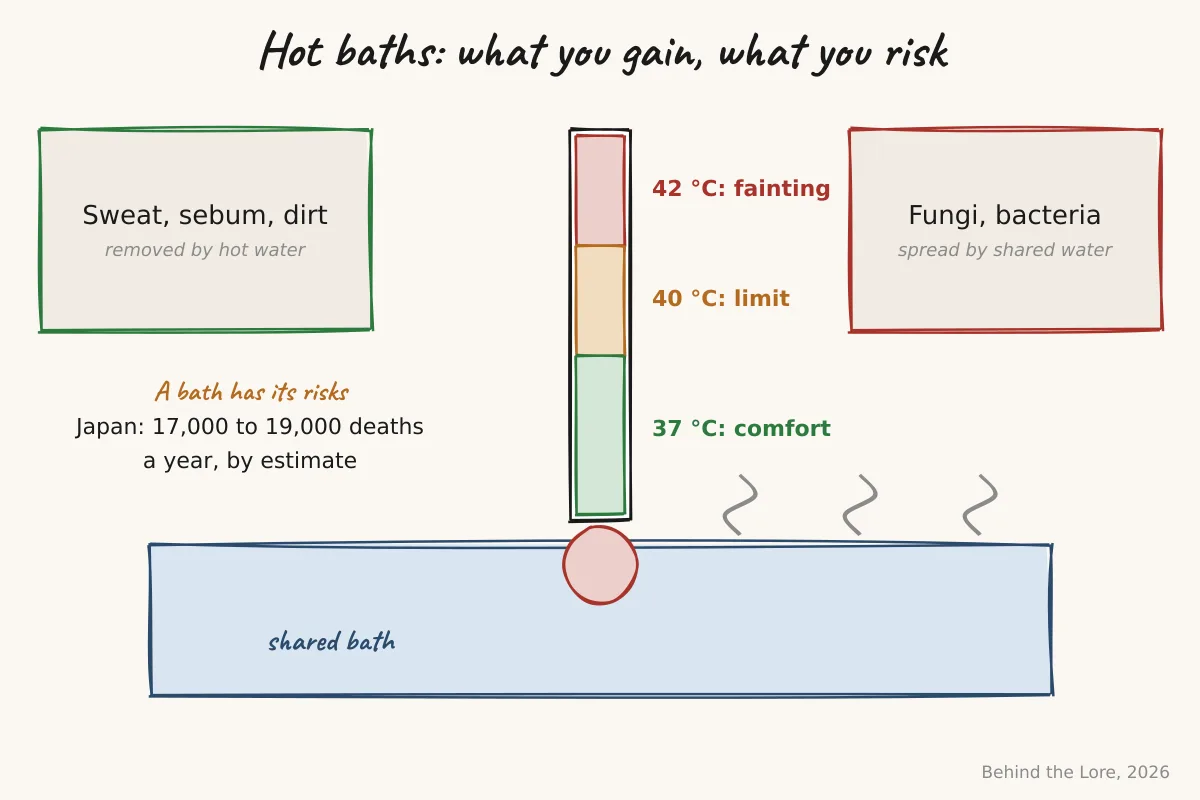
Hot water softens the outer layer of the skin and makes sebum more fluid, the oily film that traps sweat, dust and flakes of dead skin. Rubbing and soap then carry them away. At the same time, the body fights the heat it receives: it widens the blood vessels of the skin to shed the excess, a mechanism of vasodilation at the heart of thermoregulation [Wikipedia] . This muscular and vascular relaxation explains the feeling of well-being after a bath. A hot bath taken in the evening also shortens the time it takes to fall asleep [Étude] .
Did communal baths protect against parasites?
Not as much as one might think. A review of archaeological remains from the Roman world shows that lice, fleas and bedbugs remained widespread despite the baths, latrines and aqueducts, and that no evidence indicates regular public bathing reduced these ectoparasites [Étude] . Washing removes grime, not the nits glued to hair nor the insects hiding in clothing.
Which infections spread in shared water?
The damp floors of baths and changing rooms favor athlete’s foot, a fungal infection between the toes caused by dermatophytes of the genera Trichophyton, Epidermophyton or Microsporum [Wikipedia] . In hot, stagnant water that is poorly renewed, the bacterium Pseudomonas aeruginosa causes folliculitis , red bumps around the hairs [Wikipedia] . Outbreaks of Legionnaires’ disease, a pneumonia spread by water droplets, have also been traced to poorly disinfected hot tubs [Wikipedia] .
At what temperature does a bath become dangerous?
Water at around 37 °C (99 °F) is considered safe for a healthy adult, and the US Consumer Product Safety Commission recommends never exceeding 40 °C (104 °F) in a hot tub [Wikipedia] . Beyond that, vasodilation makes blood pressure drop during immersion. On standing up, blood stays in the legs: this is orthostatic hypotension , which can cause loss of consciousness and a slide under the water [Étude] . In Japan, a frequently cited estimate, extrapolated from regional data, puts bath-related deaths at about 19,000 a year, another at about 17,000, mostly in winter and among older people; official statistics underestimate these deaths, which are often certified as cardiac or cerebral [Étude] .
Going further
- Soap: the chemistry of saponification and pH
- Drinking Water and Waterborne Diseases: how pathogens spread through water
- Hot Springs and Sulfur: the geothermal origin of natural hot water
- Discipline: Medicine
- Discipline: Microbiology
- Discipline: Biology
Glossary
- Sebum ↗
- Oily film secreted by the skin's glands. It protects the outer skin but traps sweat, dust and flakes of dead skin if it is not removed.
- Vasodilation ↗
- Widening of the blood vessels. In hot water, the skin fills with blood to shed heat, which lowers blood pressure.
- Ectoparasite ↗
- Parasite that lives on the surface of its host's body, such as lice, fleas or bedbugs.
- Dermatophyte ↗
- Microscopic fungus that feeds on keratin (skin, nails, hair) and causes fungal infections such as athlete's foot.
- Folliculitis ↗
- Inflammation of the hair roots, often caused by a bacterium, which produces small red bumps.
- Orthostatic hypotension ↗
- Sudden drop in blood pressure when standing up, which can cause dizziness or fainting.
Sources
- Public baths, French Wikipedia [Wikipedia]
- Public bathing, English Wikipedia [Wikipedia]
- Thermae, French Wikipedia [Wikipedia]
- Huaqing Pool, English Wikipedia [Wikipedia]
- Thermoregulation, French Wikipedia [Wikipedia]
- Athlete’s foot, French Wikipedia [Wikipedia]
- Hot tub folliculitis, English Wikipedia [Wikipedia]
- Hot tub, English Wikipedia [Wikipedia]
- Mitchell P. D., Human parasites in the Roman World, Parasitology, 2016 [Étude]
- Tochihara Y., A review of Japanese-style bathing: its demerits and merits, J. Physiol. Anthropol., 2022 [Étude]
- Tochihara Y. et al., Why do many elderly Japanese die suddenly during winter bathing?, Int. J. Biometeorol., 2026 [Étude]
Published on
Keep investigating
Auto-suggested from shared concepts, disciplines, episodes, or characters.
Drinking Water and Waterborne Diseases
Heat kills the bacteria, viruses and parasites behind cholera, typhoid and dysentery. How boiling works, the main waterborne diseases, and John Snow's discovery.
Soap
In The Apothecary Diaries, dispensary soap stings the eyes. We explain saponification, amphiphilic molecules, and micelles.
Hot Springs and Sulfur
In The Apothecary Diaries, hot springs provide sulfur for gunpowder. We explain the geothermal gradient, the smell, and native sulfur deposits.
Castration and Eunuchs
Castration before puberty keeps the voice high, the limbs long and the face beardless. The real biology behind court eunuchs, and why age changes everything.
Quarantine and Isolation
In The Apothecary Diaries, a contagious patient is isolated. The history of quarantine, fomites, and isolation long before germs were understood.