Soap: saponification and micelles explained
Story context (click to hide this block) (click to show this block)
This paragraph may contain plot information.
At the imperial court’s baths, Maomao and her companions find soap supplied by the dispensary. Their first impression is blunt: it stings the eyes. This offhand remark reveals something real about the formulation of a medicinal soap for treatment, which is more alkaline than an ordinary toilet soap. The episode does not dwell on the chemistry, but the scene is enough to open up the subject.
The subject in depth
Soap is the product of a chemical reaction called saponification [Wikipedia] . A fat (vegetable oil or animal grease) is heated with a strong base, historically lye (sodium hydroxide) or potash (potassium hydroxide). The base breaks the ester bonds of the triglyceride and releases fatty acids in salt form (these salts are the soap molecules themselves) along with glycerol as a byproduct [Wikipedia] .
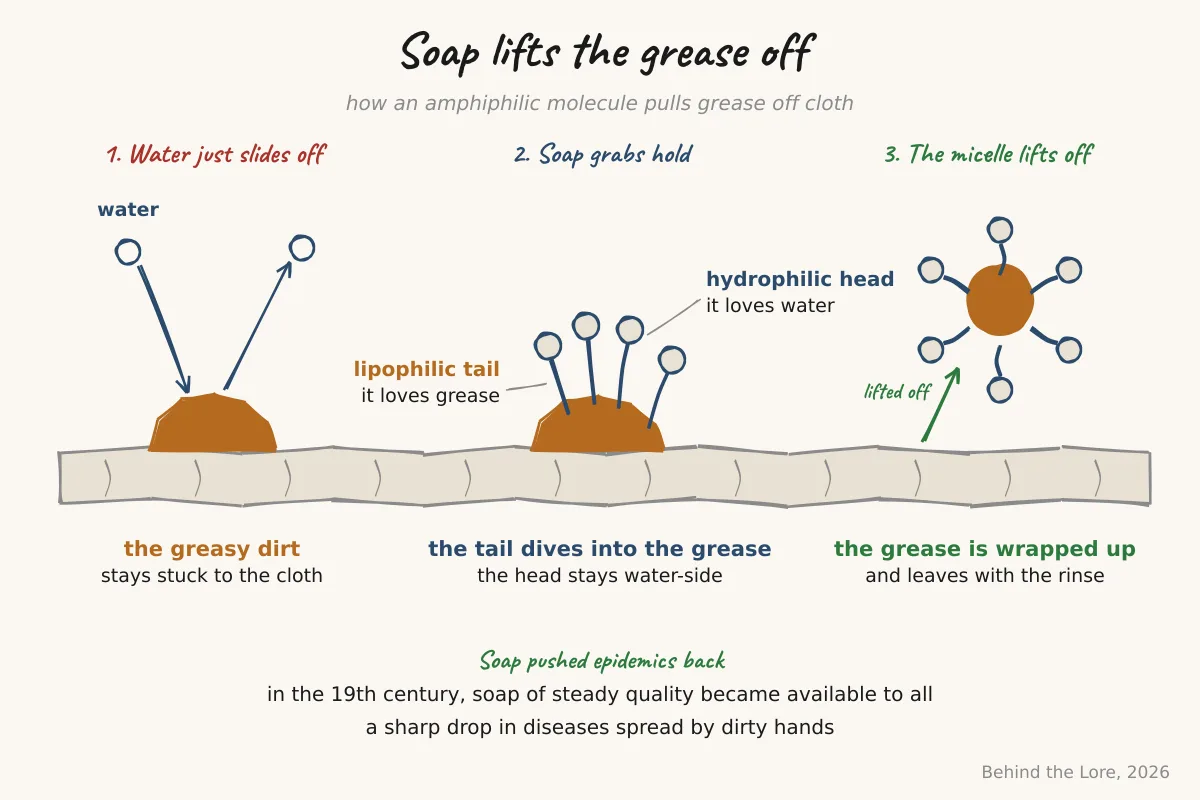
These fatty-acid salts have a distinctive architecture: a polar, ionic head compatible with water (hydrophilic), and a long, nonpolar carbon chain compatible with fats (lipophilic). It is this dual nature, called amphiphilic, that gives soap its effectiveness.
When soap is placed in the presence of water and greasy dirt, the molecules organize themselves spontaneously. The tail buries itself in the grease to avoid touching water, while the head stays on the water side. This forms spheres a few dozen nanometers across, called micelles, which trap the dirt at their center. These micelles are soluble in water and can be carried away when rinsed, whereas water alone would simply slide off a greasy surface without picking anything up.
The full saponification reaction produces an alkaline medium, and that is where the episode’s remark comes in. A dispensary soap, designed for active treatment, can have a higher pH than a soap made for general cosmetic use. The eye’s mucous membrane is highly sensitive to pH: it tolerates only a narrow range around 7.4 (the pH of tears) and reacts with a burning sensation as soon as that threshold is exceeded. An overly alkaline soap in contact with the eyes causes exactly this irritation, with no lasting toxicity as long as the contact is brief and followed by rinsing with water.
Going further
Sources
Published on
Keep investigating
Auto-suggested from shared concepts, disciplines, episodes, or characters.
Mercury
In The Apothecary Diaries, quicksilver goes into a court poison. We explain mercury, its toxicity, and the immortality elixirs that killed emperors.
Orpiment and Arsenic
In The Apothecary Diaries, a yellow pigment poisons slowly. We explain orpiment, arsenic, and the chronic poisoning of court painters.
Antiseptic Alcohol
In The Apothecary Diaries, a distilled alcohol is called a highly effective disinfectant. We explain why ethanol kills germs, and at what concentration.
Activated Charcoal
In The Apothecary Diaries, Maomao gives activated charcoal in an emergency. Why does it work? How does adsorption trap toxins? Its real limits.
Anthocyanins
In The Apothecary Diaries, Maomao reveals why blue roses are impossible. We explain anthocyanins, their response to pH, and their antioxidant property.