Hot Springs and Sulfur: Why the Smell?
Story context (click to hide this block) (click to show this block)
This paragraph may contain plot information.
During the siege of the Shi clan’s stronghold, a character points out that the proximity of hot springs makes it possible to extract sulfur on site. This detail isn’t decorative: it explains how an army on campaign can procure one of the three ingredients of gunpowder without a long supply chain. The episode’s military logistics rest on this local geography.
The subject in depth
The Earth constantly releases heat left over from its formation and from the radioactive decay of elements in the mantle. This flow, called the geothermal gradient, raises the temperature by roughly 25 to 30°C per kilometer of depth outside active zones [Wikipedia] . Where water seeps deep underground, it heats up and rises under pressure: that’s a hot spring
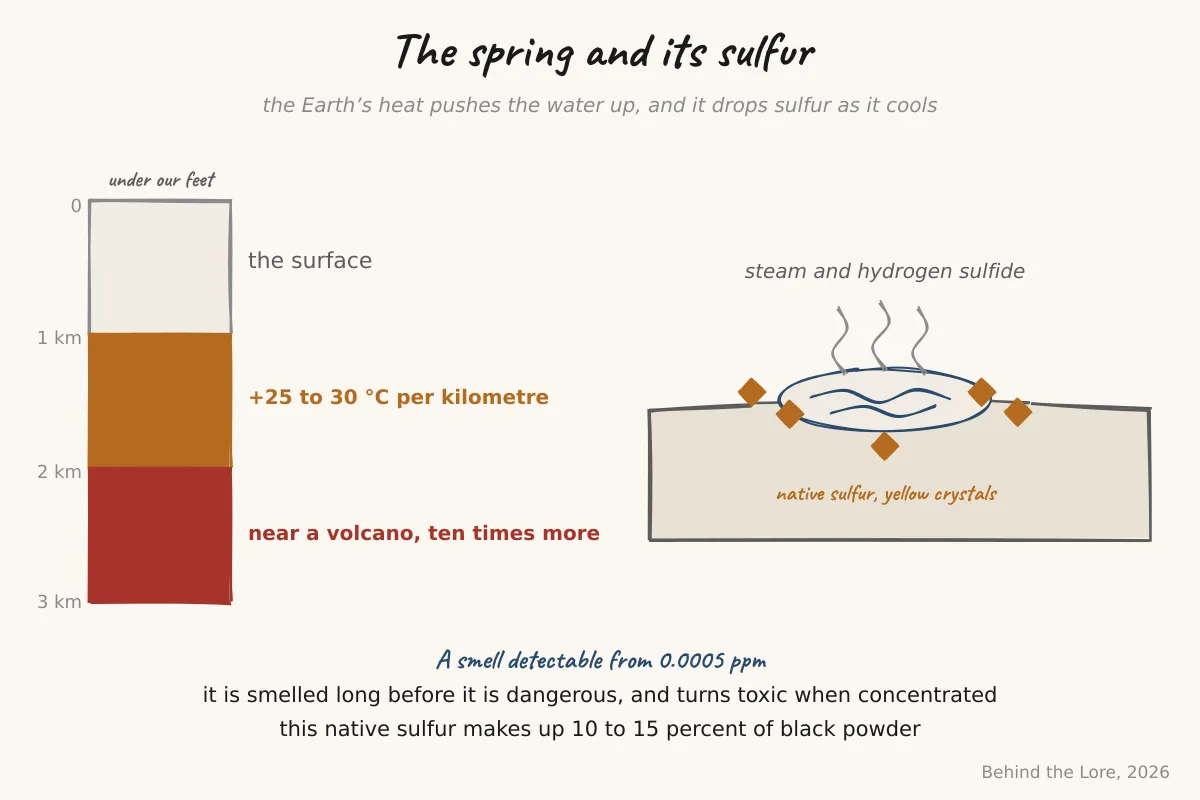
Near volcanoes or fault zones, this gradient is far stronger, sometimes ten times the normal rate. Water in contact with volcanic rock dissolves gases and minerals there: carbon dioxide, hydrogen sulfide (the famous “rotten egg” smell), and various sulfur compounds. When this water reaches the surface and cools, these compounds precipitate out: native sulfur forms characteristic yellow crystals around vents and pools.
The native sulfur deposited this way is chemically pure, easy to collect and grind
[Wikipedia] . That’s a considerable asset for any civilization wanting to make black powder, in which sulfur makes up roughly 10 to 15% of the composition (alongside saltpeter and charcoal). Sulfur lowers the ignition temperature of the mixture and contributes to the speed of the blast: without it, black powder doesn’t work properly.
The characteristic smell of volcanic hot springs comes mainly from hydrogen sulfide (H₂S), a gas dissolved in the water that escapes as it emerges. In low concentrations, this gas is harmless but perceptible at very low thresholds (as low as 0.0005 ppm). At high concentrations, it quickly becomes toxic, which explains why some hot springs in enclosed valleys can pose a real danger to people and animals.
Going further
Sources
Published on
Keep investigating
Auto-suggested from shared concepts, disciplines, episodes, or characters.
Carbon Monoxide
In The Apothecary Diaries, embers bring guests down at a party. We explain carbon monoxide, why it suffocates without warning, and the right thing to do.
Mercury
In The Apothecary Diaries, quicksilver goes into a court poison. We explain mercury, its toxicity, and the immortality elixirs that killed emperors.
Orpiment and Arsenic
In The Apothecary Diaries, a yellow pigment poisons slowly. We explain orpiment, arsenic, and the chronic poisoning of court painters.
Clay and Kaolin
In The Apothecary Diaries, clay is used as makeup. We explain kaolinite, its layered structure, its absorbent power, and its uses.
Calcium Carbonate
Senku presents calcium carbonate as civilization's cornerstone: we explain CaCO₃, the lime cycle, and its uses in agriculture and construction.